
IHORRORDB · HORROR FILM HISTORY
On October 31, familiar streets and homes become the setting for activities that would seem unusual on almost any other night. Costumes conceal identities in public, children approach strangers’ doors after dark, and deliberately frightening performances become part of communal entertainment. Horror filmmakers have repeatedly drawn on these temporary changes in everyday behaviour. They have also adapted beliefs and customs associated with the dead, sometimes preserving recognizable traditions and sometimes inventing new meanings for them. The cinematic history of Halloween is therefore a history of how a real celebration has been represented, reshaped and used to construct different forms of fear.
Halloween appeared in cinema and television before it became closely identified with the modern slasher. Early screen depictions established its customs as familiar popular entertainment; later horror productions gave the date a more decisive role in shaping characters’ movements, encounters and expectations. Supernatural stories, independent films and television experiments developed different uses for the holiday, while its commercial expansion supplied new settings and forms of spectacle. Those developments arose in distinct historical and production contexts.
Drawing on film archives, production documentation and filmmakers’ accounts, this study examines how Halloween has been represented and reinterpreted in horror cinema. iHorrorDB’s Halloween Horror Movies List brings together films connected to the holiday in different ways, from stories built around October 31 to works in which Halloween has a smaller role. This study traces the historical developments, production practices and cinematic conventions that shaped the holiday’s representation on screen.
Selected milestones

PART ONE · Origins–1978
Origins and the Halloween Setting
What Makes a Halloween Horror Movie?
The term “Halloween horror movie” describes two different relationships between a film and the holiday. Some productions are watched regularly in October because their monsters, atmosphere or imagery seem appropriate to the season, even though their stories are set at another time. Others actually take place on or around October 31, using its celebrations, public spaces and customary behaviour to organize the narrative. A history of Halloween-set horror must begin with that distinction. A film about witchcraft, a haunted building or an autumn landscape does not become a Halloween film merely because it is suitable seasonal entertainment.
A useful counterexample is The Blair Witch Project (1999). The recovered-footage narrative begins with a documentary expedition in October 1994, but its forest setting and witch legend do not depend on trick-or-treating, disguises or the observance of October 31. Describing it as an autumnal horror film is different from identifying a story whose actions are organized by Halloween. That distinction also separates the thematic purpose of this history from the broader practice of recommending horror films for seasonal viewing.
The holiday is most important when removing it would change the story. In John Carpenter’s Halloween (1978), trick-or-treating and evening babysitting establish the movement of children and adults through a suburban neighbourhood. In Night of the Demons (1988), a costume party accounts for the presence of teenagers at an abandoned funeral home. In Michael Dougherty’s Trick ’r Treat (2007), the observance and violation of Halloween customs provide the organizing principle for an entire set of stories. Each production uses the date differently, but none treats it as an interchangeable calendar detail.
Other films have a more limited relationship with October 31. A Halloween sequence can frame a childhood memory, establish a single incident or supply the occasion for a gathering while leaving the central threat independent of the holiday. Tom DeSimone’s Hell Night (1981), produced by Irwin Yablans and Bruce Cohn Curtis, offers a useful borderline case: its fraternity initiation follows a costume-party gathering, but the American Film Institute describes the overnight initiation without establishing that it takes place on October 31. Its association with Halloween imagery should not be mistaken for a verified Halloween-night setting. Television specials and short films also belong in the discussion when their form or circumstances of exhibition materially contribute to the development of Halloween horror.
This essay examines how October 31 became an identifiable setting for horror cinema and how filmmakers subsequently used the holiday in different narrative and industrial contexts. It is not a ranked collection of films, nor an attempt to place every seasonal horror production into one continuous lineage. The history is better understood through particular innovations, changing patterns of distribution and the repeated exploitation of familiar Halloween activities.
From Samhain to the Screen: How Horror Cinema Reinterpreted Halloween Traditions
The history of Halloween provides horror cinema with a recognizable body of customs, but those customs did not emerge at one moment or survive unchanged from antiquity. Folklorists describe a succession of practices associated with the Gaelic festival of Samhain, Christian commemorations of the dead and later forms of communal entertainment in Ireland, Scotland, Britain and North America. The Library of Congress records the historical interaction between the late-October and early-November observances while distinguishing Halloween from Mexico’s Día de Muertos. This history matters to filmmakers because the modern celebration contains elements developed in different centuries for different purposes. When a horror film treats them as a single ancient system, that coherence is usually part of its fiction.
Samhain marked an important seasonal transition in the traditional Irish calendar, at the beginning of winter. Later recorded beliefs associated the period with the presence of the dead, encounters with otherworldly beings and protective practices. The National Museum of Ireland’s Folklife Collection documents customs such as communal fires, household protections, games of divination and warnings about travelling alone. These records provide a firmer basis for discussing the holiday than a generic claim that every familiar Halloween monster originated in a single Celtic rite. They also document practices in comparatively recent communities; they do not establish every detail of how people behaved in the pre-Christian period.
Halloween III: Season of the Witch (1982) deliberately takes a different path. Its manufacturer of commercial Halloween masks invokes an ancient sacrificial logic, then attempts to carry out mass murder through industrial distribution and a synchronized television advertisement. The film’s use of Stonehenge imagery and a ritual plot should be read as an invented supernatural mythology, not as a depiction of a documented Samhain ceremony. Its historical importance lies in the way it combines modern retail systems with the popular idea of a threatening pre-Christian past. The apparent antiquity of the danger is placed at the service of a specifically late-twentieth-century story about manufactured products and mass communication.
Masks supply another bridge between folklore and film, although the bridge is not one of unchanged meaning. The National Museum of Ireland records guising—visiting households in disguise—as well as masks and mischief among the customs associated with Irish Halloween. Such practices had social and sometimes protective meanings long before the emergence of the twentieth-century slasher. In Carpenter’s Halloween (1978), however, Michael Myers’ featureless disguise functions through the ordinary acceptance of costume-wearing on October 31. The film does not claim that his mask descends from an ancient ritual. It uses the contemporary visibility of masks to alter how a suburban community perceives an individual threat. That distinction separates historical inspiration from practical narrative design.
The carved lantern underwent a comparable transformation. The National Museum of Ireland documents turnips hollowed into frightening lanterns, while pumpkins became the most recognizable North American alternative. Film posters, title sequences and seasonal interiors generally adopt the pumpkin because it is visually legible to audiences familiar with contemporary American Halloween. In Michael Dougherty’s Trick ’r Treat (2007), however, the lantern acquires a further fictional responsibility: respecting or disregarding a seasonal custom can have supernatural consequences. The film draws upon recognizable ritual behaviour but invents the authority enforcing it. Sam, its recurring figure, is an original creation for the film, without an established counterpart in traditional Samhain narratives.
Door-to-door visiting also developed through more than one historical practice. The Library of Congress discusses different proposed relationships between souling, Scottish guising and modern trick-or-treating; the National Museum of Ireland records visitors performing for food and other rewards. North American suburban celebrations made children’s visits and the exchange of packaged sweets especially familiar to later cinema. This setting underlies the tension in Satan’s Little Helper (2004), where a child interprets a dangerous adult through the assumptions of Halloween play, and in All Hallows’ Eve (2013), where an object recovered among trick-or-treating gifts initiates the horror. Neither film needs to reproduce the historical origins of the custom. Both use what contemporary characters expect that custom to mean.
Some filmmakers have approached the relationship between folklore and contemporary Halloween more directly. Kate Dolan’s Irish feature You Are Not My Mother (2021) draws on changeling belief and situates its events around Halloween in Dublin. In a March 2022 interview with /Film, Dolan explained that the earliest draft had not been set during Halloween. The setting emerged as she researched Irish pagan practices and the place of bonfires in local celebrations; the changeling folklore and the story’s climactic fire became connected to the holiday during writing. This is a documented statement of creative intention, not an ancestral meaning imposed on the work by later commentators. Her film can be studied alongside Halloween III as an example of filmmakers borrowing from folklore, while keeping their sources and purposes distinct.
Ray Bradbury’s animated television film The Halloween Tree (1993), adapted from his novel, offers another perspective, although it belongs to dark fantasy, with a different audience and tone from adult horror. Its children travel through imagined historical encounters with traditions of death and remembrance. Contemporary reporting recorded Bradbury’s interest in making a story that would explain the holiday to children. The film is therefore useful as evidence of the popular desire to arrange diverse customs into a single narrative journey. Its historical associations should nevertheless be distinguished from the separate development of holidays such as Día de Muertos, whose traditions cannot be reduced to an earlier version of modern American Halloween.
These cases reveal the difference between a film borrowing a traditional image, a filmmaker explicitly adapting recorded folklore and a screenplay inventing a new ritual around familiar symbols. For a historical study of Halloween cinema, that difference is essential. It allows the ancient and modern components of the festival to be discussed without converting artistic invention into evidence about the past. It also explains the holiday’s adaptability: cinema inherits customs already altered by migration, religion and commercialization, then reorganizes them according to its own demands for suspense, narrative clarity and memorable imagery.
Before Michael Myers: Halloween on Screen Before 1978
Before John Carpenter, Halloween appeared on screen within a wider tradition of seasonal entertainment. The early examples are diverse in form and intended audience: black comedy, animation, television specials and independent short horror films. They establish that October 31 had a recognizable cinematic identity before 1978, while showing why the appearance of the holiday in one production does not by itself demonstrate a direct line of influence upon another.
Early screen representations did not necessarily belong to horror. Frank Capra’s Arsenic and Old Lace (1944), adapted from Joseph Kesselring’s play, takes place at Halloween, but it is fundamentally a black comedy about murder within a seemingly respectable family. Disney’s animated Trick or Treat (1952) uses costumes, door-to-door visiting and a witch for comic purposes. It’s the Great Pumpkin, Charlie Brown (1966) offers a further indication that the rituals of childhood Halloween were recognizable to American television audiences long before an independent slasher made the date a commercial horror identity. These works belong to the screen history of Halloween, not to an uninterrupted cycle of Halloween horror films.
A more direct horror precedent survives in the British short Mirror Mirror (1969), made by the Eastbourne Cine Group. The British Film Institute’s archival record describes a seven-minute production in which an antique mirror becomes the means of an uncanny encounter involving a Halloween costume and an act of violence. The film is significant because it provides documented evidence of filmmakers organizing a frightening story around the date before Carpenter’s feature. Its existence does not demonstrate an influence on Halloween, and the film’s amateur origins should not be inflated into a claim that it established a commercial genre.
Robert Voskanian’s American feature The Child (1977) is another genuine precursor. The film centres on a young girl with supernatural abilities, and the surviving distributor’s description confirms that Halloween forms part of the escalation of her frightening activities. Its regional exploitation context differs from the production of Halloween, as does its mixture of telekinesis and the returning dead. Taken together, such examples establish that the date was available to horror filmmakers before 1978, though no comparable, enduring commercial formula had yet formed around it.
The broader development of suspense cinema also matters. Psycho (1960) and Black Christmas (1974) contributed important techniques and situations to later stalker narratives without taking place at Halloween. The second film in particular demonstrated the dramatic potential of locating domestic violence within a recognizable holiday environment. Recognizing this wider context avoids treating Carpenter’s achievement either as the invention of all Halloween horror or as the simple repetition of one obscure earlier production.
Halloween (1978): The Transformation of a Holiday into a Horror Setting
John Carpenter’s Halloween emerged from a low-budget independent production whose commercial and creative history is unusually well documented. According to the American Film Institute, executive producer Irwin Yablans conceived a project initially called The Babysitter Murders and subsequently proposed setting it on Halloween night. Carpenter and Debra Hill wrote the screenplay in 1977; Hill also produced the film, and financier Moustapha Akkad advanced $300,000 for production. The AFI describes a very limited initial release in four Kansas City theatres and separately records a Los Angeles opening on October 25, 1978. Those details refer to different stages of the film’s early exhibition and are consistent with one another. The change of title and setting gave the story a date with established associations and provided practical explanations for much of the action.
The narrative links the murder committed by the child Michael Myers on Halloween in 1963 to his return to Haddonfield fifteen years later. Carpenter and Hill organize the suspense through the ordinary geography of a residential neighbourhood, keeping the holiday’s mythology largely in the background. Streets, school corridors, bedrooms and front doors become places in which the presence of a killer is possible but not immediately recognized. Laurie Strode’s evening is structured by babysitting, while the surrounding community accepts the movement of costumed children as part of the celebration.
Dean Cundey’s widescreen cinematography plays a central role in this construction. The arrangement of people within the frame, the use of deep space and the duration of certain shots encourage audiences to examine ordinary backgrounds for a threatening figure. Michael is sometimes visible before the characters become aware of him. Elsewhere, camera movement changes the audience’s knowledge by disclosing a previously unseen part of a room or street. These formal decisions make an otherwise familiar suburb seem difficult to read without turning it into an obviously fantastic environment.
The opening sequence introduces a related use of restricted visual knowledge. The audience initially sees a murder from the assailant’s viewpoint before learning that the killer is a child. Later appearances of Michael depend less on such strict subjective photography than on the tension between what the audience can observe and what the characters believe to be present. The central mask contributes to this uncertainty. Production designer and editor Tommy Lee Wallace modified a commercial Captain Kirk mask to create Michael’s pale, apparently expressionless face, reducing the personal information ordinarily conveyed by appearance.
The fact that masks are normal on October 31 adds a social dimension to the design. A disguised stranger may be interpreted as another participant in the celebration, particularly by a community already occupied with seasonal activities. The holiday permits the killer to circulate in the open while the film develops a pattern of delayed recognition. Carpenter’s largely electronic score, with its recurring piano theme, reinforces these shifts between ordinary activity and anticipated violence. The film’s influence on later slasher films was extensive, but its distinctive historical achievement within Halloween cinema was to make the date itself part of the narrative machinery.
The degree to which Halloween itself accounts for the film’s effectiveness remains open to interpretation. Moria’s published review concentrates on Carpenter’s peripheral compositions, misdirection and control of anticipation, devoting relatively little attention to the holiday’s folklore. This critical emphasis identifies techniques that can be appreciated independently of the calendar setting. The stronger argument for October 31 is therefore more specific: the date does not create the suspense by itself, but it provides the social circumstances in which the suspense works. Costumes normalize concealment; babysitting accounts for isolated young people supervising children; neighborhood activity makes an unfamiliar presence harder to distinguish from ordinary celebration. Cinematography and sound organize the audience’s fear within that environment. Recognizing both levels avoids confusing a useful setting with a complete explanation of the film’s artistry.
Halloween also became an October event in the business of film exhibition. The AFI records a screening at the San Diego Film Festival on October 31, 1978, attended by Debra Hill and Jamie Lee Curtis at the La Jolla Museum of Contemporary Arts. The same catalogue documents the film’s limited early theatrical circulation and its subsequent suitability for annual Halloween reissues. A particularly revealing example occurred in New York in 1980, when the distributor Aquarius Releasing coordinated an October rerelease in 83 theatres with simultaneous pay-cable availability and exclusive videocassette sales through Video Shack stores. Contemporary trade reporting, preserved by the AFI, identified this multi-format release as an unusual marketing arrangement. The film’s setting thus affected not only its story but also how it could be repeatedly promoted and consumed on the annual date. This pattern also distinguishes a film set at Halloween from a film merely released during the Halloween season. In Carpenter’s case the story, title and annual exhibition opportunities reinforced one another, allowing distributors to renew interest in an existing feature at a predictable point on the calendar. The AFI’s record of later seasonal reissues supports that industrial argument without establishing that every horror opening in October belongs to the same narrative tradition.
PART TWO · 1981–1988
The Eighties and the Holiday as Genre
Halloween II and Halloween III: Two Futures for the Holiday
The first sequels to Halloween exposed a division between the fictional identity of Michael Myers and the wider possibilities of the holiday. Directed by Rick Rosenthal and written by Carpenter and Hill, Halloween II (1981) continues the events of the original film on the same night. Laurie Strode is taken to Haddonfield Memorial Hospital, and Michael’s pursuit moves from suburban houses into institutional corridors and treatment rooms. October 31 remains the chronological framework, but the sequel depends increasingly on the established relationship between the returning murderer and the survivor of the first film.
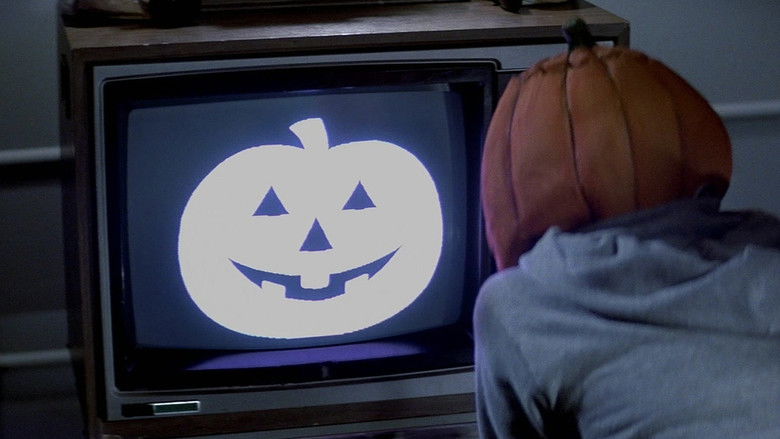
Halloween III: Season of the Witch (1982), written and directed by Tommy Lee Wallace, adopted a radically different premise. Carpenter and Hill remained producers, while the new film abandoned Michael Myers as its antagonist. The AFI’s production documentation establishes that the filmmakers intended an original story independent of Michael Myers’ continuing narrative. In place of the stalker narrative, the film introduced the Silver Shamrock novelty company, whose commercially distributed Halloween masks are central to a scheme involving ritual sacrifice and a television commercial.
The mechanism of danger in Season of the Witch is dependent on the modern organization of the holiday. Children purchase costumes and masks; shops distribute identical products; advertising creates demand; and scheduled broadcasting allows the fictional threat to reach households simultaneously. The narrative joins ideas of ancient ritual to electronic technology and consumer commerce. Its treatment of television and mass-produced seasonal goods connects the horror directly to consumer culture and the customs surrounding Halloween.
The contrasting directions of the two films are essential to the history of Halloween horror. One develops continuity around an identifiable villain and his victims. The other suggests that the annual celebration could support unrelated stories with different monsters, settings and formal strategies. The intended anthology direction did not become the permanent organizing structure of the Halloween franchise, but Halloween III remains a clearly documented attempt to make the holiday itself the connecting principle. Its significance does not require claiming that every later anthology or occult Halloween film was directly influenced by it.
Beyond Haddonfield: The Other Halloween Horrors of the 1980s
The 1980s produced a considerable range of Halloween-set horror that cannot be reduced to the adventures of Michael Myers. Gary Graver’s Trick or Treats (1982) uses the circumstances of babysitting, prank-playing and a dangerous visitor. Its proximity to the domestic-threat model makes comparison with Carpenter unavoidable, but its mixture of black comedy and exploitation conventions differs in tone. The holiday supplies the setting in which misleading behaviour and unexpected visitors can appear relatively ordinary.
Television and international genre production offered alternatives to the suburban slasher. Jack Bender’s television film The Midnight Hour (1985) combines a Halloween gathering with supernatural consequences and youth-oriented entertainment. In Mexico, Rubén Galindo Jr.’s Cemetery of Terror (1985) presents Halloween festivities alongside an occult ceremony and the return of the dead. Both demonstrate how the same date could support narratives organized around a disruption of the boundary between living people and supernatural forces, with no single human attacker at their center.
Charles Martin Smith’s Trick or Treat (1986) brings heavy-metal music and teenage identity into a Halloween horror framework. Its commercial development is unusually well recorded in the AFI Catalog: producer Dino De Laurentiis sought a film capable of entering the market for seasonal horror, while the writers developed a story involving a deceased rock musician and a young fan. The film combines the social world of music with supernatural revenge, distinguishing itself from the masked-killer formula even while responding to the same seasonal audience.
Kevin S. Tenney’s Night of the Demons (1988) offers an especially direct instance of Halloween shaping a film’s structure. The action begins with a party held by teenagers at an abandoned funeral home, where supernatural events transform the gathering into a deadly situation. The AFI documents the production’s working title as Halloween Party. The location matters because the gathering already invites costumes, scary decorations and deliberate encounters with frightening objects. It supplies a credible route from social entertainment into occult horror.
The setting remained productive beyond the first film. Brian Trenchard-Smith’s Night of the Demons 2 (1994) returns to Hull House, but shifts the social setting toward students from a Catholic boarding school. Paramount’s synopsis identifies both an official Halloween dance and the unauthorized gathering at the abandoned mansion. The sequel uses the choice between a supervised school event and a forbidden alternative to bring its characters back to the site of danger. Halloween remains structurally necessary, even though the institution, group dynamics and religious conflict differ from the original film.
Frank LaLoggia’s Lady in White (1988) uses Halloween differently, making a childhood encounter with a ghost and a murderer part of an investigation into a community’s concealed crimes. The film’s period setting places the holiday within a child’s experience of school, pranks and family life. Its concerns are closer to ghostly memory and murder mystery than to a party-based exploitation picture. This variety illustrates why Halloween should be treated as a narrative setting shared by several subgenres, not as the name of one uniform cinematic formula.
PART THREE · 1992–2016
Television, Independence and Anthologies
Halloween on Television: Horror as a Broadcast Event
Television introduced a dimension that theatrical Halloween horror could not automatically reproduce: a programme could be watched on October 31 while presenting its story as though it were occurring at the same moment. The broadcast date could therefore reinforce the fictional circumstances. This was particularly significant for productions that borrowed the language of factual reporting or live entertainment, because their form made the difference between a fictional event and a genuine programme less immediately visible.
The television circulation of Carpenter’s Halloween (1978) offers an unusually concrete example of seasonal horror being altered for another medium. The American Film Institute records that NBC acquired broadcast rights and that Carpenter filmed additional scenes with Donald Pleasence during the production period of Halloween II in order to lengthen the original film for television. One new scene showed Dr. Loomis discovering the word “sister” in Michael’s room, retrospectively incorporating a family relationship that had not been established by the 1978 theatrical version. Television exhibition was therefore not only another outlet for the same text: its practical requirements produced a materially different cut.
Recurring television specials used Halloween differently. The Simpsons introduced its Treehouse of Horror format on October 25, 1990, developing an annual sequence of short horror, fantasy and science-fiction stories. As Disney’s programme guide explains, the segments form a distinct seasonal anthology, separating the special from the series’ continuous family narrative. Their stories do not all take place on October 31; instead, Halloween supplies the broadcast identity and permission to depart from the series’ usual conventions. This is another reason to distinguish Halloween programming from fiction actually set during the holiday.
The clearest example is the BBC drama Ghostwatch (1992), written by Stephen Volk and directed by Lesley Manning. Broadcast on Halloween, it staged an apparent live investigation of disturbing activity in a suburban home. Michael Parkinson, Sarah Greene, Mike Smith and Craig Charles appeared as recognizable television personalities playing fictionalized versions of themselves. The programme had been scripted and recorded in advance, but its use of studio discussion, reports from the house and familiar broadcasting conventions created the impression of an unfolding event.
The British Film Institute has documented both the programme’s design and its controversial original reception. The production was made for the BBC’s Screen One drama strand, a context that was not equally obvious to every viewer. Its unusual impact depended partly on the authority audiences associated with presenters normally encountered in other programmes. The frightening story unfolded within the familiar visual and institutional vocabulary of television.
The Halloween broadcast date strengthened this arrangement. The fictional investigation was associated with the holiday, and viewers encountered the transmission during the same celebration. Ghostwatch consequently belongs not only to the history of haunted-house drama but also to the history of how distribution and exhibition shape a horror text. Later productions imitating local television, recovered videotapes and supposedly authentic broadcasts would make similar use of the reliability viewers attach to recorded media, although the existence of formal similarities is not itself evidence of direct influence.
The Independent Halloween Film: Communities, Childhood and Parties
The independent Halloween films of the 2000s used the holiday to explore spaces and groups that major slasher franchises had often treated only marginally. The date provides a recognizable occasion, but the interest of individual films depends on the specific social environment created around it. Sometimes the opportunity is simple: a costume party can bring unrelated characters together in an unusual location. Elsewhere, it is the presence of a large public celebration, the vulnerability of a child or a failure to recognize danger beneath a costume.
Paul Etheredge’s Hellbent (2004) takes place during the Halloween celebration in West Hollywood and follows gay male characters pursued by a masked murderer. Its importance derives from the combination of a familiar slasher framework with an openly queer principal ensemble and a recognizable urban celebration. The date explains the crowded streets and disguises that facilitate the killer’s movement. Claims that it was indisputably the first queer slasher are less useful than the demonstrable fact that it placed characters and settings rarely foregrounded in earlier mainstream examples at the centre of its narrative.

Jeff Lieberman’s Satan’s Little Helper (2004) investigates the consequences of childhood belief and misrecognition. A child interprets a violent stranger through the logic of Halloween play, so the conventions of costumes and pretend horror contribute directly to the danger. The film’s premise is more particular than the general observation that a masked person is frightening. Its central problem is that a person behaving dangerously can temporarily be treated as part of a game, delaying intervention by those around him.
Jeremy Saulnier’s Murder Party (2007) begins with an invitation to a Halloween gathering and develops into an aggressively comic story of violence within an art-world milieu. The costume party operates as an encounter between characters whose intentions are incompatible. The production uses the holiday to create an apparently harmless social invitation without needing a supernatural explanation or an established slasher mythology. Its scale and tone demonstrate how useful Halloween can be to filmmakers working outside large commercial series.
These productions show the value of studying Halloween horror at the level of setting and social behaviour. A film made with modest resources can exploit conventions already understood by the audience, while using an unfamiliar group of characters or a specific urban environment to produce new situations. The result is not a separate evolutionary stage in which independent cinema replaces studio horror, but an overlapping field of productions approaching the same date from different directions.
Trick ’r Treat: Halloween Customs as a Narrative System

Michael Dougherty’s Trick ’r Treat (2007) provides a particularly clear example of Halloween functioning as the organizing idea of an entire feature. Its interwoven stories take place within a shared community and repeatedly return to the customs of the holiday. Unlike a conventional anthology in which unrelated episodes have only a framing device in common, the film connects events, characters and locations across its separate narratives. The viewer gradually learns how these incidents form part of one Halloween night.
The film treats practices such as carving and lighting jack-o’-lanterns, wearing costumes and respecting trick-or-treating traditions as obligations that possess significance within the fictional world. The threat does not come solely from one killer pursuing victims through a suburb. It also emerges when characters disregard a system of customs whose supernatural authority becomes increasingly apparent. This gives ordinary seasonal behaviour a specific narrative function: a familiar tradition is transformed into a rule whose violation may carry consequences.
The recurring character Sam embodies that principle. His appearance recalls a costumed child, but his role is more closely connected to the continued observance of Halloween than to an ordinary human murderer. His presence links stories that otherwise feature very different kinds of danger. Dougherty can therefore include tales involving human violence and supernatural events without presenting them as episodes from one continuous killer biography.
The film’s distribution history is part of its later reputation. Although associated with 2007, it did not reach a broad American theatrical audience through a conventional wide release at that time; its 2009 home-video distribution became particularly important to its circulation. Legendary subsequently promoted anniversary screenings and related publishing projects, while the film acquired an audience that regularly returned to it during Halloween. Its eventual cult status should not obscure the distinction between when the film was produced, when it first screened and when it found its wider seasonal audience.
Compared with Halloween (1978), Dougherty’s film makes a different proposition about October 31. Carpenter uses the date to shape the movement and perceptions of a suburban community confronting a concealed murderer. Trick ’r Treat imagines a community in which the celebration itself has binding supernatural customs. The contrast demonstrates the range available to Halloween horror once the holiday is treated as more than an atmospheric background.
Anthologies, Found Footage and Reconstructed Television
The horror anthology has remained useful to Halloween horror because one annual celebration can plausibly contain many independent incidents. Different stories need not share a monster or causal explanation if they take place under the same widely understood seasonal conditions. This flexibility has encouraged filmmakers to assemble short pieces within a framing narrative, while others have used recordings, tapes and fictional broadcasts to make the stories appear to enter the viewer’s world through media objects.
Damien Leone’s All Hallows’ Eve (2013) presents a babysitter discovering a videotape among children’s trick-or-treating materials. The film uses the recording to introduce a series of frightening segments, including appearances by Art the Clown, who later became prominent through the Terrifier films. The importance of the tape is structural: characters watch material that at first appears separate from their situation before the distinction between recording and immediate threat is disturbed. Halloween provides a credible reason for the tape to be discovered and for its contents to be mistaken initially for entertainment.
Chris LaMartina’s WNUF Halloween Special (2013) explores a different relation between horror and recorded media. It reproduces the appearance of an old local television broadcast, including commercial breaks and the conventions of regional programming. In an interview published by the Horror Writers Association, LaMartina discussed both the influence of VHS collecting on the project and his unconventional distribution of physical tapes. The film’s apparent age is thus an intentional formal device, while the circulation of the recordings contributed to the impression that viewers had discovered an obscure broadcast.
The multi-director anthology Tales of Halloween (2015) returns to a more direct division into separate stories, united by the date and its familiar imagery. A later variation appeared in V/H/S/HALLOWEEN (2025), which applied the holiday to the found-footage anthology franchise. In such films, Halloween performs two functions. It brings together incidents that would otherwise have no reason to share one feature, and it gives recordings, costumes and broadcast events an immediately intelligible cultural setting. Claims of direct descent between individual films require testimony or production evidence; the shared conventions alone establish a recurring approach, not a proven chain of influence.
PART FOUR · 1998–2025
Contemporary Attractions and Global Cinema
Haunted Attractions: When Manufactured Fear Hides Real Danger
Commercial haunted attractions created a specific narrative environment for twenty-first-century Halloween horror. Visitors enter such spaces expecting costumed performers, sudden confrontations and threatening scenery. Unlike ordinary houses or streets, these venues are intentionally designed to make alarming behaviour seem normal. A filmmaker can exploit the uncertainty between what is part of an agreed performance and what constitutes actual danger. This premise draws on the established business of seasonal entertainment, giving the Gothic building and frightening mask a specific commercial context.
Bobby Roe’s The Houses October Built (2014) follows a group of friends exploring increasingly extreme haunted attractions. The project was developed through a relationship between documentary observation and fictional narrative. Roe and collaborator Zack Andrews described to Dread Central how they worked with actual attractions, performers and operators, incorporating some footage and experience from an earlier version of the project. Their testimony establishes that the real industry was more than a decorative influence: practical access to functioning attractions directly shaped the production.
Stephen Cognetti’s Hell House LLC (2015) moves into a fictional attraction whose disastrous opening becomes the subject of later investigation. Its found-footage structure places images of threatening figures, abandoned interiors and seemingly unexplained incidents inside recordings assembled after the fact. What would be a routine frightening decoration in one context can become possible evidence of danger in another. The attraction is therefore both the scene of the events and the mechanism that makes those events difficult to interpret.
Gregory Plotkin’s Hell Fest (2018) applies the premise to a larger entertainment complex in which a murderer operates among performers and customers. Scott Beck and Bryan Woods’s Haunt (2019) focuses on visitors who agree to participate in an extreme Halloween experience and discover that its apparently theatrical rules conceal actual violence. These films differ in budget and supernatural content, but they exploit the same temporary change in acceptable behaviour: within a haunt, an aggressive stranger is initially expected to be part of the show.

The haunted-attraction film consequently marks a change in the relationship between Halloween and the built environment of horror. A film no longer needs to establish that an ordinary place is secretly dangerous. The public has already chosen to enter a space designed to appear dangerous; the fictional crisis begins when that appearance ceases to be safely controlled.
Franchises, Nostalgia and New Halloween Killers
The history of Halloween horror also includes repeated efforts to revisit established slasher identities. Halloween H20: 20 Years Later (1998) returned Jamie Lee Curtis to the role of Laurie Strode during a period when American slasher cinema was enjoying renewed commercial attention. Rob Zombie’s Halloween (2007) reconstructed Michael Myers’ origins and placed greater emphasis on the character’s childhood and social environment. These films should not be treated as one continuous historical interpretation of the original: they are distinct creative projects made within changing franchise arrangements.
David Gordon Green’s Halloween (2018) again revised the continuity, establishing a direct sequel to the 1978 film and returning to Laurie’s experience of violence and its long consequences. Halloween Kills (2021) extended the action of the same October night, while Halloween Ends (2022) approached the franchise’s later fictional period differently. Across these iterations, Michael Myers becomes an icon whose history can be reconstructed for new audiences even as the holiday continues to supply the setting and recurring imagery.
Period reconstruction also provides a distinct way of using Halloween as a setting. André Øvredal’s Scary Stories to Tell in the Dark (2019) begins on Halloween night in 1968, when a group of teenagers enters a house associated with local stories. Based on Alvin Schwartz’s books and produced with Guillermo del Toro, the film places the act of discovering and telling frightening stories inside a recognizable period setting. The date organizes the teenagers’ encounter with the house. In a 2019 interview, Øvredal explained that the choice of 1968 also brought the Vietnam War, political conflict and the effects of circulating false stories into the characters’ lives. The period supplies historical and thematic context for the horror while informing the production design. Its United States theatrical opening was in August 2019, a reminder that fictional Halloween settings and actual release seasons are separate historical facts.
Damien Leone’s Terrifier (premiered in 2016; released theatrically in 2018) places Art the Clown in a Halloween setting, combining clown horror with practical makeup effects and the graphic violence characteristic of independent extreme horror. Terrifier 2 (2022) again places its principal events around Halloween and enlarges the narrative surrounding Art. The subsequent Terrifier 3 (2024), however, uses a Christmas setting. This change is a useful reminder that a character associated with Halloween does not automatically make every subsequent film part of the Halloween-set tradition.
The distinction between a holiday-based film and a franchise identity becomes increasingly important as series continue. A recognizable mask, performer or killer may carry commercial value independent of October 31. The historical study of Halloween horror therefore requires attention to each film’s actual setting alongside its branding, release season and the audience’s established association between a villain and the holiday.
Halloween Beyond the United States: Adaptation and Cultural Context
Halloween’s prominence in horror film is strongly associated with American popular culture, but its cinematic use has never been restricted to the United States. Documented productions reveal how individual national cinemas adapt Halloween imagery within their own cultural contexts. An individual film may use Halloween as a commercial reference point, a local celebration, a supernatural date or an occasion for characters to gather. These functions should not be assumed to carry the same meaning in every national context.
Rubén Galindo Jr.’s Cemetery of Terror (1985) is a clear Mexican example in which Halloween celebrations become connected with occult activity and the resurrection of the dead. Its premise draws on supernatural and exploitation conventions available within Mexican genre filmmaking, while the holiday provides a readily identifiable occasion for young characters to engage in dangerous experimentation. The film demonstrates the cross-border circulation of Halloween horror settings without requiring an unsupported claim that its makers were specifically imitating a particular American production.
The French feature Livid (2011), directed by Alexandre Bustillo and Julien Maury, places a disturbing tale in Brittany during Halloween. Its imagery of an isolated house, a vulnerable elderly resident and occult secrets makes it notably different from the American suburban slasher. The date is present in the story, but the film’s principal formal interests lie in its Gothic spaces and fantastic violence. This distinction is important when evaluating the extent to which Halloween shapes a film’s narrative beyond establishing its date.
These films show that Halloween on screen is neither a purely American phenomenon nor a self-contained international genre. The local context changes the character of the setting, and the same date can support distinct forms of occult horror and Gothic fantasy. Treating each production on its own terms is more useful than assembling every foreign title into a supposed movement for which there is no documentary evidence.
PART FIVE · A thematic analysis
How Halloween Changes Horror
Masks, Trick-or-Treating and the Narrative Mechanics of October 31
The repeated return to Halloween settings is partly explained by the holiday’s ability to change ordinary expectations about appearance and behaviour. Costumes allow people to move through public spaces without revealing their identity. Visitors are invited to approach houses, and celebrations place strangers together in crowded rooms or streets. These circumstances are recognizable before the film introduces any particular monster or murderer. They provide horror filmmakers with practical ways to explain why an intruder is not recognized, why an unusual gathering takes place or why frightening conduct is interpreted as performance.
Masks are central to the first mechanism. A threatening disguise encountered on an ordinary evening may attract immediate attention; the same disguise during Halloween can appear routine. Halloween, Hellbent and Terrifier exploit this ambiguity in different social settings. Haunted-attraction films intensify it by surrounding the characters with many people whose professional task is to behave menacingly. The mask is consequently more than an image associated with a particular franchise: it changes how a character can be perceived by witnesses.
Trick-or-treating reorganizes the domestic threshold. The holiday temporarily makes it customary for costumed visitors to approach unfamiliar houses and for residents to open their doors. Stories involving babysitters and children can use this pattern to create interruptions without elaborate exposition. Satan’s Little Helper demonstrates how seasonal play can also interfere with the interpretation of actual violence. The tension does not arise merely because a stranger arrives, but because circumstances provide a socially acceptable explanation for the stranger’s appearance and actions.
Halloween parties create another recognizable structure. A house, funeral home, school or entertainment venue can contain a group that would otherwise have little reason to remain together. The occasion accounts for costumes, loud music, practical jokes and unfamiliar decorations. In Night of the Demons, the party assembles the characters in a dangerous location; in Murder Party, it attracts someone into the orbit of people with murderous plans. Such films differ in narrative form, but their initiating situations depend on common assumptions about what a seasonal party entails.
Some filmmakers attach supernatural authority to the customs themselves. Halloween III: Season of the Witch imagines commercially distributed masks and a television promotion as instruments of ritual violence. Trick ’r Treat treats the holiday’s practices as rules with consequences. Ghostwatch links a fictional investigation to the actual timing of a television transmission, while WNUF Halloween Special recreates the language of seasonal broadcasting. These examples show that the holiday can govern not only the action inside a story but also the framing and circulation of the film.
The history of Halloween horror is therefore a history of multiple filmmaking traditions meeting in one annual celebration. These developments encompass different production histories and cannot be reduced to a single slasher formula. What connects the strongest examples is the precise use of established customs to alter what characters know, what they expect and when they recognize a threat. That narrative usefulness helps explain the holiday’s continuing presence across horror cinema, television and independent production.
RESEARCH & DOCUMENTATION
Selected References
View the 12 research sources
- National Museum of Ireland – Ghost Turnips, the Púca, Fortune-Telling and Evil Abductions – Folklife collection documenting Irish Halloween lanterns, guising, communal fires and other customs.
- Library of Congress – The Origins of Halloween Traditions – Historical context for guising, souling, trick-or-treating and lanterns.
- BFI – Halloweens Gone By: British Rituals and Traditions Captured on Film – Archival examination of Halloween customs and the 1969 amateur short Mirror Mirror.
- American Film Institute – Halloween (1978) – AFI Catalog production history documenting The Babysitter Murders, the screenwriters, financing and original release.
- American Film Institute – Halloween III: Season of the Witch (1982) – Contemporary production records documenting the decision to develop a stand-alone story.
- American Film Institute – Night of the Demons (1988) – Production record identifying the working title Halloween Party and original release information.
- American Film Institute – Trick or Treat (1986) – Production notes detailing the commercial conception of the heavy-metal horror film.
- British Film Institute – Why I Love Ghostwatch – A dedicated historical analysis of the 1992 BBC Halloween broadcast, its television techniques, influences and reception.
- Horror Writers Association – Interview with Chris LaMartina – Firsthand discussion of WNUF Halloween Special, VHS aesthetics and distribution methods.
- HorrorNews.net – Interview with Bobby Roe and Zack Andrews on The Houses October Built – Extended first-hand discussion of location research, filming within operating haunted attractions, available resources and production decisions.
- /Film – You Are Not My Mother Director Kate Dolan on Halloween and Irish Folk Tales – March 2022 interview discussing changelings, the original screenplay and the decision to use Halloween and bonfires.
- The Beat – Interview with André Øvredal on Scary Stories to Tell in the Dark – Firsthand explanation of the Halloween 1968 setting, the production’s period context and the adaptation of Alvin Schwartz’s stories.
Leave a Reply