
The history of practical effects in horror cinema is therefore larger than the biographies of its most famous artists or the familiar debate about whether computer imagery looks better than rubber monsters. It concerns the materials that can imitate living tissue; the engineering that allows a constructed creature to breathe, blink or collapse; the staging that makes an illusion convincing; and the industrial conditions that determine what can be built at all. The craft has traveled between theatre, magic, medical simulation, industrial manufacturing, stop-motion animation and increasingly sophisticated visual-effects pipelines. It has developed differently in Hollywood, British studios, Japanese tokusatsu workshops, Italian exploitation productions and independent cinema.
This history follows the effects themselves: what they are, how they work, why a production chooses one solution over another, and how successive generations have changed the appearance of horror. Individual films and practitioners supply documented examples grounded in production history. Digital effects and artificial intelligence enter the story where they genuinely change methods of design, fabrication, photography or post-production; they do not erase the longer, physical history that makes contemporary images possible.
I. From Stage Illusion to the Modern Horror Effect
Trick photography, stagecraft and the first impossible bodies
Practical horror effects emerged from traditions that predate cinema: theatre machinery, stage makeup, automata, conjuring performances, waxwork exhibitions and the construction of artificial bodies for display. Early filmmakers combined those techniques with a new power, the ability to interrupt and manipulate photographic time. Georges Méliès, himself a stage illusionist and experienced builder of theatrical devices, explored substitution splices, double exposure, painted scenery, mechanical props and other methods that permitted characters to vanish, change shape or appear without a plausible physical cause. The disturbing transformations of early fantasy and trick films helped establish a visual grammar later adapted to horror, although many of those sequences were originally designed for comedy or spectacle.
A distinction becomes necessary here. A physically built severed head is a practical prop; a camera substitution that makes a performer appear to lose that head is a photographic trick; a finished sequence may require both. Matte paintings, optical printing and multiple exposures belong to historical visual-effects practice but are not, strictly speaking, practical makeup effects. They enter this history because they were frequently photographed with models, puppets, appliances and constructed sets. The separation between practical and visual effects is useful for understanding labor and technique, but a successful shot commonly combines disciplines that historians later discuss separately.
Lon Chaney, performance and character makeup
Silent horror found a distinctive use for makeup in Lon Chaney, whose transformations relied on the performer’s control of expression, posture and movement as much as on artificial facial features. The Hunchback of Notre Dame (1923) and The Phantom of the Opera (1925) made the altered body central to the audience’s perception of character. The Phantom’s unmasking became a defining instance of a horror reveal, but its impact depends on blocking, framing and the time the film allows an apparently ordinary face to become monstrous. Reports surrounding Chaney’s exact makeup methods are often repeated with more certainty than surviving documentation supports. The documented achievement is character design integrated into performance; accounts of particular materials and alleged discomfort should be distinguished from independently verified production evidence.

At the same time, German Expressionist and other European productions demonstrated the importance of practical settings, stylized shadow and camera manipulation. Nosferatu (1922) transforms Max Schreck through silhouette, costuming and makeup; Häxan (1922) uses creatures, constructed objects and theatrical staging in its depiction of witchcraft and demonic spectacle. These are not early versions of the same American studio pipeline. They demonstrate multiple routes toward convincing or intentionally stylized supernatural images, created before the industrial standardization of modern effects departments.
Universal monsters: the makeup department becomes a design discipline
In the early sound era, Universal’s horror cycle established character makeup as a central element of studio production. Jack Pierce‘s work on Frankenstein (1931), The Mummy (1932) and The Wolf Man (1941) was inseparable from the performances of Boris Karloff and Lon Chaney Jr., the lighting of the cinematographers and the visual decisions of the directors. The Monster’s flattened head, prominent brow and constructed skin surfaces supplied a design capable of surviving close-ups, while the Mummy relied on the impression of aged, desiccated flesh. Werewolf makeup demanded a different solution: an animalized face still recognizable as a performing human being.
The material history was not one of uninterrupted improvement. Earlier makeup frequently used labor-intensive applications, adhesives, hair work and substances that were uncomfortable or difficult to remove. Archival evidence also records physical consequences: the American Film Institute’s account of The Ghost of Frankenstein (1942) notes contemporary reporting that Chaney suffered an allergic reaction to Pierce’s makeup and missed shooting days. The reported reaction also documents the practical consequences of a makeup design for the actor and the shooting schedule. Contemporary productions use more controlled materials, dedicated tests and professional protocols, although no prosthetic system can be treated as automatically risk-free.
Stop motion, miniature destruction and the Japanese monster tradition
Willis O’Brien‘s work on King Kong (1933) established how articulated miniature figures could be animated one frame at a time and combined with actors through photographic techniques. Ray Harryhausen later extended the possibilities of miniature creatures and stop-motion performance in productions including The Beast from 20,000 Fathoms (1953), whose enormous reptile joins the lineage of cinematic monsters born from model animation. Such work should be distinguished from animatronics: a stop-motion armature is repositioned between exposures; a mechanical puppet is operated to move while the camera runs. Both use real objects, but their production rhythms and photographic constraints differ fundamentally.
Japan developed a related tradition on another scale. In Ishirō Honda’s Godzilla (1954), special-effects director Eiji Tsuburaya and the Toho team integrated performers in creature suits, meticulously constructed miniature environments and puppetry. Godzilla was not created by suit performance alone. As a 2026 British Film Institute study documents, a hand puppet was used for several effects, including the creature’s initial appearance above a hill; additional puppetry contributed to the atomic-breath illusion. Later kaiju films combined costume acting with marionette mechanisms, miniature explosions and optical additions. The coordinated techniques associated with tokusatsu illustrate how specialized crafts combine within a production tradition.

Miniatures also carried a technical burden of their own. The destruction of a small model photographed at an unsuitable speed can reveal its scale through debris, flame and gravity. Effects crews used lighting, lens choice, atmospheric perspective, camera position, controlled breakage and, where appropriate, higher frame rates to produce the appearance of massive structures. Yet the effect was never entirely a problem of disguising size. A miniature had to be designed to break in a visually readable manner while allowing the photographed action to serve the story. In the best Japanese monster cinema, architectural models and creature performance formed a deliberately theatrical but consistently organized cinematic world.
The 1960s and 1970s: graphic injury becomes a dramatic possibility
The conventions of horror changed as filmmakers became increasingly willing to show injuries and bodily destruction directly. Blood Feast (1963), directed by Herschell Gordon Lewis, became a reference point for the American splatter tradition, although its methods and production resources differed substantially from later effects-heavy studio pictures. George A. Romero’s Night of the Living Dead (1968) made the decomposing or devouring body an enduring image of modern horror, while the development of more permissive exhibition environments created demand for explicit practical gore. The resulting aesthetic ranged from rough, improvised illusions to highly planned transformations that required specialists and multiple departments.
British Gothic horror followed its own progression through Hammer‘s elaborate costume, set and makeup work, and through films that pushed anatomical and supernatural imagery into increasingly lurid directions. Italian filmmakers likewise cultivated styles based on high-contrast photography, prosthetic damage and sudden material shock. The graphic effect did more than illustrate a violent screenplay: in many productions it affected editing patterns, the duration of close-ups, marketing stills and the circulation of films under different censorship regimes. A convincing prosthetic could become an identifiable commercial feature even where the actors and directors were not familiar to international audiences.
II. The Materials of Horror: Skin, Flesh, Bone and Surface
Material selection is an artistic and engineering decision
A practical effect begins with questions that are more precise than whether a material looks realistic. Must it bend with an actor’s forehead, resist sweat and heat, accept paint, remain translucent, tear on cue, float in water, support a mechanism or survive repeated shooting days? A flexible facial appliance and a breakaway skull cannot sensibly be made to the same specification. A corpse prop filmed underwater faces different demands from a prosthetic cheek captured in extreme close-up. Cost, curing time, shelf life, weight, durability, performer comfort and ease of repair can all change the appropriate choice. No one material has replaced every predecessor: older substances remain useful where their properties fit the shot.
Liquid latex and foam latex
Natural latex rubber has long been associated with masks, flexible surface coatings and other theatrical effects. Its behavior depends on formulation, thickness and production method. The expression foam latex denotes a processed, aerated rubber material widely used for lightweight prosthetics and creature skins. It offers useful flexibility and low weight, permitting performers to move beneath comparatively extensive makeup or suit surfaces. Its relative opacity, susceptibility to aging and difficulty of reuse distinguish it from many silicone systems. Latex allergy is a genuine consideration in selecting materials and planning performer contact.
Foam latex is particularly important to the history of full-scale creatures and facial appliances because it can cover complex shapes without requiring a solid mass of heavy rubber. However, a rubber surface still needs careful seam treatment, painting and maintenance to appear integrated with skin or anatomy. Different foam densities are chosen for different tasks: an appliance designed to move comfortably with a face need not have the same resistance to repeated mechanical stretching as the covering of an animatronic. The Stan Winston School’s professional instruction stresses that foam latex and silicone remain parallel options, with distinct performance characteristics suited to different applications.

Gelatin, soft appliances and limited-use effects
Gelatin-based prosthetics can provide translucency at relatively low material cost. They are useful for certain wounds, small appliances and close-up applications, particularly where flexibility and long-term durability are not the dominant requirements. Their vulnerabilities include heat, moisture, deformation and less predictable endurance under demanding working conditions. A finished gelatin appliance may look highly convincing but remain less suitable for a strenuous performance, an extended outdoor shoot or repeated application than another material would be. Its place in effects history is consequently neither a quaint precursor nor a universal substitute for silicone, but an example of how different solutions survive for specific tasks.
Wax products, putties and other modeling materials are similarly useful when the required illusion is relatively shallow or short-lived. They can alter contours, conceal edges or create particular surface details, but they are not interchangeable with a mechanically responsive full-face appliance. The distinction between a sculpting material, a mold material and a material safe and suitable for direct contact with an actor must remain clear. A workshop may use many substances during fabrication that would be inappropriate to place directly against skin.
Silicone and the pursuit of believable skin
Silicone elastomers expanded the possibilities of prosthetic makeup by providing combinations of flexibility, surface detail, controlled softness and optical translucency. Pigments can be incorporated within some formulations so that the apparent color has depth beneath the exterior paint. Silicone appliances may be encapsulated in thin films to produce manageable edges; such techniques can make a piece easier to apply and integrate visually, but their success depends on material compatibility and precise handling. Silicone is not automatically the most realistic solution for every shot. It can be heavier than foam latex, may retain heat when covering large areas and can create painting or adhesion challenges if the wrong surface treatments are used.

Creature makers often mix materials within a single character. The Stan Winston School’s account of the amphibian creature in The Shape of Water (2017), for example, describes a suit built predominantly in foam rubber with selected silicone components where translucency served the design. Its gills used animatronic movement, while subtle eye and facial behaviors were completed digitally. That case illustrates material selection as a hierarchy of needs: performer mobility, optical surface quality, reliable mechanical motion and final on-screen expression were assigned to different methods. The filmed character combined a moving physical suit and mechanical details with digitally refined eyes and expressions.
Resins, fiberglass, urethane foams and rigid structures
Not all horror props should resemble soft tissue. Rigid resins, fiberglass-reinforced shells, cast plastics and other structural materials are used for teeth, bones, armor, shells, mechanical housings and objects intended to retain a carefully controlled shape. Lightweight foam structures can build volume without the mass of a solid casting; flexible urethane materials can be suited to particular props or appliance components. Skeletons, mechanical supports and internal armatures are often hidden beneath softer surfaces, allowing a creature to possess both a controlled structure and apparently organic skin.
A realistic severed head, for example, is an assembly of multiple materials. It may combine a durable internal support, sculpted and cast exterior surfaces, separately fabricated eyes, implanted hair, paint layers and removable components required by the shot. Its construction changes again if it must be carried, dropped, struck or destroyed. Silicone and resin do not inherently signify anatomical realism; scale, texture, gravity, color variation and correct behavior are just as important to the audience’s belief.
Paint, hair, teeth, eyes and the anatomy of detail
Much of the apparent realism of an appliance is achieved after it leaves the mold. Artists establish a base coloration, then introduce variations associated with blood circulation, bruising, pigmentation, pores, veins, scars, decay or the thickness of skin. Paint must remain compatible with the material’s movement and with the adhesive and sealing system. A close-up may expose the failure of a single uniform color more quickly than it reveals a slightly inaccurate sculptural form. Airbrushing, stippling, hand painting and translucent color layers allow surfaces to be varied without making every mark appear equally prominent.
Hair work, including individually placed strands and constructed hairpieces, contributes significantly to the integration of appliances. Artificial teeth and dentures change an actor’s mouth while imposing demands on articulation, comfort and hygiene. Creature eyes may involve fabricated eyeballs and operated lids; contact lenses require qualified professional oversight and performer-specific fitting. A monster’s credibility often depends on these small components functioning together. A convincing skin texture can be undermined by an immobile eye, while an excellent animatronic jaw becomes unpersuasive if the surrounding surface creases in the wrong direction.

III. Inside the Workshop: Designing and Building a Horror Illusion
Breaking down the script and designing for the shot
The construction of an effect begins long before any liquid rubber is mixed. The script and director describe an event; the effects supervisor determines which parts must be built, which can be hidden, and which belong to another department. A transformation might appear in the screenplay as one sentence, yet require separate shots of an actor’s face, an oversized mechanical jaw, a false torso, an articulated hand and a final full-body creature. Breaking the action into achievable images is therefore a creative act. The team must know camera distance, lens characteristics, expected lighting, the performer’s movements, continuity requirements, scheduling and whether the effect must work more than once.
Concept drawings and three-dimensional maquettes explore the creature before full-scale fabrication begins. A director may approve an image that becomes physically impossible when translated into a wearable suit; legs may not permit a performer’s natural stride, or a moving mouth may not leave room for the mechanism that would animate it. Good creature design resolves these contradictions during planning. The production can change the camera angle, introduce a puppet for close-ups, alter the anatomy or reserve a particular movement for digital augmentation. Ridley Scott’s contemporary account of Alien (1979) in American Cinematographer emphasizes that detailed storyboarding was essential for converting an abstract creature concept into specific physical tasks and a workable budget.
Life casting, digital scanning and anatomical reference
Life casting records the dimensions and contours of a performer’s face or body so appliances and mechanical doubles will fit or resemble that performer. Traditionally, artists produced impressions with appropriate specialist molding materials, created a positive casting and sculpted new anatomy over the resulting form. Modern workflows can also employ structured-light scanning, photogrammetry and digitally produced positives. The information captured, however, is only a starting point. A sculpture intended to become a prosthetic must account for where the performer needs to move, where edges will disappear and how the character’s anatomy changes under expression.
Life casting is a safety-critical undertaking requiring careful planning: products, breathing arrangements, supervision and performer consent must be evaluated by qualified crews. Digital scanning avoids some physical-contact requirements but introduces others, including the handling of identifiable facial or body data. Neither approach eliminates the need for fitting, testing and revision. A scanning system may reproduce the exact current contours of a face, but cannot independently decide how a fabricated face should deform convincingly during speech.
Sculpture, mold making and casting
Sculpting establishes the visible anatomy and the intended character of a transformation. Artists create shapes in clay or other suitable modeling media, defining muscular planes, wrinkles, tissue boundaries, wounds, scales and surface texture. For a human makeup appliance, the sculpt often sits on a replica of the performer’s face and must taper to controlled edges. A monster suit may require separate sculpts for the head, torso, hands and limbs. These elements must be designed so that seams can be concealed by anatomy, costume, paint, camera placement or movement.
The mold is the negative form from which the finished piece is cast. Rigid and flexible mold systems can be used in different combinations depending on shape, material and undercuts. A multipart mold allows a complicated object to be released while retaining its geometry; a flexible mold can capture fine surface detail but needs external support to prevent distortion. Mold planning determines where joins will appear and how the casting material will enter or expand within the cavity. A beautifully sculpted model can still produce an unusable appliance if its mold captures air, deforms thin edges or cannot release without tearing the result.
Casting converts the design into the material required for filming. That distinction explains why a production may fabricate several versions of the same object from one master. A close-up head prioritizes detail; a stunt head prioritizes safety and impact behavior; a mechanical head requires a cavity for moving parts; a destruction head may need to fracture predictably. The physical replica can also be used for lighting tests, camera rehearsals and digital scanning. Effects artists routinely work through prototype versions because a model that looks convincing on the bench may fail as soon as it moves or enters the lighting environment of the set.

Applying prosthetics: adhesion, blending and expression
On the shooting day, a carefully manufactured prosthetic must become part of a living performance. The team positions pieces against the performer’s features, applies the appropriate skin-compatible adhesive, blends visible borders and integrates paint, hair and other details. Contact zones must withstand speaking, sweating, facial expression and costume changes without lifting. A full monster makeup may require hours of work before the actor can face the camera, and removal is itself a planned procedure. The complexity of application affects not only an effects budget but the entire daily shooting schedule.

Dick Smith‘s development of overlapping foam-latex appliances marked a major advance in the ability to age or transform an actor without replacing expressive behavior with a comparatively rigid mask. The Academy’s account of his work explicitly connects that technique to the remarkable elderly appearance of Dustin Hoffman in Little Big Man (1970). For horror, the same principle helped establish the possibility of intense, sustained close-ups of a character whose appearance had been drastically altered. Smith’s work on The Exorcist (1973), including Regan’s evolving demonic appearance, integrated makeup into an extended dramatic performance.
Blood, wounds and simulated bodily damage
Blood effects demand more choices than their red coloration suggests. A substance designed to remain visible on a wall behaves differently from one intended to run across skin, soak into fabric, pool on the floor or issue from an appliance during a take. Color shifts under different light sources, against different surfaces and through different cameras. Viscosity determines how quickly a fluid moves, whether it beads or spreads, and how long a specific shape remains visible. The practical design must also take account of staining, compatibility with wardrobe and props, safe handling, and cleanup between takes. Commercial theatrical formulations and qualified effects supervision are preferable to assumptions that an improvised household mixture will be acceptable on performers or sets.

The apparent injury may be built into a thin appliance applied to the actor, a removable section of artificial anatomy, or a complete body double that allows a camera to show something impossible or unsafe on a person. A surgical incision, for example, can be staged on a separate prosthetic surface, leaving the performer’s skin untouched. A severed limb can require a matched performer appliance and a detached prop, with editing joining the two. Other effects involve tubing and controlled fluid delivery concealed within scenic structures. These are primarily problems of repeatability, framing and safety: audiences need to see a believable event, not the method by which it is achieved.
Tom Savini‘s contributions to George A. Romero’s Dawn of the Dead (1978) and Day of the Dead (1985) became influential precisely because zombie makeup and simulated injuries could function within sustained action and extensive ensemble scenes. In Day of the Dead, effects operate at several levels at once: individual zombie characterization, large numbers of decomposing bodies and destructive gags that make the collapse of an organized human group visually explicit. The audience reads these effects as features of a coherent infected population. Their narrative integration is an important measure of technical achievement, and the films belong to the wider body-horror tradition in which physical transformation drives the narrative.
Breakaway props, body doubles and effects designed to fail
A horror prop often succeeds by being engineered to break. Artificial glass, controlled breakaway doors, specially prepared furniture, collapsible objects, stunt-safe replicas and pre-scored scenic structures make apparently violent interactions possible without treating an ordinary object as suitable for performance. An impact may employ separate shots of an actor’s reaction and the destruction of a prop, sometimes with a concealed cut or precise camera alignment. The result may last less than a second, while the preparation requires considerable fabrication and rehearsal.
Realistic body doubles extend this logic to the human figure. A lifelike head, hand or torso can be treated in ways that cannot safely be performed on a person; prosthetic inserts and matching clothing can conceal the transition between performer and replica. The more conspicuous the effect, the more important movement becomes. A rubber arm that rebounds unnaturally or a lightweight body that fails to fall with convincing mass can betray an otherwise excellent sculpt. Weighted internal structures, controlled articulation and shot-specific staging are used to make the dummy behave convincingly. These effects should never be interpreted as instructions to substitute improvised breakable objects or dangerous devices for professional stunt and special-effects practice.
Transformation effects: several physical objects, one impossible body
On-screen metamorphosis is among the most demanding forms of practical horror because it depicts an object that cannot truly exist: a human body changing its anatomy without interruption. A convincing sequence is commonly an editorial construction involving progressively altered appliances, moving sculptures, articulated mechanisms and changes of scale. The apparent continuity is supplied by matched lighting, repeated framing, performer reactions and the order of shots. Practical transformation effects are therefore closer to filmmaking systems than to self-contained gadgets.
An American Werewolf in London (1981) made this technical challenge unusually visible. Rick Baker‘s team developed an array of mechanical and prosthetic transformations for David Naughton’s character: the metamorphosis is presented in light, with its successive physical changes given unusually sustained attention. The Academy confirms that Baker’s work earned the inaugural competitive Academy Award for Makeup. The sequence is often celebrated as an effects breakthrough, but its achievement also belongs to the way the actor’s pain, the carefully segmented body changes and the film’s photography turn the transformation into a comprehensible event.
Other productions place different demands on the same discipline. The Howling (1981), with transformation work led by Rob Bottin, explores visibly elastic facial anatomy; The Fly (1986) instead requires stages of progressive deterioration over the course of a narrative. In the latter film, the Chris Walas and Stephan Dupuis makeup team used appliances, suits and puppetized elements to make transformation a developing condition. A 1986 production account preserved by the American Society of Cinematographers details cinematographer Mark Irwin’s difficulty photographing these effects without exposing cables and support mechanisms within the frame. The film won the Academy Award for Makeup, confirming the scale of work required to make a changing anatomy serve both performance and story.
IV. Giving the Creature Movement: Puppetry, Mechanics and Photography
Hand puppets, rods, cables and coordinated operators
A puppet can do things that a human actor in a suit cannot: crawl across a ceiling, emerge from a tiny opening, turn a face through an impossible angle or reveal mechanical anatomy beneath a surface. Horror puppets range from small inserts manipulated by a single operator to large creatures whose body parts require coordinated crews. Rods, cables and hidden hand controls transmit movement; internal armatures maintain shape; removable sections give operators access to components requiring adjustment. A puppet’s performance is choreographed in relation to the camera, and the operators may depend on monitors or off-set sightlines because they cannot directly see the action from beneath a stage or behind a scenic wall.
For The Thing (1982), Rob Bottin’s creations demanded multiple distinct approaches because the organism refuses to maintain a single body. The production used elaborate puppets, articulated anatomical forms and other shot-specific devices. When Bottin’s workload became unsustainable, Stan Winston’s studio contributed the kennel creature; the raised set allowed manipulation from below. The result is sometimes summarized as evidence of Bottin’s individual genius, but the fuller history includes Winston’s intervention, the assistants and operators behind the creature, and the staging that concealed their work. Detailed documentation by the American Society of Cinematographers is especially valuable because it preserves accounts of problems encountered on set alongside assessments of the finished image.
Animatronics: when the prop becomes a machine
An animatronic is a physically built figure or body part animated through mechanical and control systems during filming. Depending on scale and period, movement may be transmitted through cables, levers, pneumatic or hydraulic actuators, electrical motors and electronically controlled servos. These technologies differ in available force, movement precision, noise, response and complexity. A large creature head may use separate systems for the jaw, eyes, eyelids, neck and facial features; the surrounding flexible skin must be engineered to move without bunching in ways that disclose the mechanism. Animatronic design therefore begins with both anatomy and available interior space.
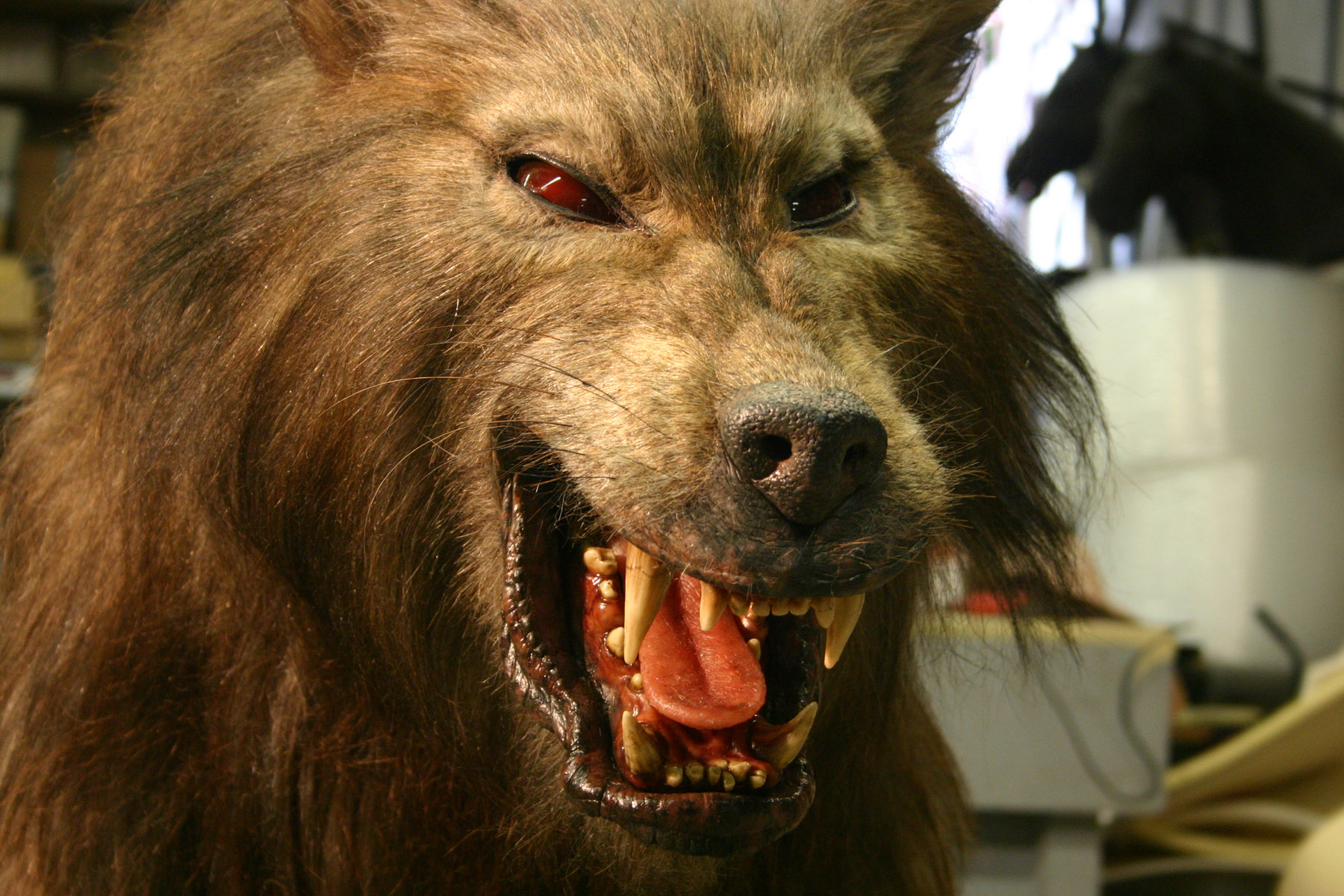
One fully mechanical creature is not necessarily preferable to several interchangeable components. A wide shot may need a durable full-size puppet capable of restrained movement, while a close-up can use a different head with elaborate eyes or mouth controls. Stan Winston Studio’s documented work on Predator 2 (1990) illustrates this modular approach: alongside suits and headpieces, the crew built a dedicated mechanized insert head for more intricate mouth movement. The production also modified an earlier Predator head to create the elder creature. Reusing a recognizable design did not mean simply retrieving an unchanged old mask; material aging, fit and new performance requirements made physical alteration necessary.
Creature suits, performers and the limits of wearable monsters
A creature suit converts an actor’s performance into the behavior of an invented body. It must provide sufficient mobility, acceptable temperature and breathing conditions, visibility, emergency access and surfaces that photograph convincingly. Suits can combine flexible exterior skins, rigid internal supports, padding, sculpted forms and separate mechanical elements. Their apparent design may be determined as much by a performer’s anatomy as by the original illustration. A creature with extremely narrow hips, reversed joints or a very long neck is difficult to embody without altering the design, combining it with puppetry or changing the framing.
The Xenomorph of Alien (1979), designed through the work of H. R. Giger and built for performance in a full-size form, became a major example of biomechanical design translated into practical imagery. The film’s creature work must be understood together with its constructed corridors, egg chamber, puppet stages and photography. Ridley Scott’s 1979 production testimony explains why the creature’s anatomy and developmental stages were planned in advance: once an adult form had been designed, the stages preceding it needed a credible internal logic. In the finished film, different creature phases require different effects strategies, and the physical environment gives them a consistent world in which to exist.
Wearable monsters also invite unintended logistical difficulties. The Stan Winston School’s account of the discarded first design for Predator (1987) describes a suit concept whose planned anatomy and difficult jungle location created major performance problems. The creature underwent redesign before the version familiar to audiences was completed. The discarded suit illustrates how performer mobility, build complexity and difficult locations could force substantial creature redesign. Effects departments often reach their strongest results through abandoned prototypes, budget compromises and recognition that a drawing cannot necessarily be performed by a human body.
The industrial creatures of Frankenstein’s Army (2013) show a different approach to suit design. Director and concept artist Richard Raaphorst developed the film’s hybrid human-machine monsters, while special-effects supervisor Rogier Samuels and model maker Xander Forterie helped translate those designs into performers, props and built creature components. Their rusted mechanical silhouettes, bodily alterations and cumbersome attachments occupied corridors and shared photographed space with actors. Raaphorst has described choosing extensive practical fabrication because it gave the production a physical presence, while acknowledging the planning required to keep equipment and operators outside long takes. The accomplishment is a coherent family of constructed monsters, with identifiable design and workshop responsibilities distributed among multiple artists.
The cinematographer as an effects collaborator
Physical effects are photographed objects, and the camera determines what properties the audience can see. A material that looks persuasive under diffuse workshop lighting may reveal seams when a hard key light strikes it from the wrong angle. A rubber surface may become visually flat under one exposure and convincingly organic under another. Lens choice changes the apparent relationship between a puppet and the surrounding set; depth of field can disguise scale or expose model construction. The effects supervisor and cinematographer must therefore solve visual problems together, frequently through practical camera tests.
Dean Cundey’s account of photographing The Thing is particularly revealing. He did not want Bottin’s sophisticated creatures reduced to silhouettes, but fully illuminating them risked exposing painted plastic and mechanisms. His answer was to create small, controlled highlights that revealed portions of surface texture while keeping an overall shape legible against a separately lit background. Such choices show why practical effects are best studied through their appearance within the finished shot. The camera may make an imperfect puppet work; it may also ruin a technically accomplished one.
Forced perspective, miniatures, model worlds and atmospheric effects
Horror creates threatening environments as well as monsters. Forced perspective can make objects appear larger or farther away through carefully constructed spatial relationships. Miniature sets and controlled-scale props can depict collapsing buildings, underground laboratories, alien landscapes and scenes impossible or uneconomical to film at full size. Matte paintings, optical methods and contemporary digital compositing may extend the image, while practical smoke, mist, dust, water and rain establish volume and texture in front of the lens. Atmospheric effects are not neutral decorative additions: they affect light transmission, visibility and the apparent depth of the scene.
Model construction requires attention to how materials read at scale. A fabric that looks correct at full size may appear too thick on a miniature. A small splash can seem disproportionately rapid; debris and flame need particular care. Certain effects can be staged using motion-control or repeatable camera paths so separately photographed passes align, but such methods involve intricate preparation. The spectacular model landscapes of Japanese kaiju cinema remain historically important for precisely the coordination of miniature fabrication, cinematography, suit performance and controlled destruction.

Stop motion, replacement animation and deliberately handmade horror
Stop motion offers another way of bringing constructed bodies to life. An articulated model is incrementally moved and photographed frame by frame; replacement animation can substitute different heads or shapes to produce expressions or metamorphoses. These systems preserve the literal presence of physical objects while producing movement that differs from live puppetry. Their distinctive temporal quality can be concealed through sophisticated animation or embraced as an uncanny attribute. Stop motion has supported monstrous cinema since the silent era and remains relevant far beyond nostalgic imitation of its older forms.
Sam Raimi’s The Evil Dead (1981) made extensive use of low-budget handmade methods, including stop-motion imagery in its climax, practical blood, makeup, contact-lens effects and inventive camera movement. The British Film Institute’s historical overview emphasizes that recollections of this difficult independent production sometimes diverge and should not all be treated as incontrovertible technical records. Later films such as Shinya Tsukamoto’s Tetsuo: The Iron Man (1989) made stop-motion and other physical transformations central to an abrasive, industrial body-horror aesthetic. Phil Tippett‘s Mad God (2021) demonstrates the continued expressive potential of painstaking model animation, puppetry, live action and digital methods within an entirely constructed nightmare world.
V. Horror Workshops Across the World
The United States: specialization, film schools and effects houses
The late 1970s and 1980s witnessed a remarkable concentration of American practical-effects talent, but it is misleading to describe that history as the work of a few solitary virtuosos. Dick Smith helped establish an unusually open model of technical education through published material and advice to younger artists. Rick Baker drew on that influence and developed large-scale makeup and creature work across horror, fantasy and other genres. Tom Savini became associated with the visceral demands of independently produced and commercially successful horror, while Rob Bottin’s projects brought spectacular transformation effects into films that increasingly organized entire sequences around them.
Stan Winston helped demonstrate the importance of a studio capable of integrating sculpture, fabrication, mechanical engineering and performance. Projects associated with his studio, including Aliens (1986), Predator (1987) and productions beyond horror such as Jurassic Park (1993), required teams able to design creatures at multiple scales and with multiple modes of operation. This system also depended on artists whose names were less visible in publicity: painters, mold makers, fabricators, electronic technicians, hair workers and operators. Alec Gillis and Tom Woodruff Jr., who developed Amalgamated Dynamics after working within the broader effects industry, continued the integration of creature suits, animatronics and specialized fabrication in films associated with the Alien series and other productions.
Chris Walas, Stephan Dupuis, Screaming Mad George, Steve Johnson, Greg Nicotero, Howard Berger and many others worked across different production scales and aesthetic approaches. In Society (1989), Screaming Mad George’s effects made collective bodily deformation integral to the film’s satire; in The Fly, Walas and Dupuis treated the collapsing organism as an evolving makeup continuity problem. Nicotero and Berger’s KNB EFX Group helped make such craftsmanship available to numerous productions, and the long-running television demands of The Walking Dead demonstrated the organizational challenge of producing consistent creature makeup for large numbers of performers. This is a history of industrial knowledge transfer as much as individual artistic recognition.
At the independent end of the American industry, the methods and ambitions can be quite different. Joe Castro developed an effects-driven filmmaking practice visible in Terror Toons (2002), where exaggerated physical gore coexists with deliberately artificial, cartoon-derived digital imagery. The combination illustrates how small productions can use computer-generated imagery to extend a deliberately handmade aesthetic. Marcus Koch, whose practical makeup work includes American Guinea Pig: Bouquet of Guts and Gore (2014), represents a more anatomical and sustained form of independent splatter. The emphasis in these productions falls on close-range fabricated bodies, controlled fluids and the endurance of detailed gore appliances under prolonged scrutiny. Their importance lies in preserving a specialized low-budget effects culture, not in claiming the same scale of innovation or influence as the major transformation sequences of the 1980s.
Britain: Gothic makeup, mechanical bodies and creature fabrication
British horror developed from earlier studio crafts of theatrical makeup, wardrobe, set building and model making. Hammer’s Gothic productions made vivid color and elaborate period presentation central to the genre’s visual identity, creating particular demands for wounds, aged characters, vampire transformations and monstrous faces. Later British horror brought more conspicuous practical effects into contemporary and fantastical settings. The difference between a Gothic monster glimpsed in carefully controlled lighting and a creature dissected in an effects-driven close-up required new fabrication skills as well as changes in taste and censorship.
The effects practice behind Hammer’s Gothic revival is especially visible in The Curse of Frankenstein (1957). Makeup artist Phil Leakey created a new appearance for Christopher Lee’s Creature, distinct from Jack Pierce’s earlier Universal design. Roy Ashton, who assisted Leakey and later became closely associated with Hammer makeup, belongs to the same workshop tradition. Surviving objects in the Science Museum Group’s Ashton and Leakey Collection include sketches, clay models, reference photographs, prosthetic fangs and glass eyes associated with productions such as Dracula (1958) and The Mummy (1959). These materials document a craft adapted to Eastmancolor photography, where simulated blood, damaged skin and the detail of a monster’s face could be photographed in comparatively direct color close-ups.
Clive Barker’s Hellraiser (1987) provides an instructive example of horror built around a coherent material conception. Its damaged bodies, cenobite makeup and grotesque physical reconstruction were essential to the film’s understanding of flesh and identity. Bob Keen and the Image Animation team contributed to the makeup and creature-effects work, combining prosthetic design with mechanically and photographically managed illusions. The later proliferation of British creature makers and international effects companies shows how workshop disciplines can migrate between horror, fantasy, advertising and television without losing their technical foundation.

The subterranean creatures in The Descent (2005) offer a later example of British makeup designed around performance and photography. Paul Hyett and his sculptors translated director Neil Marshall’s conception of underground-adapted humans into prosthetic faces and bodies that actors could move through dark, confined spaces. Camera tests led to adjustments in skin coloration because an overly pale finish reflected too much light against the caves. The resulting design depended on coordination among sculptors, performers and the cinematographer.
The physical hallucinations in Brandon Cronenberg’s Possessor (2020) demonstrate another contemporary British contribution. Effects artist Dan Martin built realistic heads and wax elements used for extreme close-ups and on-camera transformations. Cronenberg and Martin have described how much of this imagery was achieved practically, with digital intervention reserved for selective finishing and other tasks. It is a useful example of effects designed to withstand intrusive camera proximity, where a convincing sculpt, appropriate surface movement and the lens are inseparable.
Italy: artisanal gore, special makeup and resourceful fabrication
Italian horror is indispensable to this history because its makeup and fabricated bodies developed in conditions different from those of the large American effects studios. The tradition ranges from the earlier Gothic atmosphere of Mario Bava’s productions to the increasingly graphic bodily imagery of the late 1970s and 1980s. A film’s effects might be developed by relatively small teams using materials and working methods chosen for their availability, speed and appearance under a particular lighting scheme. The visual result could nevertheless become influential abroad, especially when striking makeups were emphasized in publicity or home-video circulation.
Carlo Rambaldi developed a distinctive approach to mechanical illusion before his work became central to major Hollywood creature productions. For Lucio Fulci’s A Lizard in a Woman’s Skin (1971), he built articulated dog models for a laboratory sequence depicting animals subjected to vivisection. Their mechanical movement and exposed anatomy created an illusion that convinced some viewers the suffering was genuine. His Italian filmography included effects for Dario Argento’s Deep Red (1975), where artificial objects and mechanical effects participated in the film’s violent set pieces. In Alien (1979), his contribution to the Xenomorph’s mechanical head translated H. R. Giger’s biomechanical design into an operated physical structure. The Academy Museum identifies both Giger and Rambaldi in the headpiece’s design and construction, with fiberglass, latex, aluminum and metal cables among its materials. The work demonstrates the engineering required for facial movement and the integration of fabricated creature surfaces with articulated mechanisms.
Giannetto De Rossi‘s work with Lucio Fulci provides an unusually clear example. In a 2017 interview about Zombie (1979, released in Italy as Zombi 2), De Rossi explained that Fulci initially wanted zombies similar to Romero’s, but he rejected that approach as insufficiently frightening and convincing. He instead developed makeup directly on the performers using clay, seeking a more credible appearance of bodily decay. In that interview, De Rossi said he had never used silicone and never would, describing the lengthy search for alternative materials capable of producing convincing results on camera. De Rossi’s work on Fulci’s other productions belongs to the development of an Italian horror language in which prosthetic damage, simulated tissue and photographed decomposition became central aesthetic components.
Cannibal Holocaust (1980) provides another revealing example of Italian practical ingenuity: comparatively simple physical devices became persuasive through framing and the rough texture of footage presented as documentary evidence. The film credits Aldo Gasparri with special effects and Massimo Giustini with makeup, but a frequently discussed illusion demonstrates why specific effects must not automatically be assigned to a single department. According to director Ruggero Deodato, production designer Antonello Geleng devised the apparent impalement using a concealed bicycle-seat support and a separate lightweight wooden element, photographed to look like a single stake passing through a body. The result depended on economical construction, controlled performance and photographic presentation, with little reliance on prosthetics.
Sergio Stivaletti belongs to a subsequent development. In interviews about Phenomena (1985) and Demons (1985), he has described how his early interest in optical effects, stop motion and creature construction informed a move into makeup and mechanical transformation. The demonic alterations in Demons are especially useful because they involve gradual bodily transformations staged across multiple shots. His account also supplies a caution about credits: particular optical or mechanical effects in productions associated with one famous specialist may actually belong to other technicians. Attribution of individual effects therefore depends on the documented responsibilities of the technicians involved.
The Italian case illustrates another recurring distinction: special makeup effects and the wider apparatus of screen illusion do not belong to the same department in every production. Camera tricks, mechanically operated birds or insects, artificial corpses, prosthetic transformations and stunt arrangements may be commissioned, supervised and credited separately. Reconstructing who did what requires production records or interviews, especially when later reviews use the broad label of practical effects without identifying individual responsibilities. The graphic cinema discussed in iHorrorDB’s history of extreme horror is consequently also a history of practical fabrication and changing access to technical expertise.
Japan, New Zealand and other traditions of handmade horror
Japan’s contribution extends beyond the kaiju tradition. The sculpted masks, physical transformations and tactile camera tricks of Japanese horror and science-fiction cinema offered alternative ways of representing possession, mutation and corrupted bodies. Shinya Tsukamoto’s Tetsuo: The Iron Man transformed industrial debris and stop-motion movement into a language of invasive metal and flesh. Takashi Miike’s Audition (1999) demonstrates a different relationship between ordinary performance and sudden practical bodily violence. It would be inaccurate to place every Japanese horror production into one technical lineage: the restrained apparition of a ghost film may rely on almost the opposite effects strategy from an aggressive cybernetic transformation.
The explicitly grotesque tradition developed by Yoshihiro Nishimura occupies a distinct place in Japanese practical effects. After working on the creature and gore effects of independent productions, he directed Tokyo Gore Police (2008), treating prosthetic mutation and violent bodily reconstruction as a sustained part of the film’s imagery. In a contemporary interview, Nishimura described coordinating a specialist makeup workshop with separate digital-effects collaborators. This division of labor helps explain how the film’s extravagant transformed bodies could be built, performed and then supplemented by digital imagery without losing their deliberately tactile appearance.
In New Zealand, Peter Jackson’s Bad Taste (1987) became a model of independent effects ingenuity. The British Film Institute describes its extended production on weekends and the resourceful creation of alien makeup. Jackson’s Braindead (1992, also known as Dead Alive) expanded the scale of grotesque comedy and practical carnage, helping establish the workshop culture that later supported a major international film industry. Other important regional production histories include Spanish and French horror, Korean creature cinema and independent workshops across Latin America.
Independent creature filmmaking in the 2010s provided further examples of production strategy shaping the result. Steven Kostanski and co-director Jeremy Gillespie made The Void (2016) with a specific commitment to physical monster fabrication. Kostanski explained that the fundraising campaign was built around the cost of practical creature work: the effects were planned as a central production objective from the outset. The experience suggests why a smaller film may concentrate resources in constructed creatures and design scenes around the practical work they can support.
A more restrained but equally revealing case is Thanatomorphose (2012), directed by Éric Falardeau. The film depicts bodily deterioration across successive stages of makeup sustained throughout the film. Falardeau’s account distinguishes the contributions of Rémy Couture, who handled fluids and some prosthetic elements, and David Scherer, who developed the decomposition effects and carried out on-set work. That division matters because the changing appearance of a decaying body requires continuity between sculpted deterioration, paint, fluids and photography. The collaboration belongs to the independent networks connecting Canadian and French-speaking practical-effects artists, without requiring either specialist to be elevated into a separate chapter of historical pioneers.
The tension between convincing gore effects and the perception of actual violence has sometimes extended beyond the screen. In A Lizard in a Woman’s Skin (1971), the dog sequence led to animal-cruelty allegations against the production. Rambaldi and producer Edmondo Amati presented the mechanical models to Italian judges to establish that no living dogs had been vivisected for the scene, and the charges were dropped. In Cannibal Holocaust, fabricated human mutilations were presented alongside documentary-style photography and real on-camera animal killings. Allegations that performers had been murdered led to legal scrutiny, and Deodato had to establish that the actors were alive; the actual animal deaths must not be confused with the simulated human injuries. Decades later, the extreme realism of Rémy Couture’s Inner Depravity photographs and short films attracted police attention following a complaint from abroad. Arrested in 2009, Couture was tried in Canada over allegations that he had produced, possessed and distributed obscene material, and was acquitted by a jury in December 2012. He was not prosecuted for murder. The three proceedings concerned different allegations: animal cruelty in the Fulci production, suspected human killings in Cannibal Holocaust, and obscenity in Couture’s case.
Budgets, schedules, labor and the reality behind a spectacular shot
Effects work is constrained by industrial organization. A low-budget film may favor a single highly effective prop and inventive cutting; a large production can build separate versions of a creature for different lenses, movements and destructive events. Neither situation guarantees artistic success. The necessary number of test days, makeup artists, mechanical operators and resettable copies can matter more than the nominal sophistication of a material. Production schedules also determine how many elaborate shots are feasible. A creature may take months to build, many hours to apply and only seconds to photograph, with removal, cleaning, maintenance and repair continuing after the camera stops.
The progression from Terrifier (2016) and Terrifier 2 (2022) to Terrifier 3 (2024) shows what happens when a director’s practical-effects workload expands beyond what a small production can reasonably sustain. Damien Leone, who came to directing through makeup effects, has explained that he personally performed much of the earlier films’ prosthetic and gore work with limited assistance. The third feature’s increased resources allowed him to commission Christien Tinsley and his team to fabricate and apply effects while Leone concentrated more fully on directing. This shift is significant as a question of specialization and production organization. The characteristic emphasis on physically staged violence continued, but responsibility for designing, applying and resetting effects was redistributed to a larger crew.
The public recognition of makeup effects developed gradually. Rick Baker’s Academy Award for An American Werewolf in London recognized the first competitive winner in the Makeup category; Chris Walas and Stephan Dupuis later won for The Fly. These awards brought attention to a craft whose essential labor had often remained outside the public discussion of filmmaking. But awards categories do not encompass every practical-effects department: model builders, mechanical crews, pyrotechnicians, puppeteers and visual-effects supervisors may be recognized through different credit systems. These distinctions explain why an award for prosthetic makeup does not necessarily encompass the mechanical, miniature and photographic work used in the same production.
VI. The Digital Turn, Contemporary Practical Horror and Artificial Intelligence
CGI and the changing division of effects labor
Computer-generated imagery altered the economics, flexibility and visual language of screen effects, but it did not make fabricated objects obsolete. Digital creatures can perform movements beyond the limits of a physical puppet; compositing can remove support rods, operators and safety equipment; digital environments can extend miniature or full-scale sets. A physical creature can provide texture, reflections, believable interaction and a tangible reference for performers. The combined system allows departments to reserve each method for what it can achieve most effectively. Problems occur when this choice is treated as an ideological debate, obscuring the practical and dramatic needs of each shot.
The public contrast between rubber and pixels obscures substantial intermediate work: digital artists may photograph and scan models made by sculptors, while creature shops increasingly design in three dimensions and use computer-controlled milling or additive manufacturing to produce masters and structural components. An appliance can begin as a digital sculpture, be fabricated physically, move with an actor and receive later cleanup in compositing. Such a finished shot remains partly practical even when the last visible image is digitally processed. Conversely, an image marketed as practical may contain large amounts of digital reconstruction. Responsible histories specify the documented contributions instead of assigning all credit to one category.
Three-dimensional printing, precision fabrication and modern hybrid creatures
Digital sculpting and 3D printing can help an effects department prototype teeth, masks, hard components, scaled maquettes and mold-making masters. Printing is not the final answer to every creature requirement: the choice of material, surface preparation, fitting, molding, cast reproduction and painting still control the final image. Digitally manufactured parts can reduce some repetitive hand fabrication while introducing new demands for file preparation, machine calibration and finishing. The continuing value of physical expertise is especially clear when the printed object must fit a human body, survive movement or reproduce the optical behavior of skin.
The Shape of Water (2017) exemplifies the layered logic of modern creature design: performer Doug Jones, flexible suit construction, selective silicone surfaces, mechanical gill operation and digital treatment of eyes and subtle facial movement formed one integrated performance. Alien: Romulus (2024) likewise became a high-profile example of a production combining physical creature traditions with contemporary VFX. Interviews with visual-effects supervisor Eric Barba and practical creature specialist Alec Gillis emphasize a deliberate partnership between physical fabrication and digital refinement. Such productions are more historically informative than an attempt to label their entire effects strategy as purely practical.
Recent television provides some of the clearest evidence that prosthetic construction remains viable at scale. For the fourth season of Stranger Things, Barrie Gower and his team built Vecna’s appearance from multiple overlapping appliances designed to preserve Jamie Campbell Bower’s movement and facial performance. The fifth season used a more extensive hybrid approach, retaining practical work on the head and parts of the upper body while realizing larger moving structures digitally. Gower’s work on the infected in The Last of Us similarly required several distinct anatomical stages of fungal transformation. These designs are significant because the production had to reproduce complex creature appearances across repeated shooting days, multiple performers and changing lighting environments. The prosthetic design functioned as a maintainable system integrated into serialized production.
For Guillermo del Toro’s Frankenstein (2025), creature designer Mike Hill and his team built a forty-two-piece prosthetic treatment for Jacob Elordi’s Creature. Hill’s approach deliberately departed from the familiar silhouette of Jack Pierce’s 1931 design: the new surface anatomy had to suggest an assembled body while directing attention toward the actor’s eyes and expression. The overlapping pieces, precisely fitted for repeated applications, illustrate how contemporary makeup can be technically elaborate without turning a character into a static display of wounds. This is an extension of the problem faced by earlier character-makeup artists: how much physical alteration can be introduced while preserving the performance beneath it? At the 98th Academy Awards on 15 March 2026, Hill, Jordan Samuel and Cliona Furey won the Oscar for Makeup and Hairstyling for the film.
The Substance: an effects-intensive film in the digital era
Coralie Fargeat’s The Substance (2024) is especially useful because unusually detailed first-hand documentation survives concerning its physical effects and photography. Cinematographer Benjamin Kračun explains that the film’s complex sequences were extensively storyboarded and realized through multiple shooting environments, prosthetics, body doubles and a separate laboratory-style production period. For the sequence in which a new body emerges from Elisabeth’s back, different parts were photographed using a constructed torso, a real arm and specially lit set elements; some additional changes were completed with VFX. The sequence achieves the appearance of uninterrupted action through the careful assembly of separately photographed elements.
Kračun also describes another apparently abstract image, a tunnel of light, made physically using rotating bicycle wheels and lighting tubes. The tunnel was photographed using synchronized physical components. The film’s makeup and hairstyling team—Pierre-Olivier Persin, Stéphanie Guillon and Marilyne Scarselli—won the Academy Award at the 2025 ceremony. That recognition is significant within the long history of physical body horror, but it should not conceal the many other departments required to put the prosthetics on screen.
A more modest but instructive development followed in Emilie Blichfeldt’s The Ugly Stepsister (2025). Prosthetic makeup designer Thomas Foldberg and hair-and-makeup designer Anne Cathrine Sauerberg created bodily alterations rooted in the story’s fixation on painful beauty treatments. The film’s 2026 Academy Award nomination for Makeup and Hairstyling brought international attention to an effects approach developed for a comparatively small European production. Unlike the large-scale transformation of The Substance, its most disturbing details depend on the familiarity of cosmetic practices and the precise manipulation of the face and body. Both films demonstrate how contemporary practical effects can serve different kinds of body-horror storytelling.
Artificial intelligence: what changes, and what remains unresolved
Artificial intelligence introduces a further distinction that ordinary discussions of practical versus digital effects frequently overlook. Conventional CGI is a broad field of computer modeling, rigging, simulation, animation, rendering and compositing, much of it carried out through explicitly controlled production tools. Generative AI, by contrast, can produce or alter imagery in response to learned patterns and human-directed inputs. These are not synonyms, and neither should be treated as a complete production method. Their outputs, control mechanisms and evidentiary status vary by model and workflow.
For horror-effects production, AI-assisted tools can be relevant at several different stages: rapid visual exploration of possible creature designs; concept comparisons before sculpting; organization and treatment of visual references; selected image modifications; rotoscoping and masking assistance; and the experimentation that accompanies digital post-production. These uses are not all equally established, nor is a generated image equivalent to a physically buildable design. An AI concept of a transformation may show limbs intersecting in impossible ways or details that cannot be retained consistently between shots. Effects supervisors still have to decide how the imagined creature moves, what a performer can wear, which physical material meets the photographic needs and how multiple shots maintain continuity.
A more consequential possibility is that AI-based video systems will be used to extend or replace some shots traditionally achieved through puppetry, animation or extensive digital VFX. This is a plausible direction of development, not evidence that conventional effects departments have already been displaced across horror production. Reproducibility, exact performance direction, consistency of anatomy, frame-to-frame continuity, integration with camera movement and responsibility for the final image remain central concerns. A production seeking an expressive, repeatable character may need much more control than a convincing isolated demonstration can provide.
The questions are not exclusively technical. Reproducing a performer’s face or body digitally raises issues of authorization, compensation and control over future uses. SAG-AFTRA’s published AI resources explain contractual protections regarding informed consent and digital replicas. The United States Copyright Office has separately examined questions of human authorship, digital replicas and the training of generative systems. Such questions cannot be solved by an effects supervisor selecting a more powerful model, nor do the same legal rules apply in every country. They belong to the industrial framework within which horror images are created.
The most useful historical comparison is therefore not a prediction that AI will replace latex or animatronics, but an observation that each major production technology redistributes creative work. Photography altered stage illusion; foam latex changed the capacity of actors to perform through artificial anatomy; computer imagery expanded the range of possible motion; and AI may change stages of ideation and image manipulation. None of these developments removes the fundamental questions of design, timing, performance, attribution and audience perception. A creature that exists only on a screen and a creature physically handled by an actor may be made through different labor, yet the filmmaker must still persuade the audience that it belongs within the world of the film.
VII. Preservation, Authorship and the Physical Legacy of Horror
Why original effects objects disappear
Effects artifacts are especially vulnerable because many were built for the immediate demands of a shoot, using materials ill-suited to decades of storage. Foam latex can degrade and become brittle; adhesives fail; paint layers separate; internal components corrode; soft materials may deform under their own weight. Pieces designed to tear, burn or collapse were sometimes intentionally destroyed during photography. Props stored in poor environmental conditions can deteriorate even when the original sculpture or paint remains historically important. A surviving creature head may therefore be a fragile record of production knowledge that requires conservation before exhibition.
Documentation matters as much as the remaining object. Design drawings, molds, test photographs, call sheets, fabrication records, camera tests and testimony from operators can explain effects whose final physical components no longer exist. Rick Baker has spoken to the Academy about the importance of preserving workshop materials, many of which would otherwise remain unseen or deteriorate in storage. Archives and museums can document the appearance of a finished monster and the chain of labor that made its screen performance possible. Digital scans may preserve some geometry, although they cannot capture the complete behavior, composition or fabrication history of an original appliance.
Understanding authorship beyond the famous name
The mythology of horror effects often turns a single artist into the author of a creature, while production records reveal many people responsible for sculpting, molding, painting, mechanisms, operation, photography and editing. Famous designers can deserve their reputations without absorbing the credit of the teams who realized the work. The same caution applies to a movie’s general visual identity: a creature designer, special makeup effects supervisor, mechanical-effects crew, cinematographer and digital-effects team contribute different things. Awards and publicity materials may identify principal figures without recording every craftsperson who made a memorable shot possible.
Reconstructing practical-effects history requires distinguishing documented credits from informal associations, contemporary production accounts from later recollections, and technical facts from production legends. Where sources conflict or records are incomplete, some details cannot be established with certainty. Production records and first-hand accounts help identify the responsibilities of individual artists and distinguish fabricated objects from the shots created around them.
Conclusion: the material imagination of horror
The enduring importance of practical effects lies neither in nostalgia nor in a claim that physical objects must always look more convincing than digital images. It lies in a century-long body of knowledge about how to make artificial anatomy, impossible movement and fabricated environments register as events before a camera. A successful illusion joins material properties to sculptural design, mechanical behavior, performer action, lighting and the organization of cinematic time. Its method may be invisible to the audience, but its construction shapes the image.
Horror provides an unusually demanding arena for this craft because it repeatedly asks cinema to show what familiar bodies and objects could become. From Chaney’s transformed characters and Pierce’s Universal monsters to Japanese model worlds, Italian gore laboratories, the American creature-effects studios, contemporary prosthetic productions and emerging AI-assisted techniques, the history remains one of continual adaptation. Across these periods, the filmed effect has depended on choices of material, movement, framing, performance and, increasingly, digital integration.
References and Original Documentation
These references document the historical, technical and production details discussed in the article.
- Academy of Motion Picture Arts and Sciences – Dick Smith – Institutional biography documenting his overlapping prosthetic technique, influence and work on The Exorcist.
- Academy of Motion Picture Arts and Sciences – Rick Baker – Collection documenting the first competitive Makeup Oscar and Baker’s practical-effects career.
- American Society of Cinematographers – Photographing The Thing – Dean Cundey’s first-hand account of lighting Bottin’s creatures and accommodating their practical limitations.
- American Society of Cinematographers – The Fly: New Buzz on an Old Theme – Production-level examination of photographing Walas’s appliances, suits and puppet mechanisms.
- American Society of Cinematographers – The Filming of Alien – Ridley Scott’s 1979 account of creature design, storyboarding and physical-effects planning.
- British Film Institute – All-out puppet attack! The monster puppetry in Ishirō Honda’s kaiju classics – Detailed historical study of suits, puppets and miniature methods in Japanese monster cinema.
- British Film Institute – 10 Great Films with DIY Special Effects – Research covering Méliès’s photographic illusions and practical production techniques in The Evil Dead and Bad Taste.
- Stan Winston School of Character Arts – Revealing the Creative Process Behind The Shape of Water’s Creature – Practical documentation of foam rubber, silicone, gill mechanisms and digital enhancement.
- British Cinematographer – Benjamin Kračun BSC / The Substance – First-hand cinematography account of prosthetic shooting, doubles and the separate effects laboratory.
- Cineclandestino – Interview with Giannetto De Rossi – First-hand testimony about clay-based zombie makeup in Zombie and the importance of material realism.
- SAG-AFTRA – Artificial Intelligence Resources – Union documentation of consent and digital-replica provisions relevant to AI-assisted filmmaking.
- U.S. Copyright Office – Copyright and Artificial Intelligence – Primary legal-policy reports on digital replicas, human authorship and generative systems.
- Starburst Magazine – Éric Falardeau on Thanatomorphose – Director’s precise account of David Scherer’s decomposition effects and Rémy Couture’s fluids and prosthetics.
- The Credits / Motion Picture Association – Barrie Gower on Vecna in Stranger Things 5 – Detailed explanation of prosthetic appliances, digital integration and repeatable creature fabrication.
- Netflix Tudum – Peeling Back Frankenstein’s Mask – Interview with Mike Hill and Jacob Elordi detailing the forty-two prosthetic pieces, departure from the 1931 design and emphasis on the Creature’s eyes.
- VICE Italia – Monsieur Cannibal: interview with Ruggero Deodato – Deodato’s own description of Antonello Geleng’s construction of the impalement illusion.
- The Canadian Press – Defendant at Corrupting Morals Trial Testifies: My Work Is Art – Contemporary reporting on the Inner Depravity images, practical makeup and obscenity charges.
- TVA Nouvelles – Le maquilleur de l’horreur est acquitté – Reports the jury’s December 2012 acquittal of Rémy Couture.
- American Film Institute – The Ghost of Frankenstein (1942) – AFI Catalog – Contemporary industry reporting on Lon Chaney Jr.’s allergic reaction to Jack Pierce’s makeup.
- Academy of Motion Picture Arts and Sciences – The 98th Academy Awards (2026) – Official winner record for Frankenstein: Mike Hill, Jordan Samuel and Cliona Furey, Makeup and Hairstyling.
- Stan Winston School of Character Arts – The Original Predator – Jean-Claude Van Damme – First-hand account by original creature-FX supervisor Steve Johnson of the abandoned Predator design and its on-set limitations.
- The Credits / Motion Picture Association – Be Still My Bursting Chest: Alien: Romulus’s VFX Team – Interviews with Eric Barba and Alec Gillis about physical puppetry, miniature fabrication and digital effects integration.
- Science Museum Group – Ashton & Leakey Collection – Primary collection of Hammer-era prosthetic, makeup and design artifacts, including The Curse of Frankenstein, Dracula and The Mummy.
- Fondazione Culturale Carlo Rambaldi – Carlo Rambaldi – Institutional biography documenting his special-effects contribution to Deep Red and transition to mechanical creature work.
- Academy Museum of Motion Pictures – Extraterrestrial Headpiece Worn in Alien (1979) – Collection record attributing the design and construction to H. R. Giger and Carlo Rambaldi and identifying the physical materials.
- Stan Winston School of Character Arts – Painting Foam Latex and Silicone Prosthetics – Professional materials and painting techniques cited in the foam-latex section.
- ScreenAnarchy – Yoshihiro Nishimura Interview – Contemporary interview concerning the division of practical and digital effects work on Japanese gore productions.
- Shock Till You Drop / ComingSoon – Interview with Richard Raaphorst – First-hand account of the creature designs and physical effects strategy in Frankenstein’s Army.
- The Guardian – Raw Dogs (2003) – Reporting and Rambaldi’s own documentary testimony on the mechanical dogs, the Italian legal proceedings and the dismissal of the animal-cruelty allegations.
Image credits and licenses
- Lon Chaney Phantom of The Opera Cropped.jpg — Wikimedia Commons · Public domain (US)
- Gojira (1954) – Behind Scenes 6.jpg — Wikimedia Commons · Public domain (Japan)
- Special make up artist.jpg — Wikimedia Commons · CC BY 3.0
- IAL Hemocyte makeup test.jpg — Wikimedia Commons · CC BY-SA 3.0
- Special effects makeup at the 2025 New Jersey Film Expo.jpg — Wikimedia Commons · CC BY 4.0
- Blood, guts and gore galore, Moulage crew brings horror to life 140723-A-IX584-057.jpg — Wikimedia Commons · Public domain (US government)
- Scarlet Studios Team working on the Burn Sfx Makeup located in Uganda, Bugolobi.jpg — Wikimedia Commons · CC0 1.0
- Blood, guts and gore galore, Moulage crew brings horror to life 140723-A-IX584-030.jpg — Wikimedia Commons · Public domain (US government)
- 300 animatronic wolf puppet Closeup.jpg — Wikimedia Commons · CC BY-SA 3.0
- Gojira (1954) – Behind Scenes 1.jpg — Wikimedia Commons · Public domain (Japan and US)
- Hellraiser Puzzle Box.jpg — Wikimedia Commons · Public domain (released by author Formanavt)
Leave a Reply