
Robert Eggers has provided new details about the development and performances of Werwulf, his forthcoming historical horror film, during appearances at the BFI London Film Festival and the Lumière Film Festival in France. His comments address the screenplay’s development with Icelandic writer Sjón, the decision to create the central role specifically for Aaron Taylor-Johnson, and the relationship between physical performance and the film’s supernatural material.
During a Screen Talk held in London on October 11, 2026, Eggers presented the opening minutes of the film to the audience. The British Film Institute subsequently published an account of the discussion on October 16, documenting the director’s remarks about his actors, working methods and the first sequence shown at the event.
The preview included a transformation involving Taylor-Johnson’s character inside a barn. According to the BFI’s account, the sequence depicts the actor undergoing an intense physical change, including convulsions and vomiting, as a human body begins transforming into a beast. The footage was presented as part of the festival discussion rather than as a public theatrical screening of the completed feature.
The film is set in 14th-century England and concerns a community threatened by a creature associated with werewolf folklore. Focus Features has scheduled its US theatrical release for December 25, 2026. The official cast includes Aaron Taylor-Johnson, Lily-Rose Depp and Willem Dafoe.
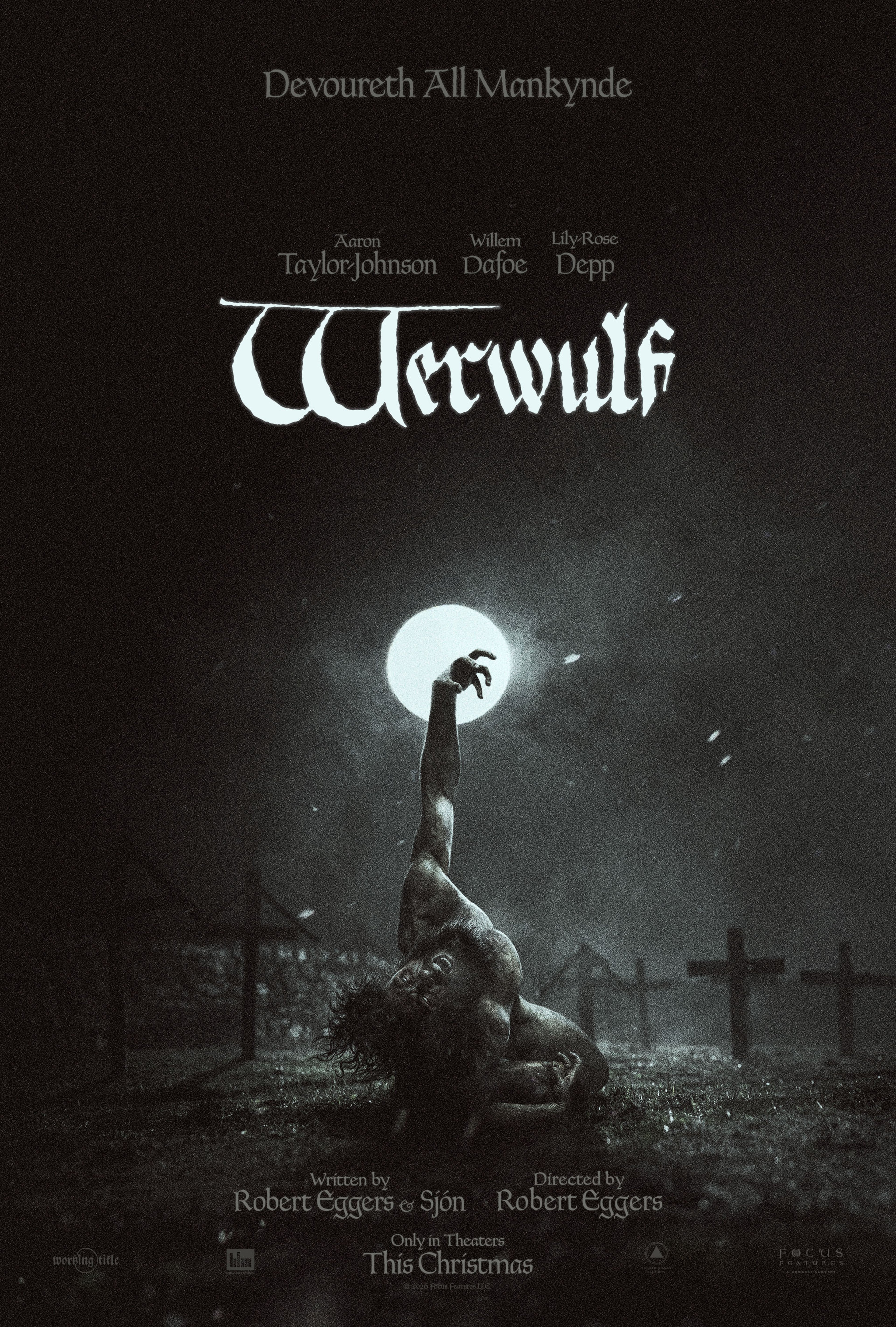
Courtesy of Focus Features.
A Role Written for Aaron Taylor-Johnson
One of the most significant disclosures during the BFI discussion concerned the creation of the leading character. Eggers explained that he developed the part specifically for Taylor-Johnson, rather than writing the role independently and selecting an actor afterward. The director also emphasized the physical demands placed on the performer, describing his work in the film as exceptionally athletic.
The decision is important to understanding the production because the central transformation is not being treated exclusively as an effects sequence. The actor’s physical performance forms part of the characterization, requiring bodily movement to communicate the transition between human and animal states.
Taylor-Johnson had previously worked with Eggers on Nosferatu (2024), in which he played Friedrich Harding. Werwulf continues their professional relationship while giving the actor a substantially different kind of role, one centered on an afflicted character whose physical condition becomes inseparable from the film’s supernatural premise.
Eggers discussed his approach to physical performance again during a master class at the Lumière Film Festival. In an official account published on October 17, he identified choreographer Marie-Gabrielle Rotie as a collaborator on both Nosferatu and Werwulf. He also acknowledged the influence of Polish theater director Jerzy Grotowski and the cinema of Andrzej Żuławski, particularly in relation to the expressive capabilities of the human body.
Rotie’s involvement establishes a connection between the two productions at the level of movement and performance preparation. In Nosferatu, Depp’s portrayal of Ellen Hutter involved demanding physical sequences associated with possession, convulsions and supernatural influence. The collaboration on Werwulf indicates that choreographed movement continues to be part of Eggers’ approach to representing bodily states that extend beyond ordinary human behavior.
During the Lumière event, Eggers also emphasized that physical expression cannot be understood independently of a character’s emotional and psychological condition. His comments provide a useful context for interpreting the transformation previewed in London: the sequence involves an actor performing an extreme bodily change, but its function within the complete narrative has not yet been established publicly.
At present, neither festival account supplies a complete technical breakdown of the transformation. The available information does not establish which elements were created through prosthetic makeup, mechanical effects, digital effects or combinations of those methods. It would therefore be premature to describe the sequence as entirely practical or entirely computer-generated.
The screenplay was developed by Eggers with Sjón, the Icelandic writer and poet who previously collaborated with the director on The Northman (2022). During the London discussion, Eggers described beginning with an atmosphere and emotional concept before working with Sjón to organize that material into a complete narrative.
This account clarifies the nature of their collaboration. Eggers presented Sjón as an active creative participant whose contributions extended beyond dialogue or revisions to an existing screenplay. The director credited him with developing ideas and helping establish the dramatic structure required to support the initial concept.
The collaboration follows their work on The Northman, which combined historical reconstruction with elements derived from Scandinavian legend. Werwulf similarly places supernatural subject matter within a historical setting, although its specific narrative relationships and treatment of folklore cannot yet be fully assessed from the available promotional material.
Eggers also spoke about the benefits of repeatedly working with the same actors and technicians. At the London event, he explained that professional familiarity allows collaborators to develop a shared understanding of the film’s intended direction, reducing the need to establish basic working methods during each new production.
Willem Dafoe illustrates that continuity. He first collaborated with Eggers on The Lighthouse (2019) and subsequently appeared in The Northman and Nosferatu. His participation in Werwulf marks another project within that continuing relationship.
Eggers associated this familiarity with his experience in theater, particularly the importance of rehearsal and the ability to develop performances through sustained collaboration. His comments suggest that the demanding physical work required by Werwulf belongs to an established production method rather than representing an isolated change in his filmmaking approach.
Historical Horror, Performance and the Representation of the Monster
Eggers’ remarks at the Lumière Film Festival provide additional context for the film’s visual conception. During the master class, he discussed his interest in silent cinema and the importance of communicating through images independently of spoken dialogue. He identified Fritz Lang as a filmmaker whose work retained a strong visual language during the transition from silent films to sound production.
Eggers connected that interest directly to Werwulf, indicating that he had attempted to pursue a related emphasis on visual storytelling in the new production. Although the film contains dialogue, his comments identify physical images and performance as central elements of its cinematic construction.
The observation is consistent with the demands of a story involving bodily transformation. Changes in posture, movement and facial expression can communicate information before a character explains an experience verbally. In this context, the London preview offers a documented example of the kind of physical material Eggers chose to present publicly ahead of the film’s release.
The director also discussed the use of direct eye contact and extreme close-ups in his films. He described positioning the camera near performers so that their gaze appears directed toward the audience. This approach is especially relevant to his discussion of monster design because he considers the visibility or concealment of a creature an important factor in producing fear.
At Lumière, Eggers identified Ridley Scott’s Alien (1979) as a particularly important monster film, praising H. R. Giger’s creature design and its disturbing combination of recognizable human anatomy with unfamiliar physical characteristics. He also discussed the absence of visible eyes in the creature’s design, contrasting that feature with the possibility of direct eye contact in the depiction of werewolves.
These remarks illuminate Eggers’ broader interests in the relationship between a monster’s physical appearance and the spectator’s response. They do not, however, establish a direct visual reference or specific creature-design technique used in Werwulf. No detailed production account confirming such an influence has been provided in the festival documentation.
Eggers further discussed his preference for concealing monsters in darkness. He explained that his supernatural subjects frequently belong to nocturnal environments and that showing a creature clearly can reduce the uncertainty on which its frightening effect depends.
The observation creates a useful distinction between two aspects of the upcoming film. The transformation sequence previewed in London demonstrates that a significant physical change occurs on screen, while the director’s comments at Lumière explain his general interest in controlling how much of a monster the audience can see. The balance between those approaches in the completed film remains to be determined.
His account of historical production design provides another point of continuity with his earlier work. Eggers described constructing environments that reflect the psychological conditions of his characters, even when strict historical accuracy would produce a different result. He cited the interiors of The Lighthouse as an example, explaining that the fictional living space contained more objects than would ordinarily have been found in comparable American lighthouses.
This distinction is relevant to Werwulf because the medieval setting requires both the recreation of a historical environment and the construction of a fictional world in which supernatural transformation can be understood by its inhabitants. The available documentation establishes Eggers’ general approach to these questions, although individual design decisions in the new film will require further evidence before they can be described in detail.
The filmmaker’s previous feature, The Witch (2015), similarly located supernatural events within an earlier cultural environment, using period language, religion and material conditions to shape the characters’ understanding of danger. Nosferatu applied historical reconstruction to nineteenth-century vampire fiction, while The Lighthouse used maritime labor and isolation as the basis for its psychological and supernatural material.
Those earlier works provide a documented career context for Werwulf, rather than evidence of how the new film will ultimately function. Before its theatrical release, the strongest conclusions concern the methods Eggers has publicly described: collaborative screenwriting, roles developed for specific actors, sustained relationships with performers and an emphasis on bodily expression and visual storytelling.
The BFI screening establishes that the opening of Werwulf contains a physically demanding transformation performed by Taylor-Johnson. The director’s appearances in London and Lyon also document the artistic decisions surrounding that material, particularly the importance he assigns to movement, emotional expression and the presentation of monstrous bodies.
Focus Features will release Werwulf in US theaters on December 25, 2026. Until the completed film is publicly available, these original festival accounts provide the clearest documented evidence of the production decisions Eggers has chosen to explain.
Sources and Original Documentation
- British Film Institute — Ibrahim Azam’s account of Robert Eggers’ Screen Talk, including the presentation of the opening sequence, Aaron Taylor-Johnson’s role and the screenplay collaboration with Sjón, October 16, 2026.
- Lumière Film Festival — Official report of Eggers’ master class, documenting his comments on physical performance, Marie-Gabrielle Rotie, silent cinema, monster design and visual storytelling, October 17, 2026.
- BFI London Film Festival — Official event listing for Robert Eggers’ October 11, 2026 Screen Talk, hosted by Anna Bogutskaya.
- Focus Features — Official film page confirming the December 25, 2026 US theatrical release, principal cast, screenplay credits, production credits and promotional materials.
Leave a Reply