



2003
Giannetto De Rossi
Horror Special Effects · Biography · Horror Filmography · Collaborators · Credits
Horror subgenres & themes
Biography
Giannetto De Rossi and the pursuit of realism in practical horror effects
Giannetto De Rossi was one of the major Italian makeup and practical-effects artists to emerge from the postwar film industry, with a career extending from traditional character makeup to prosthetics, gore effects, creature construction and eventually directing. Horror audiences know him particularly for The Living Dead at Manchester Morgue, Zombie Flesh Eaters, The Beyond, Killer Crocodile and High Tension, but his professional importance extends well beyond those titles. He worked across historical epics, auteur cinema, international science fiction and large commercial productions, carrying techniques learned in conventional makeup into increasingly elaborate physical effects.
De Rossi’s guiding principle was realism. He frequently argued that successful makeup should not advertise the technique used to create it. Even highly elaborate prosthetics needed to look as though they belonged naturally to the actor rather than having been placed on top of a face or body. The same principle informed his horror effects. Blood, wounds, decomposition and transformation were most effective when the audience responded first to the apparent physical event and only later considered how it had been manufactured.
A family already connected with filmmaking
Giannetto De Rossi was born in Rome on August 8, 1942 and entered an environment in which filmmaking was already part of family life. His father Alberto De Rossi worked professionally in makeup, while the previous generation had also been connected with cinema. De Rossi did not initially describe the profession as a childhood vocation. Like many young people entering family businesses, he first assisted because film work offered employment and access to a world he already knew indirectly.
His earliest responsibilities were extremely modest. He recalled beginning by helping his father on sets and performing basic tasks before being trusted with more complicated work. During the production of Cleopatra, his father gradually allowed him to participate more substantially, including work connected with the appearance of background performers. The experience introduced him to the reality that professional makeup depended on repetition, speed and consistency as much as artistic imagination.
Learning the basic discipline before attempting special effects
De Rossi never treated sophisticated prosthetic work as a substitute for conventional makeup skill. He compared the profession with learning a musical instrument: advanced work is impossible without first mastering elementary technique. Foundation, shading, color relationships, hair application and the ability to understand a face remained essential even after his career became associated with extreme effects.
This foundation distinguished his later work. A wound or prosthetic appliance had to respond to exactly the same visual considerations as ordinary beauty or corrective makeup. Skin possesses variations in color and transparency, while faces move continuously beneath anything attached to them. An effect that ignores those properties may be technically elaborate but will still appear artificial when photographed.
From makeup into physical effects
De Rossi gradually became interested in work that extended beyond conventional makeup. He was drawn toward sculpture, fabrication and difficult technical problems and described himself as someone who needed new challenges. The transition did not happen through one formal change of profession. Makeup, prosthetics and physical effects increasingly overlapped as filmmakers asked him to create injuries, transformations and objects that had to interact directly with performers.
He later identified Waterloo as an important point in this development. His father initially worked on the production before De Rossi assumed greater responsibility. Large historical filmmaking required injuries, battlefield effects and numerous performers to remain visually consistent under demanding production conditions. The experience helped move him toward a broader definition of what a makeup artist could contribute on set.
Realism as De Rossi’s central professional principle
Throughout his career De Rossi returned repeatedly to one idea: the audience should believe what the camera records. He disliked materials or applications that appeared obviously synthetic and remained skeptical of techniques that he felt created a visible layer between actor and character. His preferred solutions changed according to the problem, but the objective remained stable.
This philosophy also explains his frequent use of effects constructed directly on performers. A prosthetic built independently in a workshop can be technically perfect but may not move naturally with the specific actor. Working directly on a face or body allowed De Rossi to respond to actual anatomy and to integrate the effect with skin, expression and camera position.
Character makeup and the education provided by major filmmakers
Before his horror work became internationally famous, De Rossi developed his craft on productions by some of the most prominent filmmakers working in Italy. These assignments exposed him to directors with very different visual expectations and required makeup to operate inside highly controlled cinematography rather than simply survive the speed of low-budget genre production.
His work with Bernardo Bertolucci and Federico Fellini was particularly useful in this respect. On 1900, De Rossi handled demanding physical effects as well as makeup. On Fellini’s Casanova, he worked specifically on Donald Sutherland, translating Fellini’s conception of Casanova into a heavily controlled facial design. Sutherland’s appearance required substantial alteration while still allowing a full dramatic performance. The assignment reinforced De Rossi’s belief that makeup exists to create character, not merely demonstrate technical virtuosity.
Moving between prestige cinema and exploitation
De Rossi developed during a period when Italian technicians could move rapidly between internationally prestigious productions and films made for exploitation markets. The same practical knowledge might therefore be used one year on an expensive historical production and the next on a violent horror or erotic film produced with very limited resources.
For De Rossi this movement was professionally valuable. High-budget productions offered time, specialist departments and refined cinematography. Low-budget genre cinema forced him to invent solutions quickly. His horror effects benefited from both experiences: they could possess the anatomical attention associated with traditional makeup while being constructed with the improvisational efficiency demanded by exploitation schedules.
The Living Dead at Manchester Morgue and early horror effects
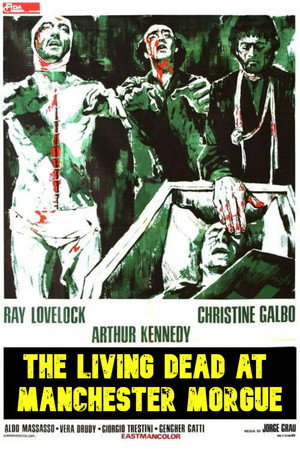
One of De Rossi’s important early horror assignments was Jorge Grau’s The Living Dead at Manchester Morgue. The film required decomposing bodies and violent physical effects within a production that combined British locations, Spanish and Italian financing and an unusually serious treatment of its zombie material.
The work helped establish De Rossi within horror before the major Italian zombie cycle at the end of the decade. His approach was already moving toward the qualities that later defined him: wounds and damaged bodies needed texture, depth and an organic relationship with the performer rather than looking like clean theatrical appliances.
Creating convincing violence before the Italian splatter boom
During the middle 1970s De Rossi became increasingly involved with effects intended to imitate severe bodily injury. His work on Emanuelle in America was especially important to this progression. Although the film is not straightforward horror, its simulated snuff material demanded effects convincing enough to appear disturbingly authentic within the narrative.
The assignment demonstrated how effectively De Rossi could make fabricated violence resemble documentary evidence. The techniques would become important when Italian horror entered a period of increasingly explicit bodily destruction. By then De Rossi had already learned how to construct effects whose impact depended on the viewer momentarily accepting them as real.
Working under severe budget limitations
De Rossi’s later horror reputation was built partly on his ability to solve problems without the resources available to large American effects shops. Italian genre films often required spectacular results from modest budgets and schedules. Casting every performer individually, manufacturing complete prosthetics and maintaining large specialist teams could be impossible.
De Rossi responded by selecting techniques according to production reality rather than according to an ideal workshop process. He could simplify applications, use inexpensive materials or create effects directly on performers when conventional prosthetic construction would have consumed too much time. The resulting method was highly dependent on personal skill because improvisation had to occur quickly while still surviving close photography.
Lucio Fulci and a decisive horror partnership
De Rossi had known and worked with Lucio Fulci before the director’s internationally famous horror period. Their relationship became historically important when they reunited for Zombie Flesh Eaters. Fulci was entering a new phase of his career, while producers were attempting to capitalize on renewed international interest in zombie cinema. De Rossi understood that simply reproducing existing American makeup would give the film little visual identity of its own.
He and Fulci could disagree strongly about how effects should look, but the relationship benefited from that argument. De Rossi resisted making the zombies resemble the cleaner, pale forms associated with contemporary American productions. He wanted bodies that appeared physically deteriorated, dirty and damaged by the environment in which they had supposedly decomposed.
Designing zombies around production reality
The makeup strategy for Zombie Flesh Eaters was shaped as much by economics as by aesthetics. De Rossi could not rely on having the same large group of background performers available throughout production. Creating individualized molds and reusable prosthetics for every zombie would therefore have been inefficient.
He developed applications directly on performers using materials including clay and other readily workable substances. This allowed each face to be altered quickly according to whoever happened to be available that day. The technique produced irregularity naturally because no two applications were identical. Instead of manufacturing a standardized army of zombies, De Rossi created bodies whose decomposition appeared uneven and accidental.
Improvisation as a professional skill
The zombie work illustrates why De Rossi regarded imagination as inseparable from technique. Knowing conventional prosthetic methods was not sufficient. The artist needed to identify when those methods were inappropriate to the available budget or schedule and replace them without sacrificing the effect.
This is one of the most important aspects of his horror contribution. De Rossi’s work belongs to a tradition of Italian genre craftsmanship in which technical ingenuity frequently substituted for industrial resources. The limitation could become an aesthetic advantage when the improvised solution produced textures or irregularities that a more standardized process might have eliminated.
Effects constructed around the actor’s body
De Rossi increasingly preferred to integrate violent effects directly with performers whenever safety and practical circumstances permitted. The technique allowed the camera to remain close because skin, prosthetic material and movement belonged to one continuous physical space. A wound did not need to exist separately as a detached prop if the actor could safely participate in the illusion.
The philosophy required careful planning. Effects involving eyes, skin penetration or severe trauma had to be constructed so that the visible danger appeared to occur at exactly the point where the performer remained protected. De Rossi’s reputation developed partly from his ability to make the boundary between real body and fabricated injury difficult to identify.
The Fulci effects unit as collaborative craft
De Rossi did not produce the major Fulci effects alone. Artists including Maurizio Trani worked alongside him, while cinematographer Sergio Salvati, special-effects technicians and the rest of the crew determined how the work would finally appear. Practical effects belong to a chain of collaboration extending from fabrication to lighting, camera position and editing.
Trani became particularly important because he could execute makeup alongside De Rossi during productions requiring numerous applications. Their work on Zombie Flesh Eaters and The Beyond belongs to the period most strongly associated with De Rossi’s international horror reputation.
Returning to Fulci with a more elaborate effects vocabulary
De Rossi returned to Fulci’s horror with The Beyond. By this point the director’s cinema had moved farther from conventional narrative logic toward a succession of supernatural and physical horrors. The makeup department therefore needed to provide a wider variety of injuries, corpses and transformations rather than one consistent class of creature.
The production allowed De Rossi to combine direct applications with prosthetic components and fabricated body parts. The range demonstrates how rapidly Italian practical effects had developed within only a few years. The emphasis was no longer merely on convincing zombie makeup but on creating a complete vocabulary of screen damage capable of supporting increasingly surreal horror imagery.
Separating documented work from repeated credit errors
De Rossi’s long career has accumulated several incorrect or misleading credits, making first-hand testimony especially important. He stated that he did not work on Cannibal Apocalypse despite the credit frequently attributed to him. Lucio Fulci also explained that De Rossi was unavailable for City of the Living Dead and that other artists handled the makeup effects.
The House by the Cemetery presents another complicated case. De Rossi’s name appears in credits and numerous databases, but he later stated that he did not actually participate in the makeup work, which was handled principally by Maurizio Trani. Distinguishing such cases is essential because De Rossi’s reputation is substantial enough without expanding it through work performed by other technicians.
Professional identity beyond gore effects
The international popularity of Italian horror caused De Rossi to become strongly identified with gore, yet he never regarded violent makeup as the complete definition of his craft. Character transformation, aging, hairstyling, conventional makeup and creature construction all belonged to the same profession from his perspective.
He was particularly proud when extensive work went unnoticed because the audience simply accepted the altered performer. This apparently contradicts the visibility of his horror effects, but the underlying principle is the same. A spectacular injury and an invisible aging makeup both succeed when viewers believe the physical state presented by the camera.
International productions and a broader technical vocabulary
During the 1980s De Rossi increasingly worked on international productions whose budgets and technical structures differed greatly from Italian exploitation cinema. Raffaella De Laurentiis became particularly important to this expansion. De Rossi later credited her with helping establish him internationally and remained personally grateful for the opportunities she provided.
His involvement with Dune placed him inside one of the most elaborate science-fiction productions of the decade. He contributed to the Guild Navigator and other makeup and physical effects while working in a much larger effects environment than the small crews associated with his Italian horror films. The experience demonstrated that his practical ingenuity could operate effectively within large international productions as well as low-budget cinema.
Adapting craft to very different directors
De Rossi worked during his career with filmmakers whose expectations could hardly have been more different, including Federico Fellini, Bernardo Bertolucci, David Lynch and numerous genre directors. He did not attempt to impose one recognizable De Rossi appearance on every production. The makeup artist’s job was to understand what a director required and then identify the most effective technical route toward it.
This adaptability helps explain the longevity of his career. He could move from grotesque horror to historical realism or fantasy without abandoning the fundamentals of anatomy, color and physical construction. Horror gave him some of his most visible opportunities, but the knowledge supporting those effects had been tested across a much broader range of cinema.
Large-scale effects and professional recognition
As De Rossi’s international work expanded, his assignments increasingly included physical effects beyond conventional makeup. Productions such as Rambo III required him to integrate wounds and mechanical effects directly with action performers, demanding coordination among makeup, stunt and special-effects departments.
His work with Fabrizio Martinelli on The Last Emperor received a BAFTA nomination for Best Special Effects. The recognition is important because it demonstrates that De Rossi’s technical reputation extended well beyond the cult horror audience. By the late 1980s he had become an internationally employed effects specialist whose skills could serve prestige historical productions as readily as graphic genre cinema.
Fabrizio De Angelis and a long production relationship
Producer Fabrizio De Angelis became one of the most consequential recurring figures in De Rossi’s horror career. He was involved with Zombie Flesh Eaters and The Beyond during the period when De Rossi’s effects reputation was being established internationally. Years later their relationship led to the two Killer Crocodile productions.
De Rossi remembered De Angelis with considerable professional loyalty. When the producer later offered him the opportunity to direct, De Rossi accepted partly because he had not forgotten the earlier opportunities De Angelis had given him. Their relationship therefore moved beyond a conventional producer-technician arrangement and played a direct role in De Rossi’s brief attempt to establish himself as a filmmaker.
Creature construction and Killer Crocodile
For Killer Crocodile, De Rossi moved from human makeup toward a large practical animal creature. The crocodile required a different engineering mentality from facial prosthetics. Size, water, structural strength and mechanical movement became more important than subtle skin movement.
The assignment nevertheless relied on principles familiar from his earlier work. The creature had to look convincing from the camera positions actually required by the film, not function as a scientifically perfect robotic animal from every possible viewpoint. De Rossi concentrated resources on the movements and surfaces the production could exploit most effectively.
Moving behind the camera
De Rossi eventually directed Killer Crocodile 2 after the first film had been made under Fabrizio De Angelis. He also co-wrote the screenplay with De Angelis and Dardano Sacchetti. The move into direction reflected his longstanding desire to test himself beyond the technical department rather than a decision to abandon makeup permanently.
He later spoke candidly about his directing work and did not attempt to elevate it artificially. De Rossi admitted that he was not particularly proud of the films he directed but remained glad that he had tried. This self-assessment is revealing of his professional personality. Challenge mattered to him even when the result did not become one of the achievements by which he wished to be remembered.
Dardano Sacchetti and recurring horror production
Screenwriter Dardano Sacchetti crossed De Rossi’s horror career repeatedly. Their shared productions include Zombie Flesh Eaters, The Beyond, Killer Crocodile and Killer Crocodile 2. The relationship spans two distinct periods, first the internationally successful Fulci cycle and later De Rossi’s transition into creature design and directing.
The recurrence demonstrates how Italian genre cinema depended on professional networks capable of reforming around new productions. Writers, producers, editors and technicians frequently moved together between projects, allowing a degree of practical familiarity that reduced the amount of time required to establish working relationships from the beginning.
High Tension and recognition from a younger horror generation
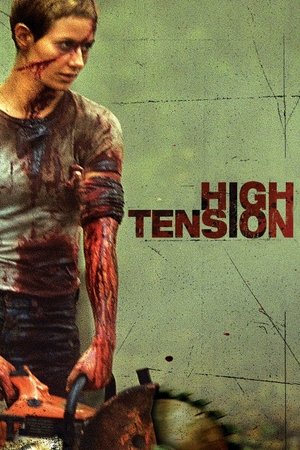
More than two decades after his most famous Italian zombie work, De Rossi became an important participant in Alexandre Aja’s High Tension. Aja specifically sought him out because he regarded De Rossi as a master of practical makeup effects. The production had limited resources, but De Rossi accepted the project after responding positively to the material.
The collaboration is historically significant because it shows his influence returning through a younger generation of European horror filmmakers. Aja had grown up in a culture in which Italian practical effects were already part of genre history. Hiring De Rossi therefore connected early twenty-first-century French horror directly with one of the technicians responsible for the physical extremity of late-1970s and early-1980s Italian horror.
Inventiveness rather than industrial scale
Aja later remembered De Rossi as exceptionally inventive and described him arriving repeatedly with practical ideas during production. This reflects the same quality that had allowed De Rossi to solve the zombie problem decades earlier. Larger budgets and newer technology had not eliminated his preference for finding the simplest convincing physical solution.
The continuity is important. De Rossi’s value did not depend on reproducing techniques from 1979 unchanged. It depended on the mindset behind those techniques: examine the actual body, camera and schedule, then design an effect specifically for those conditions.
The difference between visible horror effects and invisible makeup
Late in his career De Rossi continued emphasizing that ordinary makeup should disappear into the performer. He regarded visible foundation, poor blending or badly chosen materials as failures because they reveal the presence of the makeup department. This philosophy extended even to extremely complicated transformations.
For Seven Sisters, he helped differentiate multiple characters played by Noomi Rapace through makeup and hair rather than relying entirely on digital alteration. The challenge was the opposite of an exploding wound: viewers should register different identities without constantly noticing the technical apparatus producing them. The assignment demonstrates the continuity between his horror effects and his broader craft.
Materials as tools rather than doctrine
De Rossi developed strong preferences regarding makeup materials and could be openly critical of techniques he believed produced artificial surfaces. His opinions sometimes differed from later industry practice, particularly regarding materials that became standard after the peak of his career.
The larger principle is more useful than treating any single material preference as universal law. De Rossi believed the artist should choose tools according to how they photograph and move on a particular actor. Technology had value only when it produced convincing flesh, age, injury or character under the conditions of the shot.
Designing from anatomy rather than from spectacle
Whether creating an injury or changing an actor’s entire face, De Rossi began from an understanding of physical structure. Prosthetic thickness affects expression. A wound needs convincing depth and surrounding tissue. Aging requires changes in several areas of the face rather than the addition of isolated wrinkles.
This anatomical awareness prevented his effects from becoming purely decorative. The horror might be exaggerated, but the viewer still needs enough familiar bodily information to understand what has supposedly happened. A grotesque image becomes more disturbing when the underlying anatomy remains recognizable.
Collaboration and the rejection of individual mythology
De Rossi could be forceful about his own ideas, but he also rejected the idea that one technician alone determines whether a film succeeds. Practical effects depend on directors, actors, cinematographers, assistants and technicians working together. His best-known horror was produced inside teams whose individual contributions cannot responsibly be collapsed into one famous name.
This is particularly important when discussing Italian genre cinema, where incomplete credits and later publicity have sometimes reassigned work from less famous technicians to better-known figures. De Rossi’s own testimony occasionally corrected credits attributed to him and provides a useful reminder that historical accuracy matters more than expanding an already substantial legend.
Teaching through professional example
De Rossi influenced younger technicians not only through the finished images of his films but through the way he solved effects on set. Assistants could observe a professional willing to abandon an expected technique when production circumstances demanded another solution. That adaptability became especially important in low-budget filmmaking, where rigid adherence to an expensive process can prevent an effect from being completed at all.
His career also demonstrated that conventional makeup and special effects are not isolated professions. Knowledge of faces, color, materials and performance can develop into creature construction and violent prosthetics without losing the fundamental discipline of makeup.
Death and the preservation of De Rossi’s work
Giannetto De Rossi died in Rome on April 11, 2021. By then his career had already undergone substantial historical reassessment. Productions once circulated largely through exploitation markets had become subjects of restorations, specialist documentaries and technical interviews, while younger filmmakers openly acknowledged the influence of Italian practical effects.
His extensive interviews from later life are particularly valuable because De Rossi discussed both successful techniques and disputed credits with unusual directness. He could criticize his own directing, reject work incorrectly attributed to him and describe occasions when disagreement with a director or producer led him to leave a production. That testimony provides a more useful historical portrait than a filmography that simply attaches his name to every effects sequence with which later audiences associate him.
Giannetto De Rossi’s contribution to horror
De Rossi’s principal contribution to horror was the pursuit of physical credibility under conditions that often made conventional effects methodology impractical. He helped move Italian horror toward decomposing bodies, wounds and transformations that appeared to occupy the actor’s actual flesh rather than exist as clean theatrical decoration. His zombie work became influential because economic necessity and artistic judgment combined to create irregular, dirty and physically convincing corpses rather than standardized masks.
His wider career explains why those effects were so effective. De Rossi had learned conventional makeup, character transformation, large-scale production and direct fabrication before horror gave him the opportunity to push bodily illusion toward greater extremity. He remained fundamentally a craftsman interested in solving visual problems, whether the result was an almost invisible facial alteration or an image designed to shock an audience. That continuity places him among the most significant practical makeup and effects artists associated with European horror.
Selected Work
Notable Horror Collaborators
Notable collaborators and creative partners throughout Giannetto De Rossi's horror career.
 Fabrizio De Angelis
Makeup-Effects Artist / Producer Collaborator
De Angelis became one of the most consequential recurring figures in De Rossi’s horror career. Their shared work includes Zombie Flesh Eaters, The Beyond, Killer Crocodile and Killer Crocodile 2, and De Angelis later gave De Rossi the opportunity to move from creature-effects work into feature direction.
DS
Dardano Sacchetti
Makeup-Effects Artist / Screenwriter Collaborator
Sacchetti and De Rossi shared major horror productions including Zombie Flesh Eaters, The Beyond, Killer Crocodile and Killer Crocodile 2. Their recurring work connects De Rossi’s Fulci-era practical effects with the later creature productions in which he expanded into directing and screenwriting.
 Lucio Fulci
Makeup-Effects Artist / Director Collaborator
De Rossi’s direct horror collaboration with Fulci is concentrated principally in Zombie Flesh Eaters and The Beyond, but the two films are fundamental to his reputation. Their work established De Rossi’s distinctive approach to decomposing bodies and direct-on-performer effects and became a major reference point in Italian practical horror.
MT
Maurizio Trani
Makeup-Effects Collaborator
Trani worked directly alongside De Rossi on Zombie Flesh Eaters and The Beyond, the two central Fulci horror productions securely attributable to De Rossi. Although the collaboration falls below the usual three-title threshold, it represents an important recurring technical partnership during the period that established De Rossi internationally.
Giannetto De Rossi Horror Movies
Special FX / Practical FX (10 credits)
1989
1982
1981
1981
1980
1979
1977
1974
1965
Visual Effects (3 credits)
1981
1977
1974
Directing (1 credits)
1990
Writing (1 credits)
1990