


1971
Edward D. Wood Jr.
Horror Director · Biography · Horror Filmography · Family · Collaborators · Credits
Biography
Edward D. Wood Jr. and independent horror cinema
Edward D. Wood Jr. became one of the best-known figures of American low-budget cult cinema through a small group of independently produced films made during the 1950s. His reputation rests primarily on Glen or Glenda, Bride of the Monster, Plan 9 from Outer Space and Night of the Ghouls, productions created with extremely limited financing and assembled outside the major Hollywood studio system. During his lifetime these films brought him little critical recognition or financial stability. Decades later they became central examples in discussions of exploitation filmmaking, cult spectatorship and the possibilities available to filmmakers working at the economic margins of Hollywood.
Wood wrote, directed, produced, edited and occasionally acted in his own projects, often combining several functions because budgets left little room for specialized crews. He repeatedly worked with performers whose careers existed outside contemporary studio prestige, including Bela Lugosi, Tor Johnson, Paul Marco and Conrad Brooks. His films borrowed freely from horror, science fiction, crime pictures and exploitation cinema. Their visible production limitations became a major component of Wood’s later reputation, although concentrating exclusively on technical errors can obscure the circumstances under which he attempted to maintain an independent filmmaking career.
Poughkeepsie, the Marines and the move toward filmmaking
Edward Davis Wood Jr. was born in Poughkeepsie, New York, on October 10, 1924. He developed an interest in movies while young and worked at the Bardavon Theatre before military service. Wood joined the United States Marine Corps during the Second World War and served in the Pacific. His military record included participation in combat operations, including the Battle of Tarawa, before his return to civilian life.
After the war he pursued theatre and filmmaking and eventually moved to the Los Angeles area. The postwar film industry offered relatively few conventional opportunities to an inexperienced writer-director without studio connections or substantial financing. Wood therefore entered the independent production environment, where projects could be mounted through private investment and personal relationships. This mode of production remained characteristic of his most important films.
Cross-dressing and Wood’s personal connection with Glen or Glenda
Wood was a heterosexual cross-dresser and discussed this aspect of his life openly within his work. It became particularly important in Glen or Glenda, released in 1953. The film was developed during intense American press attention surrounding Christine Jorgensen, whose transition had become an international news story. Producer George Weiss initially hoped to capitalize on that publicity, while Wood developed material much more closely connected with his own experience of cross-dressing.
Wood plays Glen under the acting name Daniel Davis. Glen wants to tell his fiancée Barbara that he wears women’s clothing and particularly values angora. The film also contains a separate story involving Alan, who transitions and lives as Anne. Contemporary terminology used by the film is dated, and its treatment of gender reflects the medical and popular assumptions of the early 1950s. Its attempt to distinguish different experiences and present them sympathetically remains unusual for an American independent feature of the period. Turner Classic Movies has described the production as an early and problematic landmark in screen representations of transgender and cross-dressing lives.
Bela Lugosi and the beginning of Wood’s principal horror collaboration
Bela Lugosi appears in Glen or Glenda as a mysterious narrator or scientist whose statements are only loosely connected with the realistic portions of the film. Wood admired Lugosi’s earlier horror work and developed a friendship with the actor during a period when Lugosi’s career had declined considerably from the prominence he achieved through Dracula. Their association became central to Wood’s later reputation because it connected his independent productions directly with one of the foundational stars of studio-era American horror.
Lugosi’s participation also gave Wood a recognizable name that could help attract exhibitors and investors. The actor’s circumstances, however, were difficult. Substantial major-studio roles had disappeared and health problems affected his later years. Wood subsequently developed projects that gave Lugosi more conventional dramatic material than the abstract appearances in Glen or Glenda, most importantly the role of Dr. Eric Vornoff in Bride of the Monster.
Bride of the Monster and the problems of independent financing
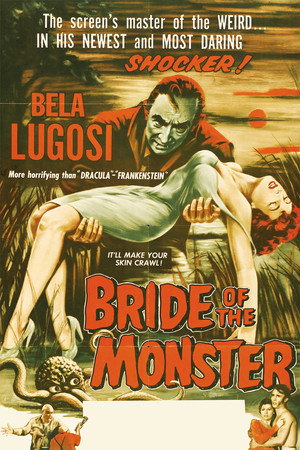
Bride of the Monster developed partly from material associated with Alex Gordon’s earlier screenplay The Atomic Monster. Wood began filming the project, initially known as Bride of the Atom, in 1954. Production stopped after only a few days when the available money was exhausted. Financing was eventually obtained from Donald McCoy, who required changes and assumed ownership of the film. Wood received a director’s salary but did not retain the property.
The production history provides a useful example of Wood’s working conditions. Completion depended on obtaining small amounts of private financing while shooting was already underway. Sets and props had to be acquired cheaply, and effects were built around whatever materials were available. The famous mechanical octopus associated with the climax became emblematic of these limitations because the prop could not be operated in the manner normally expected from a studio creature effect.
Dr. Eric Vornoff and Bela Lugosi’s final major role
Lugosi plays Dr. Eric Vornoff, a scientist conducting experiments intended to create physically powerful human beings. Tor Johnson appears as Lobo, his large mute assistant. The role gave Lugosi extended dialogue and a conventional character arc at a point when substantial film roles had become rare. Bride of the Monster became the last feature in which he completed a major speaking role.
Wood’s direction relies heavily on Lugosi’s ability to carry long speeches despite the modest resources surrounding him. The actor’s theatrical delivery sometimes contrasts sharply with the performances of less experienced cast members. This difference became one of the reasons the film attracted later cult attention, but it also documents the coexistence of an actor from Universal’s early sound-horror tradition with a form of independent filmmaking operating far outside that studio environment.
Tor Johnson and the emergence of Wood’s recurring ensemble
Swedish-born wrestler Tor Johnson became one of the performers most closely associated with Wood after appearing as Lobo in Bride of the Monster. His imposing physical appearance made him useful within horror and science-fiction productions even though his acting experience was limited. Wood brought him back for Plan 9 from Outer Space and Night of the Ghouls, establishing a recurring screen presence across the director’s principal horror films.
Paul Marco similarly became a regular through the comic police officer Kelton. Marco appears as Kelton in Bride of the Monster, Plan 9 from Outer Space and Night of the Ghouls. The repeated use of performers such as Johnson, Marco and Conrad Brooks gave Wood a small informal repertory company. This was partly an economic necessity, since collaborators willing to work under difficult low-budget conditions were particularly valuable to an independent producer.
Plan 9 from Outer Space and the combination of horror and science fiction
Wood’s best-known film was shot under the working title Grave Robbers from Outer Space and eventually released as Plan 9 from Outer Space. The narrative combines flying saucers with the resurrection of the dead, creating a hybrid of the alien-invasion cycle then popular in American science fiction and Gothic graveyard imagery associated with older horror. Tor Johnson plays Inspector Clay, Maila Nurmi appears in her Vampira persona and Criswell provides the opening narration.
The production was financed through investors connected with a Baptist organization. Turner Classic Movies documents that participants were required to undergo baptism as part of the financing arrangement. The unusual agreement is representative of the improvised methods through which Wood assembled production money. Principal interiors were filmed at Quality Studios, while location work and stock footage supplied material the budget could not produce directly.
Bela Lugosi’s footage in Plan 9 from Outer Space
Lugosi died in August 1956 before principal production of Plan 9 from Outer Space. Wood nevertheless possessed silent footage of the actor that had been shot for an unrealized project sometimes identified as The Vampire’s Tomb. The material shows Lugosi in a cape outside a house and in other brief situations. Wood incorporated these shots into the new film and developed the character of an elderly widower around them.
Additional scenes required another performer. Thomas R. Mason, a chiropractor and acquaintance of Wood, doubled for Lugosi while holding a cape across the lower part of his face. The visible differences between the two performers later became one of the film’s most frequently discussed continuity problems. The circumstances are more important historically as evidence of Wood’s determination to reuse available material rather than abandon footage featuring the most recognizable actor he had worked with.
The production style of Plan 9
Plan 9 from Outer Space displays many characteristics associated with extremely low-budget independent production: limited sets, visible stock footage, inexpensive miniature effects and scenes completed with little possibility for retakes. William C. Thompson photographed the film, continuing his recurring work with Wood. Editing attempts to connect material created at different times and under different production circumstances.
The film entered general release in 1959 after an earlier preview under its original title. It attracted limited mainstream attention at the time. Its later reputation developed gradually as television, repertory screenings and writing about unsuccessful cinema brought the film to new audiences. The claim that it is the worst film ever made is a piece of later critical folklore rather than an objective historical classification. Its continued circulation has made it far more culturally visible than many technically superior independent genre pictures of the same period.
Science fiction, atomic anxiety and Wood’s screenplay
The aliens in Plan 9 revive human corpses as part of an attempt to stop Earth from developing increasingly destructive weapons. The screenplay therefore incorporates contemporary atomic anxiety alongside its supernatural imagery. The subject was common throughout 1950s science fiction, although Wood approached it through unusually direct explanatory dialogue and a mixture of genre conventions.
This thematic background is sometimes overlooked because discussions of the film concentrate heavily on continuity errors and effects. The story belongs to a wider period of American popular culture concerned with nuclear technology, military secrecy and unidentified flying objects. Wood’s version operates at a much lower production level than the principal studio science-fiction films of the decade but draws from the same contemporary concerns.
Night of the Ghouls and the continuation of Wood’s horror world
Night of the Ghouls returns to elements from Bride of the Monster. Paul Marco again plays Kelton, and Tor Johnson returns as Lobo. The story concerns a fraudulent medium who operates from a supposedly haunted house and exploits clients through fake supernatural manifestations before genuine supernatural events emerge.
The film demonstrates that Wood regarded his earlier horror characters as reusable material rather than isolated appearances. The recurring performers and locations create a loose continuity across productions made with very limited resources. Distribution problems prevented the film from obtaining normal theatrical circulation when completed, contributing to its obscurity compared with Plan 9.
Wood’s use of stock footage and inexpensive production resources
Wood frequently incorporated pre-existing footage, borrowed locations and readily available props into his films. Stock material could provide military operations, explosions or other imagery impossible to stage with his budgets. Sets were often simple interiors dressed to suggest laboratories, police offices or domestic environments. These practices were common throughout low-budget filmmaking, although Wood’s productions sometimes make the joins unusually visible.
William C. Thompson’s photography gave several of the films a degree of visual continuity despite their fragmented production conditions. Thompson had worked professionally for decades before his association with Wood and became one of the director’s most important technical collaborators. His presence illustrates that Wood’s crews combined experienced film workers with amateurs and performers recruited through personal networks.
The Sinister Urge and crime exploitation
The Sinister Urge, released in 1960, moves from supernatural horror toward crime and exploitation while retaining Wood’s interest in marginal areas of the entertainment industry. The film concerns pornography, organized crime and murder and again uses several familiar performers. It became one of Wood’s last substantial directing projects before his career moved increasingly toward writing and adult material.
The shift reflects changes in the low-budget market. Independent producers increasingly found opportunities in sexploitation and adult publishing as traditional theatrical outlets for inexpensive horror and science fiction contracted. Wood adapted to these markets as a matter of employment rather than maintaining one stable identity as a horror director.
Writing, pulp publishing and the later career
Wood wrote extensively beyond the films he directed. During the 1960s and 1970s he produced paperback fiction, magazine material, screenplays and adult-oriented writing under his own name and various pseudonyms. Much of this work was produced quickly for commercial publishers operating at the lower end of the market. Its volume demonstrates that Wood’s professional identity was at least as strongly connected with writing as with the relatively small number of films that later made him famous.
His financial situation deteriorated during this period, and alcoholism became increasingly serious. Later years included involvement with pornographic films and publishing as mainstream directing opportunities disappeared. Wood died in Los Angeles on December 10, 1978 at the age of fifty-four. At the time, the critical reassessment that eventually made him a cult figure had barely begun.
The posthumous creation of the Ed Wood cult
Wood’s modern reputation developed largely after his death. Books and retrospective screenings began presenting Plan 9 from Outer Space and his other films as examples of exceptionally unsuccessful filmmaking. The label of worst director became attached to him so strongly that it often replaced serious discussion of the production environment in which the films were made.
The cult expanded because the films remained easily recognizable and quotable. Their handmade production qualities became part of their appeal to audiences interested in exploitation and outsider cinema. This reception differs substantially from contemporary responses during Wood’s lifetime, when most of the films were simply inexpensive products with limited circulation.
Tim Burton’s Ed Wood and historical reassessment
Tim Burton’s 1994 film Ed Wood, starring Johnny Depp as Wood and Martin Landau as Bela Lugosi, introduced the filmmaker to a much larger audience. Scott Alexander and Larry Karaszewski’s screenplay drew partly from Rudolph Grey’s oral-history biography Nightmare of Ecstasy. The film concentrates on Wood’s 1950s work and ends around the production of Plan 9, leaving his later decline largely outside the narrative.
Burton’s film is a dramatized biographical work rather than a documentary record, but its success changed the tone of discussion surrounding Wood. Landau received the Academy Award for Best Supporting Actor for his portrayal of Lugosi, and the film encouraged renewed availability of Wood’s original productions. BFI and other film institutions now discuss Wood in the context of cult and independent cinema rather than solely through the older worst-director label.
Edward D. Wood Jr. in horror history
Wood’s importance to horror comes from a position far removed from the classical studio directors who preceded him. His principal films document a form of American genre production in which financing could collapse during shooting and recognizable actors worked beside amateurs. The resulting films preserve conditions rarely visible in polished studio products.
His collaboration with Bela Lugosi also gives the work an unusual historical connection with an earlier generation of horror. Bride of the Monster provided Lugosi with his final substantial starring role, while Plan 9 turned fragments of the actor’s final footage into part of a new independent production. Wood’s later cult reputation transformed these circumstances into mythology, but the films remain useful documents of a filmmaker attempting to work continuously outside conventional Hollywood resources.
Selected Work
Notable Horror Collaborators
Notable collaborators and creative partners throughout Edward D. Wood Jr.'s horror career.
 Bela Lugosi
Director / Actor Collaborator
Wood cast Lugosi in Glen or Glenda and Bride of the Monster and later incorporated previously filmed material of the actor into Plan 9 from Outer Space. Their relationship connected Wood’s 1950s independent productions with one of the principal stars of early sound horror and supplied Lugosi with his final substantial leading role.
 Tor Johnson
Director / Actor Collaborator
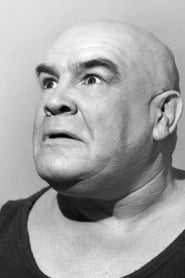
Johnson became one of Wood’s principal recurring horror performers through Bride of the Monster, Plan 9 from Outer Space and Night of the Ghouls. His physically imposing screen presence allowed Wood to reuse him in different monster and supernatural contexts across the director’s main horror cycle.
 Paul Marco
Director / Actor Collaborator
Marco played police officer Kelton in Bride of the Monster, Plan 9 from Outer Space and Night of the Ghouls. The repeated character provides one of the clearest continuities among Wood’s independently produced horror films and reflects the small repertory company the director assembled around his projects.
 Conrad Brooks
Director / Actor Collaborator
Brooks worked repeatedly with Wood during the 1950s and became part of the informal group of performers available for the director’s low-budget productions. His recurring appearances connect several stages of Wood’s independent filmmaking and later made him an important first-hand source on those productions.
WT
William C. Thompson
Director / Cinematographer Collaborator
Veteran cinematographer William C. Thompson photographed several of Wood’s major independent productions, including Plan 9 from Outer Space and other films from the director’s principal 1950s period. His experience provided technical continuity on projects made with very limited production resources.
 Criswell
Director / Performer Collaborator
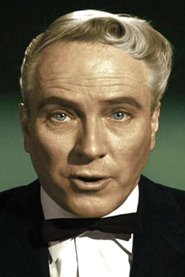
Criswell became closely associated with Wood’s screen world through his appearances and narration in productions including Plan 9 from Outer Space and Night of the Ghouls and through later work connected with Wood. His television persona fitted the director’s recurring interest in supernatural claims and exploitation presentation.
Edward D. Wood Jr. Horror Movies
Directing (5 credits)
1959
1959
1957
1955
Writing (10 credits)
2022
2015
1971
1970
1965
1959
1959
1958
1957
1955
Production (4 credits)
1959
1959
1957
1955
Editing (2 credits)
1959
1957
Acting (2 credits)
1997
1959
Other Crew (2 credits)
2023
2014