



2017
Herschell Gordon Lewis
Horror Director · Biography · Horror Filmography · Collaborators · Credits
Horror subgenres & themes
Biography
Herschell Gordon Lewis and the birth of modern gore cinema
Herschell Gordon Lewis (1926–2016) was an American film director, producer, screenwriter, cinematographer and exploitation filmmaker whose work fundamentally changed the representation of graphic violence in horror cinema. Widely known as the Godfather of Gore, he established the modern commercial splatter film with Blood Feast (1963), a low-budget production that made explicit bodily mutilation its principal attraction. At a time when most American horror films suggested violent injury through editing, reaction shots or brief glimpses, Lewis placed the damaged human body directly before the camera. His approach introduced a form of horror in which the spectacle of physical destruction became a central component of the viewing experience.
The historical significance of Lewis extends beyond the notoriety of Blood Feast. With Two Thousand Maniacs! (1964), Color Me Blood Red (1965), The Gruesome Twosome (1967), The Wizard of Gore (1970) and The Gore Gore Girls (1972), he developed a distinctive branch of independent American horror that combined practical gore effects, regional production, grotesque comedy and aggressive theatrical marketing. These films were frequently criticized for their rudimentary performances, uneven storytelling and technical limitations, but their commercial strategies and willingness to display violence influenced the development of subsequent exploitation horror, body horror and slasher cinema. Lewis demonstrated that graphic effects could create an identifiable market for films operating outside the major studio system.
His importance also lies in the relationship between filmmaking and advertising. Lewis approached cinema with the instincts of a professional marketer, considering the audience, theatrical presentation, promotional materials and commercial positioning as essential elements of production. He understood that a film made with limited resources needed a distinguishing attraction that competitors could not easily reproduce. Graphic violence became that attraction. The results established a recognizable identity in horror history, while his larger career provides an important example of how independent filmmakers developed specialized audiences through regional distribution and sensational promotional campaigns.
From advertising and exploitation filmmaking to Blood Feast
Lewis was born on June 15, 1926, in Pittsburgh, Pennsylvania. After his father died during his childhood, his family moved to Chicago, where he later attended Senn High School. He studied journalism at Northwestern University and initially pursued work in education and broadcasting. His professional development eventually brought him into television production, commercial filmmaking and advertising. These activities gave him practical experience with cameras, editing, production management and the economics of persuasive visual communication. Unlike filmmakers who entered horror through theatre or established studio apprenticeships, Lewis developed his directing methods within businesses organized around selling products and reaching specific audiences.
During the 1950s he became involved in commercial production in Chicago and gradually moved toward independent feature filmmaking. His early theatrical projects included Living Venus and a succession of inexpensive exploitation pictures designed for markets underserved by mainstream distributors. In collaboration with producer and distributor David F. Friedman, Lewis worked extensively in the nudie-cutie cycle, producing films that combined comedy, suggestive situations and carefully controlled nudity. Their productions relied on economical filming methods, available locations and direct appeals to audience curiosity. The partnership proved essential to Lewis’s subsequent horror work because Friedman understood the distribution networks and promotional practices through which unconventional films could reach paying audiences.
By the early 1960s, Lewis recognized that the exploitation market was becoming increasingly competitive. The commercial opportunities offered by nudity were no longer as distinctive as they had been, and other independent producers could imitate the formula with limited difficulty. He began looking for a different subject that could be promoted as something audiences had never encountered in ordinary commercial cinema. Graphic bodily violence offered that possibility. Although earlier horror films had depicted blood, torture and physical injury, few American features had organized their primary attraction around sustained, explicitly photographed mutilation. Lewis concluded that the absence of such material represented a potential commercial opening.
The resulting production was Blood Feast, filmed in Florida in February 1963 on a budget of approximately $24,000. Lewis directed and photographed the film, working with Friedman and a small crew that included performers and technicians accustomed to the practical demands of independent exploitation filmmaking. The limited shooting schedule required simple staging and rapid execution, while the graphic effects depended on inexpensive materials, artificial blood and animal organs. These limitations became closely associated with the film’s visual identity. Its shocking material was displayed in comparatively static shots, allowing the audience to observe effects that more conventional horror productions would have concealed through montage or implication.
Blood Feast (1963): establishing the splatter film
Blood Feast follows Fuad Ramses, an Egyptian caterer played by Mal Arnold, who murders young women and collects body parts for a ritual intended to revive the goddess Ishtar. The film combines a conventional police investigation with scenes of ritualized murder whose graphic content forms its principal attraction. William Kerwin plays Detective Pete Thornton, while Connie Mason appears as Suzette Fremont, whose planned celebration becomes connected to Ramses’s murderous activities. The narrative is direct and its characterization limited, allowing the killings to function as major dramatic events rather than brief consequences of a more elaborate plot.
Lewis’s most consequential innovation was the way these scenes were photographed. The removal of a victim’s tongue, the severing of a leg and the display of mutilated bodies were presented with an explicitness unusual in American theatrical horror at the time. Earlier cinema had certainly explored gruesome subjects, and Blood Feast did not invent screen violence. Its achievement was to transform visible dismemberment into the organizing commercial principle of an entire horror feature. The audience was invited to anticipate each new effect, while the film’s publicity emphasized the extremity of the spectacle. This combination became foundational to the development of modern splatter.
Color photography was crucial. Lewis wanted the red of the artificial blood to be plainly visible, giving the mutilation effects a sensational immediacy that black-and-white photography might have reduced. The bright colors and straightforward camera placement distinguished the film from the shadow-heavy Gothic style associated with many earlier horror productions. Its violence was presented in ordinary rooms and recognizable contemporary surroundings, interrupting the familiar world with images of physical destruction. The resulting aesthetic was frequently crude, but its directness became part of the experience that audiences remembered.
The contributions of Lewis’s collaborators were substantial. Friedman helped organize production and distribution, while William Kerwin performed a variety of practical duties in addition to acting. Allison Louise Downe participated in the production and received screenplay credit, although later accounts disputed the precise extent of individual writing responsibilities. The film was made through a flexible production structure in which cast and crew could assume several tasks. This working method enabled Lewis to create effects-heavy scenes without the specialized departments and substantial budgets available to established studios.
Blood Feast became commercially successful through exploitation distribution, particularly in drive-in theatres and independent venues willing to advertise material considered unsuitable for conventional mainstream programming. Its advertising encouraged curiosity, revulsion and controversy. Lewis understood that negative reactions could strengthen the appeal of a film marketed as unusually extreme. The publicity strategy therefore reinforced the central filmmaking decision: audiences were offered images that other producers seemed unwilling to show. This relationship between transgressive content and promotional identity became an important principle for later independent horror distributors.
Contemporary critical responses were often hostile. Reviewers attacked the acting, writing, editing and technical execution, and these objections remained part of the film’s reputation. Its historical importance nevertheless proved durable because it demonstrated a new commercial possibility within horror. Blood Feast made graphic mutilation sufficiently prominent to sustain a recognizable subgenre. Subsequent filmmakers would develop more sophisticated effects and narrative structures, but Lewis had already shown how an inexpensive film could distinguish itself through the explicit display of bodily damage.
Two Thousand Maniacs!, Color Me Blood Red and the Blood Trilogy
Following the success of Blood Feast, Lewis and Friedman continued their exploration of graphic horror with Two Thousand Maniacs! (1964). The film follows Northern travellers who are invited to participate in a centennial celebration in Pleasant Valley, a Southern town whose inhabitants are apparently welcoming and hospitable. The visitors gradually discover that the celebration conceals an elaborate campaign of revenge. The townspeople, revealed to be supernatural revenants, seek retaliation for the destruction of their community during the American Civil War. The premise allowed Lewis to combine gore with regional caricature, macabre comedy and a more sustained narrative structure than his previous horror production.
The film’s violence is organized around public festivities and communal participation. Games and ceremonies become mechanisms for killing, with the victims subjected to increasingly elaborate punishments. Lewis uses the contrast between cheerful celebration and calculated cruelty to generate suspense. The townspeople behave as if the murders are ordinary local entertainment, while their guests struggle to understand the danger. The resulting structure anticipates later rural horror narratives in which isolated communities conceal collective violence behind superficially welcoming traditions.
Two Thousand Maniacs! also reflects the historical and political imagery of the American South. The story uses Confederate memory, regional resentment and the mythology of Civil War revenge as components of its supernatural premise. Its representation is exaggerated and frequently grotesque, drawing on established stereotypes while turning Southern hospitality into a mechanism of entrapment. This combination of regional identity and collective hostility became a recognizable element of American exploitation horror. Lewis approached it through spectacle and black comedy rather than sustained historical commentary.
William Kerwin and Connie Mason returned in leading roles, while Jerome Eden and other recurring performers contributed to the ensemble. Lewis wrote and performed the film’s principal musical theme, incorporating an aggressively regional musical identity into the production. He later identified Two Thousand Maniacs! as his favorite among his early gore films, particularly because he considered its story and escalating suspense more effective than the relatively simple structure of Blood Feast. The film remains one of his most influential productions and a significant precursor to later American horror centered on murderous communities and unsuspecting travellers.
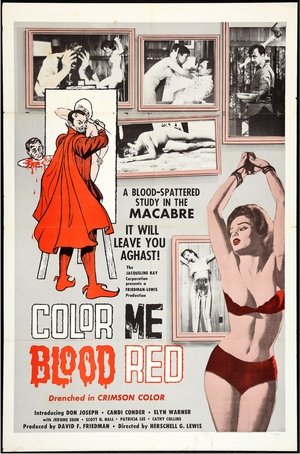
Color Me Blood Red (1965) completed the group of films commonly described as the Blood Trilogy. The story concerns Adam Sorg, a frustrated painter who discovers that human blood provides the vivid red pigment he has been unable to achieve with conventional materials. His attempts to satisfy his artistic ambitions lead to increasingly violent crimes. The premise placed mutilation within an art-world setting, making physical destruction the direct means by which the protagonist creates his work. As in Blood Feast, the film’s central attraction was the spectacle of exposed bodily injury, but its narrative connected that violence with artistic obsession and the pursuit of recognition.
The production marked the breakdown of Lewis’s professional partnership with Friedman. Financial disputes involving their business associates damaged the relationship and complicated the completion of the film. Although Color Me Blood Red continued the commercial formula established by its predecessors, its production history demonstrated the instability of independent filmmaking arrangements dependent on informal partnerships, rapidly moving funds and uncertain distribution returns. Lewis subsequently continued his career without Friedman as his principal producing partner, expanding into other exploitation formats while retaining the gore films as an important part of his commercial identity.
The Blood Trilogy established the essential characteristics of Lewis’s early horror: graphic color effects, simple narrative premises, amateur or semi-professional casts, inexpensive locations and a promotional emphasis on previously prohibited sights. Its films also demonstrated the flexibility of the formula. Blood Feast used ritual murder, Two Thousand Maniacs! employed supernatural revenge and Color Me Blood Red explored the violence of an obsessive killer. The common element was the centrality of bodily destruction, presented as an attraction in its own right. This approach became a foundational reference point for the later evolution of splatter cinema.
Expanding horror: vampires, grotesque murder and supernatural illusion
After the Blood Trilogy, Lewis continued directing films across several exploitation categories while experimenting with different forms of horror. His involvement with Monster a-Go Go! (1965) was unusual because the production had originally been undertaken by Bill Rebane and remained unfinished before Lewis supplied material to complete it. The resulting science-fiction horror film became notorious for its disjointed narrative and unconventional ending. Its place in Lewis’s career is best understood as a commercial completion project rather than a fully developed expression of his established gore formula.
A Taste of Blood (1967) represented a different ambition. Rather than concentrating on short intervals between graphic killings, Lewis developed an extended vampire narrative concerning a businessman transformed after drinking a mysterious alcoholic preparation. The story combines contemporary American settings with Dracula-related mythology and a revenge plot. At approximately two hours, the film is considerably longer than his early splatter productions and relies more heavily on dialogue, exposition and Gothic conventions. Lewis sought to work within a recognizable supernatural tradition while retaining elements of his independent production style.
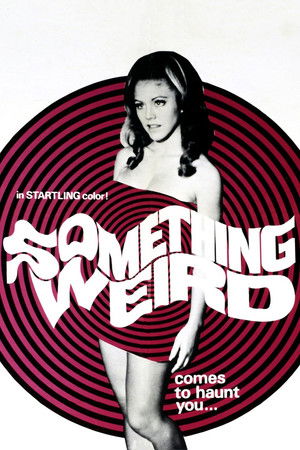
Something Weird (1967) explored another branch of fantastic cinema through psychic abilities, witchcraft, disfigurement and altered states of perception. Its narrative combines supernatural intervention with contemporary interests in extrasensory perception and psychedelic experience. Although the film lacks the tightly defined gore premise of Blood Feast, its mixture of paranormal ideas, crime and unconventional imagery demonstrates Lewis’s willingness to explore horror outside the specific model that had made him commercially successful. The production subsequently supplied the name for Something Weird Video, the company that became especially important in preserving and distributing American exploitation cinema.
Lewis returned to more explicit mutilation with The Gruesome Twosome (1967). The film concerns a woman who operates a wig shop and her murderous son, whose victims provide the human hair used in the business. The grotesque premise combines serial murder with domestic comedy and an investigation into the disappearance of young women. Allison Louise Downe wrote the screenplay and also worked in the production, continuing a professional relationship that extended through several of Lewis’s later horror films. The scalp-removal effects developed the director’s interest in making mutilation serve an easily communicated narrative premise.
The Gruesome Twosome demonstrates how Lewis used ordinary commercial activities as frameworks for grotesque violence. The apparently harmless wig business conceals murder, allowing the film to move between familiar domestic settings and scenes of physical destruction. The killings are constructed around a specific bodily consequence rather than around a supernatural mythology. This approach foreshadows elements of later serial-killer horror, particularly the use of an eccentric family environment and the treatment of victims as materials for a murderer’s private activity.
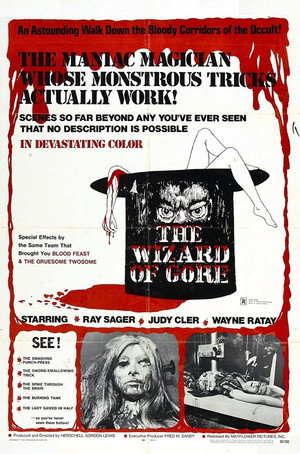
The Wizard of Gore (1970) became one of Lewis’s most conceptually distinctive horror productions. Ray Sager plays Montag the Magnificent, a stage magician who performs apparently lethal illusions on female volunteers. During the performances, the women appear to be mutilated before the audience, yet they emerge unharmed when the tricks conclude. They subsequently die from injuries corresponding to those displayed during the stage acts. The narrative introduces uncertainty about hypnosis, perception and the relationship between theatrical spectacle and physical reality.
The film’s importance rests partly on its transformation of the theatrical audience into participants in the horror. Montag presents acts of extraordinary bodily destruction while insisting that appearances can be manipulated. Lewis repeatedly stages elaborate mutilations before spectators who treat the events as entertainment. The distinction between witnessing an illusion and witnessing genuine injury becomes increasingly unstable. This structure extends his established interest in graphic effects toward a more self-conscious examination of spectatorship, making The Wizard of Gore an unusually relevant production within discussions of exploitation cinema and its audience.
Lewis’s work on the film depended on familiar collaborators, including Allison Louise Downe, who contributed to production and special effects, and Ray Sager, whose performance gave Montag a theatrical identity built around exaggerated speech, commanding gestures and elaborate demonstrations of power. The effects remained inexpensive and visibly artificial, but their presentation was integrated with the story’s central uncertainty. The Wizard of Gore consequently became one of Lewis’s best-known cult films and was later remade in 2007 by director Jeremy Kasten.
With This Stuff’ll Kill Ya! (1971), Lewis examined religious exploitation and deadly manipulation within a community influenced by a charismatic leader. The film continued his interest in authority figures who transform groups into instruments of violence, although its subject matter differs from the ritual murders of Blood Feast and the supernatural revenge of Two Thousand Maniacs!. It also illustrates the increasingly fluid boundaries between horror, crime and other exploitation genres during the early 1970s.
The Gore Gore Girls (1972) represented the culmination of Lewis’s original period of splatter filmmaking. Structured around the murders of women associated with a strip club and the investigation conducted by an eccentric detective, it combines a conventional mystery framework with elaborate and aggressively grotesque killings. The production pushed the director’s emphasis on explicit violence toward a particularly extreme form of exploitation, incorporating nudity and black comedy into scenes designed primarily for shock. The film’s treatment of female victims also makes evident the gendered sensationalism that characterized much of the era’s exploitation market.
The Gore Gore Girls was Lewis’s final feature before his long withdrawal from filmmaking. Its violent imagery reflected a changing marketplace in which independent producers faced increasingly direct competition from larger companies and other exploitation specialists. The film brought his original gore cycle to an end after a period during which his productions had repeatedly tested the limits of what commercial horror audiences could be shown. Although his films remained technically uneven, the visual boundaries they challenged had changed considerably between Blood Feast and The Gore Gore Girls.
Rediscovery, return to filmmaking and influence on extreme horror
Lewis subsequently devoted most of his professional activity to advertising, direct marketing and copywriting. His ability to construct attention-grabbing promotional messages had been central to his filmmaking, and the same skills supported a substantial career outside cinema. He wrote instructional books on advertising and became a recognized authority within the direct-response marketing field. His departure from filmmaking also reflected changes in the exploitation industry, where the commercial advantages of graphic violence were diminishing as other producers adopted increasingly explicit material.
During the following decades, Lewis’s horror films attracted renewed attention through repertory screenings, specialist publications and home-video distribution. The emergence of dedicated collectors and exploitation-film historians encouraged reassessment of productions previously dismissed as disposable drive-in entertainment. Something Weird Video became particularly important to this process by distributing and promoting material from the American exploitation tradition. Lewis’s films were increasingly examined within the histories of independent production, censorship, sensational advertising and the changing representation of screen violence.
Lewis returned to directing with Blood Feast 2: All U Can Eat (2002), a sequel that deliberately revisited the mythology and grotesque humor of his 1963 breakthrough. The production was made for an audience already familiar with his historical reputation and sought to reproduce the combination of exaggerated gore, crude comedy and sensational premises associated with his early work. Its existence demonstrated the durability of Blood Feast as a recognizable horror property nearly four decades after its original release.
He continued his late filmmaking activity with The Uh-Oh Show (2009), which placed graphic violence within the framework of a television game show. The premise extended an idea present throughout his career: the transformation of suffering into entertainment and the commercial appeal of witnessing events that violate ordinary social expectations. His involvement with Herschell Gordon Lewis’ BloodMania, released in 2017 after his death, further connected his name with contemporary independent splatter filmmaking.
The documentary Herschell Gordon Lewis: The Godfather of Gore (2010), directed by Frank Henenlotter and Jimmy Maslon, contributed to the historical reassessment of his work by examining the films, their production circumstances and their commercial identity. Later restorations and home-video editions, including extensive collections released by Arrow Video, made his filmography more accessible for detailed study. These preservation efforts helped establish a clearer understanding of the collaborative labor and production conditions behind images that had previously circulated mainly through inexpensive prints and heavily worn video editions.
Lewis’s influence on horror developed through several related channels. His willingness to display mutilation directly helped establish a model later expanded by practical-effects artists and filmmakers working in splatter, body horror and extreme cinema. The emphasis on graphic set pieces became particularly important to parts of the slasher cycle, while his combination of grotesque imagery and deliberate absurdity found an audience among directors interested in the relationship between horror and bad taste. His work also demonstrated how independent producers could build an identifiable commercial identity around material that mainstream studios regarded as unsuitable or excessively specialized.
His films nevertheless require historical assessment beyond the familiar Godfather of Gore designation. Their visual construction was often basic, their treatment of women frequently exploitative and their narratives sometimes secondary to effects sequences. These limitations are significant to understanding the films rather than incidental defects to be excused by their cult reputation. Lewis’s achievement was industrial and aesthetic: he identified the explicit representation of bodily destruction as a marketable feature, developed production methods capable of delivering it economically and helped establish a new direction for commercial horror.
Herschell Gordon Lewis died on September 26, 2016, in Fort Lauderdale, Florida, at the age of ninety. His legacy remains inseparable from the transformation of graphic screen violence during the 1960s and early 1970s. From the ritual murders of Blood Feast to the communal brutality of Two Thousand Maniacs!, the theatrical mutilations of The Wizard of Gore and the extreme killings of The Gore Gore Girls, his films established lasting precedents for displaying the destruction of the human body as a central horror spectacle. Their importance lies in the development of a form of cinema that could operate outside conventional studio standards while influencing the techniques, marketing and audience expectations of later generations of horror filmmakers.
Selected Work
Notable Horror Collaborators
Notable collaborators and creative partners throughout Herschell Gordon Lewis's horror career.
DF
David F. Friedman
Director / Producer Collaborator
David F. Friedman was Lewis’s principal producing and distribution partner during the creation of modern splatter cinema. Their shared horror productions include Blood Feast (1963), Two Thousand Maniacs! (1964) and Color Me Blood Red (1965). Friedman’s experience in exploitation marketing and independent theatrical distribution was essential to the commercial development of the early gore cycle.
 Allison Louise Downe
Director / Screenwriter and Special Effects Collaborator
Allison Louise Downe worked extensively with Lewis as a screenwriter, assistant director and practical-effects contributor. Their horror collaborations include Blood Feast, A Taste of Blood, Something Weird, The Gruesome Twosome, The Wizard of Gore and The Gore Gore Girls. Her work encompassed screenplay development, production coordination and the creation of graphic makeup and gore effects.
 William Kerwin
Director / Actor and Production Collaborator
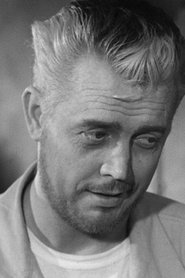
William Kerwin became one of Lewis’s most important recurring performers and production associates. He played Detective Pete Thornton in Blood Feast (1963), Tom White in Two Thousand Maniacs! (1964) and Dr. Hank Tyson in A Taste of Blood (1967). He also worked in production capacities, including production management on The Gruesome Twosome, and contributed to the practical demands of Lewis’s low-budget filmmaking.
JE
Jerome Eden
Director / Actor Collaborator
Jerome Eden appeared across the three original films of Lewis’s Blood Trilogy. His roles included the uncredited high priest in Blood Feast (1963), John Miller in Two Thousand Maniacs! (1964) and Rolf in Color Me Blood Red (1965). He also worked as unit production manager on Two Thousand Maniacs!, making him part of both the performing and production teams behind the foundational gore cycle.
 Ray Sager
Director / Actor and Production Collaborator
Ray Sager worked with Lewis on The Gruesome Twosome (1967), The Wizard of Gore (1970) and The Gore Gore Girls (1972). His defining performance was Montag the Magnificent in The Wizard of Gore, where his theatrical portrayal of the murderous illusionist became central to one of Lewis’s most distinctive horror films. He also contributed to editing and second-unit production during their collaborations.
 Connie Mason
Director / Actress Collaborator
Connie Mason played Suzette Fremont in Blood Feast (1963) and Terry Adams in Two Thousand Maniacs! (1964), appearing in the two films that established Lewis’s reputation as a pioneer of modern gore cinema. Her performances connected the early splatter cycle with the independent exploitation acting community and placed her among the most recognizable leading performers of Lewis’s formative horror productions.
Allison Louise Downe
Director / Screenwriter and Special Effects Collaborator
Allison Louise Downe worked extensively with Lewis as a screenwriter, assistant director and practical-effects contributor. Their horror collaborations include Blood Feast, A Taste of Blood, Something Weird, The Gruesome Twosome, The Wizard of Gore and The Gore Gore Girls. Her work encompassed screenplay development, production coordination and the creation of graphic makeup and gore effects.
William Kerwin
Director / Actor and Production Collaborator
William Kerwin became one of Lewis’s most important recurring performers and production associates. He played Detective Pete Thornton in Blood Feast (1963), Tom White in Two Thousand Maniacs! (1964) and Dr. Hank Tyson in A Taste of Blood (1967). He also worked in production capacities, including production management on The Gruesome Twosome, and contributed to the practical demands of Lewis’s low-budget filmmaking.
JE
Jerome Eden
Director / Actor Collaborator
Jerome Eden appeared across the three original films of Lewis’s Blood Trilogy. His roles included the uncredited high priest in Blood Feast (1963), John Miller in Two Thousand Maniacs! (1964) and Rolf in Color Me Blood Red (1965). He also worked as unit production manager on Two Thousand Maniacs!, making him part of both the performing and production teams behind the foundational gore cycle.
Ray Sager
Director / Actor and Production Collaborator
Ray Sager worked with Lewis on The Gruesome Twosome (1967), The Wizard of Gore (1970) and The Gore Gore Girls (1972). His defining performance was Montag the Magnificent in The Wizard of Gore, where his theatrical portrayal of the murderous illusionist became central to one of Lewis’s most distinctive horror films. He also contributed to editing and second-unit production during their collaborations.
Connie Mason
Director / Actress Collaborator
Connie Mason played Suzette Fremont in Blood Feast (1963) and Terry Adams in Two Thousand Maniacs! (1964), appearing in the two films that established Lewis’s reputation as a pioneer of modern gore cinema. Her performances connected the early splatter cycle with the independent exploitation acting community and placed her among the most recognizable leading performers of Lewis’s formative horror productions.
Herschell Gordon Lewis Horror Movies
Directing (12 credits)
2009
2002
1972
1970
1967
1967
1967
1965
1965
1964
1963
Acting (18 credits)
2021
2017
2016
2015
2011
2010
2010
2009
2009
2009
2009
2007
2005
2004
1967
1967
1967
1963
Writing (6 credits)
2017
2009
1968
1965
1964
1963
Cinematography (4 credits)
1968
1965
1964
1963
Special FX / Practical FX (3 credits)
1972
1970
1963
Production (7 credits)
2010
1972
1970
1967
1967
1965
1963
Music & Sound (2 credits)
1972
1963
Other Crew (3 credits)
2018
1967
1965
Production Design / Art Department (1 credits)
1965