


2023
Takashi Miike
Horror Director · Biography · Horror Filmography · Collaborators · Credits
Horror subgenres & themes
Most represented across this person's horror filmography:
EXTREME
• SPLATTER
• NECROPHILIA
Biography
Takashi Miike: Japanese Horror, Extreme Cinema and Genre Mutation
Takashi Miike occupies an unusual position in modern horror cinema. He has never been exclusively a horror director, and much of his enormous filmography belongs to crime, action, comedy, period drama, fantasy and other genres. Yet several of his most internationally influential films are rooted in horror, and his approach to violence, bodily transformation, psychological instability and tonal disruption has made him one of the defining Japanese genre filmmakers to emerge during the 1990s. From Audition and Ichi the Killer to Gozu, One Missed Call, Imprint, Over Your Dead Body and Lumberjack the Monster, Miike has repeatedly approached horror as a form that can absorb other genres rather than remain confined by them.
His horror films are consequently difficult to reduce to a single style. Some build tension through restraint and delayed revelation, while others combine grotesque violence with absurd comedy, crime narratives, supernatural folklore or extreme physical transformation. What connects them is Miike's willingness to destabilize expectations. A domestic drama can become a nightmare, a yakuza story can turn into supernatural body horror, and a familiar ghost-film structure can be pushed toward parody or social grotesque. This unpredictability has been central to his reputation among horror audiences and also explains why several films not conventionally classified as pure horror remain important to the development of his genre identity.
From V-Cinema to Horror Filmmaking
Miike entered directing during the expansion of Japan's V-Cinema market, where relatively fast production schedules and direct-to-video distribution provided opportunities to work across crime, action and exploitation material. During the 1990s he became extraordinarily prolific, developing an ability to move between budgets and genres without establishing a fixed commercial identity. Films involving gangsters, social outsiders and extreme violence preceded his international horror breakthrough and gave him a working environment in which abrupt tonal shifts and unconventional imagery could be developed without the expectations attached to prestige filmmaking.
This background matters to his horror work because Miike did not enter the genre with a predetermined horror style. He brought with him the rhythms of crime cinema, black comedy, melodrama and low-budget genre production. As a result, violence in his films can be frightening, ridiculous, emotionally painful and deliberately excessive within the same narrative. Horror becomes one component in a broader cinema of instability. That principle would become crucial once Audition brought him to a much larger international audience.
Audition and Takashi Miike's International Horror Breakthrough
Audition became Miike's decisive horror film and one of the most internationally recognized Japanese horror films of its period. Adapted from Ryu Murakami's novel, the story begins with widower Shigeharu Aoyama agreeing to a deceptive plan in which women are interviewed under the pretense of auditioning for a film so that he can identify a potential new wife. He becomes fascinated by the reserved Asami Yamazaki, played by Eihi Shiina. Miike deliberately allows much of the early film to resemble a restrained relationship drama, postponing overt horror until the assumptions established by both Aoyama and the viewer begin to collapse.
The structure is fundamental to the film's effect. Instead of identifying its threat immediately, Audition makes normality itself uncertain. The apparently gentle courtship is gradually contaminated by unexplained absences, incomplete stories and disturbing images before the narrative enters a much more unstable psychological space. By the time the film reaches its notorious scenes of torture, the violence has been preceded by a long process of unease. Miike has discussed this deliberate delay, explaining that the audience is encouraged to question why the film does not initially behave like the horror film it expected to see.
The resulting reversal helped distinguish Audition from more immediately supernatural examples of late 1990s Japanese horror. Its fear emerges through relationships, deception, trauma and the vulnerability of the body. Interpretations of Asami and Aoyama have varied, particularly around gender and power, but the film refuses the simplicity of a conventional monster narrative. Asami is terrifying without being presented as an abstract embodiment of evil, while Aoyama's own method of seeking a partner establishes an imbalance long before physical violence begins.
The film caused strong reactions during its international festival circulation and became one of Miike's first works to receive wide attention outside Japan. It subsequently became inseparable from discussions of J-horror even though its methods differ considerably from the technological ghosts and curses associated with several other films in that movement. For Miike, its importance was larger still: the international success of Audition established an expectation that his name might signify danger, extremity and unpredictability, an association that would follow him throughout his career.
Ichi the Killer, Visitor Q and the Limits of Horror
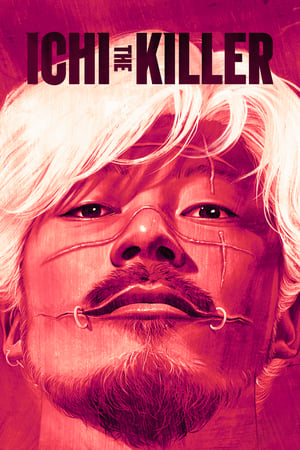
Ichi the Killer in 2001 pushed Miike's international reputation toward a different form of extremity. Adapted from Hideo Yamamoto's manga and scripted by Sakichi Sato, the film is fundamentally connected to yakuza and crime cinema, but its imagery of torture, mutilation, sadomasochism and psychological conditioning repeatedly crosses into splatter and body-horror territory. The distinction is important: treating Ichi the Killer simply as a conventional horror film reduces the strange mixture that gives it its identity. Miike turns criminal violence into something grotesquely theatrical, combining cruelty with exaggerated performance, black comedy and deliberately uncomfortable shifts in sympathy.
The film's notoriety became part of the broader phenomenon through which Miike was marketed internationally as an extreme filmmaker. Yet the violence is not organized around a stable heroic perspective. Kakihara's fascination with pain and Ichi's manipulated brutality create a world in which victim and aggressor repeatedly exchange positions. The film exaggerates physical damage until violence becomes simultaneously repulsive and absurd. This unstable reaction, in which the audience may recoil and laugh within the same sequence, became one of the clearest characteristics associated with Miike's extreme cinema.
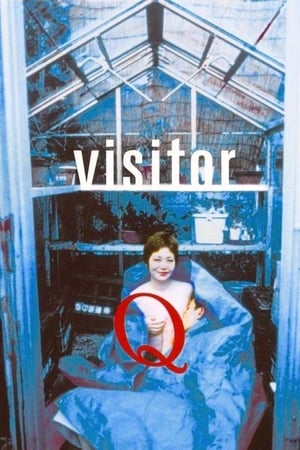
Visitor Q, also released in 2001, operates at another boundary between horror, family drama, transgressive comedy and social grotesque. Its catalogue of abuse, sexual dysfunction and bodily fluids is designed less around conventional suspense than around systematic violation of acceptable family behavior. Again, the film is important to Miike's horror identity precisely because it demonstrates how readily he moves outside genre definitions. Horror can emerge from a supernatural presence, but it can also emerge from the family unit, social performance and the collapse of supposedly normal relationships.
The Happiness of the Katakuris and Horror as Comedy
Miike's The Happiness of the Katakuris offered a radically different use of horror imagery. Derived from the premise of Kim Jee-woon's Korean film The Quiet Family, Miike transforms the story into a mixture of black comedy, musical, family melodrama, grotesque animation and zombie film. The Katakuri family attempts to operate a rural guesthouse, only to discover that their guests have an alarming tendency to die. Their efforts to conceal the bodies turn an already unsuccessful family enterprise into an increasingly absurd confrontation with death.
The film demonstrates that Miike's attraction to horror has never depended solely on severity. Corpses, burial and resurrection coexist with musical numbers and intentionally artificial effects. Clay animation interrupts live action, emotional scenes give way to slapstick, and death becomes a problem that the family repeatedly attempts to incorporate into ordinary life. Rather than parodying horror from a safe distance, Miike treats its imagery as one more element in a collision of incompatible genres. The result is among the clearest examples of his refusal to maintain a consistent tone simply because genre convention expects one.
Gozu and the Transformation of the Yakuza Film
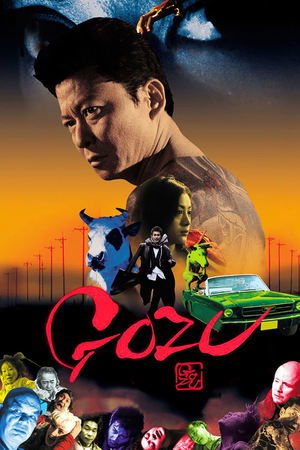
Gozu in 2003 represents one of Miike's most complete fusions of crime and horror. Written by Sakichi Sato, who had also scripted Ichi the Killer, the film begins within recognizable yakuza territory. Minami is ordered to dispose of Ozaki, an increasingly unstable senior gangster, but the assignment collapses when Ozaki's body disappears. What follows gradually abandons the logic of the gangster narrative and enters a world of supernatural suggestion, sexual anxiety, bodily impossibility, folklore and dreamlike repetition.
Its title itself identifies the project as a form of yakuza horror, and the film treats the underworld not as a stable criminal environment but as the entrance to something irrational. A cow-headed figure, strange bodily transformations, unexplained behavior and an increasingly unstable distinction between male and female bodies make Gozu one of Miike's strangest genre films. The horror is frequently comic, but the comedy never restores normality. Each absurd event instead makes it less certain that normal rules still exist.
Originally conceived on the scale of V-Cinema production, Gozu ultimately reached the Directors' Fortnight at Cannes. That trajectory is particularly appropriate for Miike. Material associated with low-budget genre cinema could pass into major international festival culture without being cleaned of its perversity or transformed into respectable art-house horror. The film remains an important example of the way his horror work can move between exploitation traditions and festival cinema without fully belonging to either.
One Missed Call and Miike Inside Mainstream J-Horror
One Missed Call presented Miike with a more recognizable J-horror framework. The central device is a mobile-phone message received from the future, containing the sounds of the recipient's own death and identifying the time at which it will occur. The idea links supernatural fatalism to a technology that had become part of everyday social communication, placing the film alongside the broader Japanese horror fascination with haunted or contaminated media.
Miike approaches the material more conventionally than Audition, Ichi the Killer or Gozu, but the film remains significant precisely because it shows his ability to operate inside a commercially legible supernatural-horror structure. The curse develops through repetition, investigation and anticipated deaths, while the ordinary act of receiving a phone call becomes a mechanism of dread. Its success generated sequels and eventually an American remake, making it one of the most visible examples of Miike working directly within the international J-horror cycle.
Placed beside Gozu, released in the same broad period, One Missed Call demonstrates the range of Miike's relationship with horror. One film destabilizes genre almost completely; the other accepts many of the expectations of contemporary supernatural horror and works within them. That ability to change method rather than impose a single authorial formula is essential to understanding his horror filmography.
Box, Imprint and Anthology Horror
Miike contributed the segment Box to the 2004 East Asian horror anthology Three... Extremes, alongside films by Fruit Chan and Park Chan-wook. Rather than competing through graphic violence, Box adopts a dreamlike and visually controlled atmosphere built around memory, guilt, confinement and a writer haunted by the past. Its icy landscapes and recurring theatrical imagery demonstrate a quieter side of Miike's horror filmmaking, one capable of producing unease through composition and repetition rather than continuous physical assault.
His contribution to Masters of Horror moved in the opposite direction. Imprint, made for the anthology television series in 2006, developed into one of the most controversial projects associated with the programme. The story combines a period setting with prostitution, memory, physical torture, deformity and deeply disturbing revelations. Showtime ultimately declined to broadcast the episode as originally scheduled in the United States, and it reached audiences through other exhibition and home-video routes.
The episode's history reinforced Miike's Western reputation as a filmmaker capable of exceeding even formats created specifically for established horror directors. More importantly, Imprint reconnects several elements already present in Audition: unreliable accounts of trauma, women subjected to abuse, physical pain and the gradual destruction of a male character's understanding of the story in which he believes he is participating. The resemblance does not make the two works interchangeable, but it reveals Miike returning to horror through memory, guilt and bodies that retain evidence of violence.
Lesson of the Evil, Over Your Dead Body and Later Horror
After years in which Miike continued moving through numerous genres, Lesson of the Evil in 2012 returned him to sustained horror material through the story of Seiji Hasumi, a charismatic teacher whose apparently exemplary public identity conceals extreme psychopathy. The film initially emphasizes the systems and relationships of the school before turning toward mass violence. Miike's interest again lies partly in the gap between a socially successful exterior and the violence hidden beneath it, a structure that connects the film to his broader fascination with unstable identities.
Over Your Dead Body in 2014 takes a more explicitly traditional route into Japanese horror. The film is built around a theatrical production of Yotsuya Kaidan, the classic story of betrayal and ghostly revenge. Relationships among the performers begin to echo the roles they are rehearsing, and the border between stage drama, private jealousy and supernatural consequence steadily erodes. Miike uses the artificiality of the theatre as part of the horror, allowing performance and reality to infect each other until it is difficult to establish where one ends and the other begins.
The same year, As the Gods Will transformed children's games into mechanisms of sudden death, combining school-age characters, supernatural rules and violently playful imagery. Yakuza Apocalypse followed in 2015 with another radical hybrid, mixing gangsters, vampires, martial arts, monsters and deliberately absurd fantasy. These films confirm that Miike's later horror did not settle into a mature house style. He continued treating genre as material to be recombined rather than a set of boundaries to preserve.
Connect, Lumberjack the Monster and a Continuing Horror Career
Miike's work in horror and dark fantasy continued into the 2020s. The South Korean series Connect combines serial murder, regenerative bodies, organ theft and grotesque physical transformation. Its premise allows Miike to return to body horror through the idea of a person whose severed tissue can reconnect and whose stolen eye creates an involuntary visual bond with a killer. The series mixes crime investigation, mutant mythology and bodily violation in a way consistent with his long-standing tendency to create hybrids rather than remain within one genre.
Lumberjack the Monster in 2023 again placed Miike inside a violent horror-thriller structure, this time involving a psychopathic lawyer, a serial killer and murders associated with the removal of victims' brains. Arriving decades after Audition, the film underlines the durability of Miike's relationship with horror. The genre has remained one part of a much larger career, but it is a part to which he repeatedly returns when exploring fractured identities, abnormal bodies, predatory social relationships and extreme violence.
Takashi Miike's Horror Style and Influence
Miike's most distinctive contribution to horror may be his refusal to treat genre as a stable contract with the audience. Audition conceals horror inside apparent romantic drama. Gozu dissolves a yakuza story into supernatural and sexual absurdity. The Happiness of the Katakuris places corpses and zombies inside a musical comedy. One Missed Call demonstrates that he can work within recognizable supernatural conventions, while Over Your Dead Body allows classical ghost-story material to bleed into contemporary performance and private life.
Violence is similarly variable across his work. It can be painfully intimate, spectacularly excessive, comic or psychologically destabilizing. Miike rarely treats graphic imagery as belonging to only one emotional register. This is one reason his films have frequently produced polarized reactions: the audience is not always given a secure position from which to interpret what it is seeing. Revulsion can coexist with laughter, sympathy with suspicion, and conventional suspense with imagery that deliberately destroys conventional tone.
His importance to horror therefore extends beyond a catalogue of individual titles. Audition became one of the major international reference points for Japanese horror at the turn of the millennium, while films such as Ichi the Killer and Gozu helped define the Western reception of a broader wave of Japanese and Asian extreme cinema. At the same time, Miike resisted becoming exclusively identified with the form that made him famous abroad. His horror filmography remains embedded inside a much larger career, which is precisely what gives it its unusual range: horror repeatedly enters his cinema from different directions and is transformed each time by the genre surrounding it.
Selected Work
Notable Horror Collaborators
Notable collaborators and creative partners throughout Takashi Miike's horror career.
 Koji Endo
HORROR COMPOSER
A recurring musical voice in Miike horror, including Visitor Q, The Happiness of the Katakuris, Gozu and One Missed Call.
HY
Hideo Yamamoto
CINEMATOGRAPHER
A major visual partner on Miike genre films, including Audition, Visitor Q, The Happiness of the Katakuris and One Missed Call.
YS
Yasushi Shimamura
EDITOR
A frequent editor across Miike horror and extreme cinema, shaping the abrupt tonal shifts and rhythms of several key films.
 Renji Ishibashi
RECURRING ACTOR
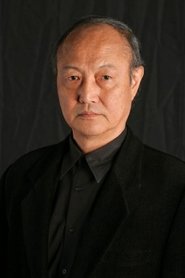
A recurring presence in Miike horror, appearing in Audition, Gozu and One Missed Call.
DT
Daisuke Tengan
HORROR SCREENWRITER
Screenwriter of Audition and Imprint, two of Miike's most important and disturbing horror works.
 Sakichi Satô
EXTREME CINEMA WRITER
Screenwriter of Ichi the Killer and Gozu, central to Miike's fusion of crime, grotesque violence and horror.
Takashi Miike Horror Movies
Directing (20 credits)
2021
2016
2015
2014
2014
2012
2007
2006
2005
2004
2003
2003
2002
2001
2001
2000
1999
1997
1988
Acting (7 credits)
2025
2006
2005
2004
2002
2000
1994
Writing (1 credits)
2012
Production (1 credits)
2012