

2014
Peter Lorre
Horror Actor · Biography · Horror Filmography · Family · Collaborators · Credits
Horror subgenres & themes
Most represented across this person's horror filmography:
HORROR ANTHOLOGY
• MEDICAL
Biography
Peter Lorre and the Human Face of Horror
Peter Lorre entered horror history without needing supernatural makeup, monstrous anatomy or conventional Gothic grandeur. His most disturbing characters remained recognizably human. The eyes, the voice, the nervous movements and the strange mixture of vulnerability and menace allowed him to suggest that terror might exist inside an ordinary body rather than behind a monster's face. Long before psychological horror became a dominant language of the genre, Lorre demonstrated how frightening a character could become when the audience was forced to recognize fear, compulsion and even suffering inside someone capable of terrible acts.
His career extended far beyond horror, encompassing crime films, thrillers, comedy, espionage stories and some of Hollywood's most famous classics. Yet horror repeatedly returned to the qualities that made Lorre unique. Fritz Lang used him to transform the screen murderer into a psychologically tormented human being in M. Hollywood turned his unsettling presence into the obsessive surgeon of Mad Love. Later films paired him with Boris Karloff and eventually Vincent Price, allowing the menace of his early career to evolve into black comedy and deliberate self-parody. Few actors connect so naturally the psychological darkness of early European sound cinema with the playful Gothic horror of American International Pictures three decades later.
M and the Birth of Psychological Terror
Fritz Lang's M (1931) provided Lorre with the performance that permanently shaped his screen identity. As Hans Beckert, a compulsive child murderer hunted simultaneously by the police and Berlin's criminal underworld, Lorre occupies one of the most disturbing positions imaginable. The character is unquestionably dangerous, yet Lang refuses to reduce him to an abstract embodiment of evil. By the time Beckert is dragged before the criminals' improvised court, Lorre exposes terror, desperation and a sense of being trapped inside impulses the character claims he cannot control.
The performance was crucial to the development of psychological screen horror even though M itself sits between crime film, thriller and social drama rather than conventional supernatural horror. Lang does not need to show graphic violence. Beckert's whistling, his shadow, the empty spaces left by his victims and finally Lorre's face produce dread through suggestion and psychology. The murderer becomes frightening precisely because he belongs to the same human world as everyone pursuing him.
That approach anticipated a major direction horror would take in later decades. The threatening figure no longer needed to emerge from a laboratory, crypt or supernatural realm. Terror could be located within compulsive behavior, damaged psychology and the uncertainty created when a monster still possesses recognizably human emotions. Lorre's performance in M became one of the foundational screen images of that idea and inevitably affected the kinds of roles he would be offered afterward.
Exile and the Transformation into a Screen Menace
Lorre was born László Löwenstein in Rózsahegy in 1904 and developed his acting career in Central European theatre before establishing himself in Berlin. His Jewish background and the political transformation of Germany made remaining there increasingly dangerous after the Nazis came to power. He left Germany in 1933, eventually moving through Britain before reaching Hollywood, carrying with him both the reputation created by M and a performance style shaped by European stage and cinema traditions.
The success of M proved both an opportunity and a trap. Hollywood immediately understood how useful Lorre's unusual appearance and vocal delivery could be for sinister, ambiguous or psychologically unstable characters. Even when he worked outside horror, casting frequently depended upon the audience's expectation that something strange or threatening might be concealed behind his character's nervous manner. That association became one of the most persistent examples of screen typecasting in twentieth-century genre cinema.
Mad Love and the American Horror Debut
Karl Freund's Mad Love (1935) gave Lorre his American screen debut and one of his purest horror roles. He plays Dr. Gogol, a brilliant surgeon whose obsessive love for actress Yvonne Orlac gradually transforms professional authority into something predatory. When Yvonne's pianist husband suffers devastating injuries to his hands, Gogol performs an experimental transplant using the hands of an executed knife murderer. The operation becomes the starting point for a nightmare built around medical power, sexual obsession and the unstable boundary between science and madness.
Lorre's appearance is deliberately transformed for the film: the shaved head, rigid expression and dark clothing turn Gogol into an almost artificial figure, yet the performance remains psychologically motivated. His horror does not come from scientific experimentation alone. It grows from the conviction that his medical abilities and emotional desire entitle him to control another person. The result places Lorre inside the mad-doctor tradition while making the character more intimate and disturbing than a simple laboratory villain.
Mad Love also demonstrated how effectively Lorre could dominate a horror film without becoming physically imposing. Gogol is unsettling because attention seems permanently concentrated behind his eyes. He watches, calculates and desires with an intensity that makes stillness threatening. The qualities that made Beckert disturbing in M were being transformed into a recognizably American horror persona.
Boris Karloff and the Horror Personalities of the 1940s
Lorre increasingly found himself appearing beside performers whose names already carried strong horror associations. You'll Find Out (1940) brought him together with Boris Karloff and Bela Lugosi in a comedy-horror hybrid built around a haunted-house setting, secret passages, séances and supernatural deception. Lorre plays Professor Karl Fenninger, supposedly an authority on psychic phenomena but actually part of the conspiracy surrounding the mansion.
The film is important less because it represents serious horror than because it recognizes that Karloff, Lugosi and Lorre had already become identifiable genre personalities. Their presence could now be used playfully. Audiences understood the expectation of menace before the characters had fully established themselves, allowing the film to turn horror casting itself into part of the joke. Lorre was becoming not merely an actor who happened to appear in sinister roles but a performer whose screen identity could signal a particular kind of macabre atmosphere.
His connection with Karloff continued in The Boogie Man Will Get You (1942). Karloff plays Professor Nathaniel Billings, whose experiments are connected to a suspicious collection of corpses, while Lorre appears as Dr. Arthur Lorentz. Again the film mixes murder, scientific absurdity and comedy, reinforcing a relationship in which the two actors could draw upon their established reputations for sinister characters while simultaneously undermining them through humor.
The Beast with Five Fingers
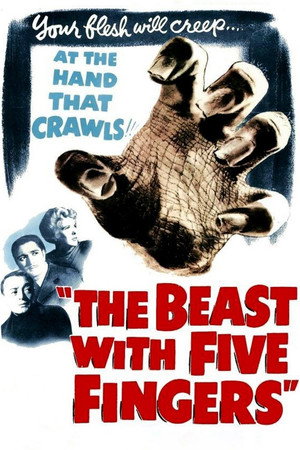
The Beast with Five Fingers (1946) returned Lorre to more serious supernatural horror. Directed by Robert Florey, the film centers on the estate of a dead pianist and the apparent appearance of the musician's severed hand, which seems capable of moving independently and murdering those around it. Lorre plays Hilary Cummins, the pianist's secretary and one of the characters most deeply destabilized by the events inside the house.
The role exploits precisely the qualities that had made Lorre a distinctive psychological performer. Cummins becomes increasingly obsessive and terrified, and the possibility of a disembodied hand allows external horror and mental disintegration to mirror one another. Instead of merely reacting to a monster, Lorre makes uncertainty itself frightening. The audience watches both the supernatural mystery and the deterioration of a man whose perception can no longer be trusted.
The film occupies an important place in Lorre's genre career because it allows him to move between the psychological terror associated with M and a more traditional Gothic premise. His performance supplies much of the intensity that gives the severed-hand story its power. Even within a film remembered for its special-effects concept, the most unsettling element is often the increasingly desperate human being confronting it.
From Menace to Macabre Self-Parody
By the 1950s and early 1960s, Lorre's sinister screen identity had become so familiar that filmmakers could use it without explanation. The development created a strange second life for his horror persona. What had once been genuinely disturbing could now become comic because audiences arrived already knowing what a Peter Lorre character was supposed to represent. His voice, eyes and nervous mannerisms had entered popular culture to the point where the actor could parody the image without destroying it.
This transition should not be mistaken for the disappearance of his importance to horror. It demonstrates how completely Lorre had become associated with the macabre. Only a performer with an established genre identity could create humor simply by exaggerating or contradicting the expectations attached to his presence. The last important horror phase of his career therefore transformed decades of typecasting into a deliberate performance tool.
Tales of Terror and Vincent Price
Roger Corman brought Lorre into the American International Pictures Poe cycle with Tales of Terror (1962). In the middle segment, combining elements of Edgar Allan Poe's The Black Cat and The Cask of Amontillado, Lorre plays Montresor opposite Vincent Price. Their characters become involved in a comic wine-tasting rivalry that gradually leads into adultery, murder and Poe's famous image of a victim sealed behind a wall.
The pairing revealed an immediate comic chemistry. Price's cultivated elegance and controlled theatricality contrasted perfectly with Lorre's disheveled, unpredictable energy. Rather than treating the humor as separate from horror, the sequence allows comedy and the macabre to reinforce one another. Domestic jealousy, drunkenness and verbal sparring eventually lead toward murder without requiring either actor to abandon the exaggerated personalities audiences already associated with them.
The success of the pairing encouraged Corman and screenwriter Richard Matheson to use Lorre and Price together again. For Lorre, this represented something more interesting than simply returning to horror. His old image as a sinister character actor was being consciously incorporated into a new style of Gothic entertainment built on the audience's knowledge of horror history.
The Raven and the Meeting of Horror Generations
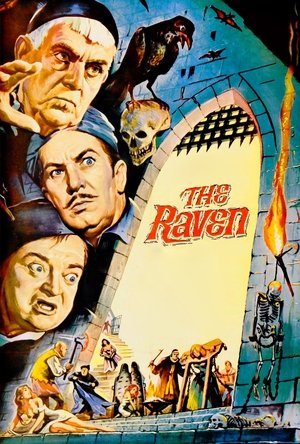
The Raven (1963) brought together Peter Lorre, Vincent Price and Boris Karloff in a comic fantasy loosely inspired by Poe. Price plays magician Erasmus Craven, Karloff is the powerful Dr. Scarabus and Lorre appears as Dr. Adolphus Bedlo, initially encountered in the form of a raven after losing a magical confrontation. The film treats supernatural horror as an arena for performance, allowing three actors strongly associated with the genre to play against their own reputations.
Lorre's Bedlo is cowardly, argumentative, opportunistic and unpredictable, functioning almost as an agent of disorder inside the more formally theatrical world occupied by Price and Karloff. The differences between the performers are essential to the film. Price brings elegant control, Karloff carries the authority of classical monster cinema and Lorre supplies nervous comic instability. Their screen histories become part of the material even though the characters themselves are new.
The production also surrounded Lorre with a recurring creative team. Richard Matheson wrote the screenplay, Floyd Crosby photographed the film, Daniel Haller shaped its Gothic environments and Les Baxter composed the score. These collaborators connected The Raven to the wider AIP horror cycle and would remain important when the same group of horror personalities was recombined again.
The Comedy of Terrors
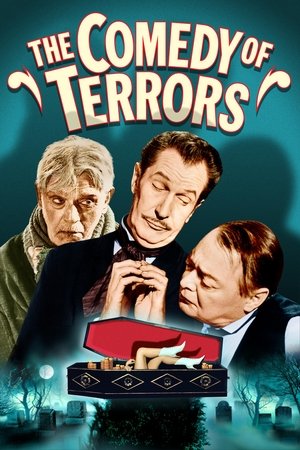
The Comedy of Terrors (1963) reunited Lorre with Vincent Price and Boris Karloff while adding Basil Rathbone, creating an extraordinary concentration of performers associated with several generations of screen horror. Richard Matheson again supplied the screenplay, with Jacques Tourneur directing after a career that had already produced such atmospheric genre landmarks as Cat People and Night of the Demon.
Price plays financially desperate undertaker Waldo Trumbull, while Lorre is his reluctant assistant Felix Gillie. Their solution to declining business is grotesquely practical: create new customers by murdering people and then charging their families for the funerals. The premise converts death itself into black comedy, but much of the film's pleasure comes from watching performers once associated with serious menace openly manipulate their established screen identities.
For Lorre the role represents almost the endpoint of a transformation that began with M. The actor who once terrified audiences as Beckert could now generate laughter simply through expression, timing and the expectation of sinister behavior. Yet the comedy works because the earlier menace has never completely disappeared. Felix may be ridiculous, but the film still belongs to a world of corpses, murder, coffins and Gothic imagery.
Peter Lorre and the Evolution of the Horror Character Actor
Lorre's importance to horror cannot be measured simply by counting conventional horror films. His influence lies in the kind of fear his performances made possible. M demonstrated that psychological compulsion could become as disturbing as any supernatural monster. Mad Love transformed intellectual obsession and medical authority into Gothic horror. The Beast with Five Fingers placed his unstable screen presence inside a supernatural mystery, while the later Poe-related films revealed how a horror persona could survive long enough to become material for sophisticated self-parody.
His collaborations also connect distinct periods of genre history. Boris Karloff linked him to the classical horror star system of the 1930s and 1940s. Vincent Price connected him to the colorful Gothic revival of American International Pictures. Richard Matheson, Les Baxter, Floyd Crosby and Daniel Haller formed part of the creative structure surrounding his final major horror cycle. Lorre could therefore move through changing styles without losing the qualities that made him immediately recognizable.
What remained constant was the tension between menace and vulnerability. Lorre could make a murderer appear frightened, a doctor appear consumed by desire, a supernatural victim appear unstable or a Gothic villain appear ridiculous without completely surrendering the possibility of danger. That ambiguity became his distinctive contribution to horror. His characters rarely require the audience to believe that evil comes from somewhere outside humanity. Again and again, Peter Lorre made the human face itself sufficient.
Photos (11)
Images: TMDB
Selected Work
Notable Horror Collaborators
Notable collaborators and creative partners throughout Peter Lorre's horror career.
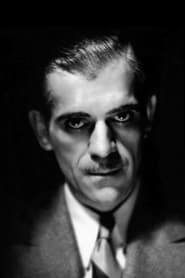 Boris Karloff
Defining Horror Co-Star
Karloff was Lorre's most frequent major horror co-star in the current iHorrorDB catalogue, appearing with him in You'll Find Out, The Boogie Man Will Get You, The Raven and The Comedy of Terrors across more than two decades.
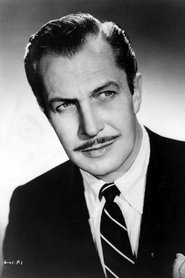 Vincent Price
Defining Horror Co-Star
Price and Lorre developed a distinctive comic-horror partnership through Tales of Terror, The Raven and The Comedy of Terrors, turning their established macabre screen personas into part of the films' humor.
 Richard Matheson
Key Screenwriting Collaborator
Matheson wrote the screenplays for Tales of Terror, The Raven and The Comedy of Terrors, shaping the three-film cycle that defined Lorre's final important period in Gothic horror and horror comedy.
 Les Baxter
Defining Musical Collaborator
Baxter composed the scores for Tales of Terror, The Raven and The Comedy of Terrors, providing a recurring musical identity to the AIP horror cycle surrounding Lorre's late-career genre revival.
FC
Floyd Crosby
Defining Cinematographer
Crosby photographed Tales of Terror, The Raven and The Comedy of Terrors, making him a recurring visual collaborator across the three films that joined Lorre to the early-1960s AIP Gothic cycle.
DH
Daniel Haller
Production Design Collaborator
Haller handled production design and art direction across Tales of Terror, The Raven and The Comedy of Terrors, helping create the Gothic environments surrounding Lorre's final major horror cycle.
Peter Lorre Horror Movies
Acting (14 credits)
2007
1964
1963
1962
1962
1955
1949
1947
1942
1942
1941
1940
1935