


2024
Vincent Price
Horror Actor · Biography · Horror Filmography · Family · Collaborators · Credits
Horror subgenres & themes
Most represented across this person's horror filmography:
HORROR ANTHOLOGY
• ZOMBIE
Biography
Vincent Price and the Elegance of the Macabre
Vincent Price became one of horror cinema's great icons without ever needing to look like a conventional monster. His most effective weapon was civilization itself. The carefully controlled voice, elegant posture, cultivated manners and apparent intelligence of his characters made the violence surrounding them more disturbing because brutality arrived wrapped in sophistication. Price could welcome someone into a mansion, discuss art or history with perfect courtesy and still create the impression that something terrible was waiting behind the next door.
That combination allowed him to occupy a unique place in American horror. Boris Karloff and Bela Lugosi had become inseparable from the monsters they played, while Peter Cushing and Christopher Lee would later define a new generation of British Gothic cinema. Price developed a different persona: the educated host of the nightmare, a man who often understood more than everyone around him and whose refinement could conceal grief, madness, cruelty or revenge. His villains were rarely mindless. They usually had explanations, wounds and elaborate reasons for becoming dangerous.
The association eventually became so strong that Price's voice alone could suggest horror. Yet he did not begin as a genre specialist. He arrived in cinema through theatre, historical drama, film noir and character roles, spending more than a decade building a career before horror transformed him into a star. That long apprenticeship mattered because when the genre finally claimed him, Price brought with him a level of theatrical control, intelligence and ironic awareness that would become central to his screen identity.
Before Horror Became His Identity
Vincent Leonard Price Jr. was born in St. Louis, Missouri, on May 27, 1911. His background was unusually cultured for a future horror star. He studied art history and English at Yale University and later continued his interest in art in London, where his path gradually shifted toward acting. The theatre gave Price the first substantial stage of his career, and by the second half of the 1930s he had established himself professionally in Britain and the United States before moving into motion pictures.
His film debut came with Service de Luxe in 1938, and the following years placed him in historical films, dramas and mysteries rather than a clearly defined horror career. Tower of London (1939) brought him into the same production as Boris Karloff, while The Invisible Man Returns (1940) gave him an early leading role inside Universal's cycle of fantastic cinema. In The House of the Seven Gables (1940), he entered Gothic territory through Nathaniel Hawthorne, but these appearances did not yet define how audiences understood him.
Price remained highly adaptable throughout the 1940s. His performance in Otto Preminger's Laura (1944) placed his cultivated manner inside film noir, where charm, deceit and social sophistication could become as dangerous as physical violence. That ability to make politeness slightly suspicious would later become invaluable in horror. Price did not need to transform himself completely when the genre became his professional home; horror simply discovered how effective qualities already present in his acting could become when surrounded by murder, supernatural suggestion and Gothic architecture.
House of Wax and the Creation of a Horror Star
House of Wax (1953) changed the direction of Price's career. He plays Professor Henry Jarrod, a gifted wax sculptor whose museum is destroyed by a business partner interested in insurance money. Horribly injured and apparently unable to continue his work, Jarrod later returns with a new exhibition devoted increasingly to scenes of violence and death. The mystery eventually reveals that the beauty of his wax figures conceals something far more physical.
The role brought together nearly everything that would become central to the Price horror persona. Jarrod begins as an artist, articulate and emotionally invested in beauty, before trauma redirects those qualities toward obsession and murder. His monstrosity does not erase his intelligence or refinement. It grows from them. The museum itself becomes an extension of his damaged worldview, turning artistic preservation into a grotesque refusal to accept the boundary between representation and corpse.
The film was also a major showcase for contemporary 3D technology, but its importance to Price went far beyond the novelty of its presentation. His performance demonstrated that he could carry a horror film as its central attraction without abandoning the cultivated qualities that had defined his earlier roles. Horror could use his elegance rather than destroy it. In fact, the more civilized Price appeared, the more effectively a film could exploit the possibility that civilization itself was only a surface.
The Fly, William Castle and the Horror Boom of the 1950s
Price's position inside horror became much stronger at the end of the decade. The Fly (1958) placed him within a science-fiction horror tragedy built around an experiment in teleportation that catastrophically merges human and insect matter. Price does not play the transforming scientist, but his presence helps ground a story whose grotesque central concept could easily have become pure sensationalism. The success of the film and his increasingly recognizable connection with horror prepared the way for an even more concentrated run of genre roles.
William Castle understood exactly what Price could bring to his theatrical style of horror. House on Haunted Hill (1959) casts him as Frederick Loren, an eccentric millionaire who invites a group of strangers to spend the night inside a supposedly haunted house in exchange for money. Price becomes both participant and master of ceremonies. His character seems to understand the performance of fear itself, making him perfectly suited to Castle's cinema, where publicity gimmicks and audience manipulation were part of the attraction.
The Tingler (1959) pushed the collaboration into even stranger territory. Price plays a pathologist investigating a creature that grows inside the human body through fear and can only be weakened by screaming. The premise turns fear into anatomy, while Castle extended the spectacle beyond the screen through his famous theatre gimmicks. Price's seriousness helps stabilize the absurdity. He explains the impossible with enough conviction that the film can move between medical horror, black humor and carnival showmanship without completely collapsing into parody.
The same period brought The Bat, another old-dark-house mystery that reinforced the connection between Price and macabre entertainment. By the end of the 1950s, he no longer merely appeared in occasional horror films. His name had become a promise of a particular experience: danger presented with wit, elegance and an awareness that terror could also be theatrical pleasure.
Roger Corman, Edgar Allan Poe and the American Gothic
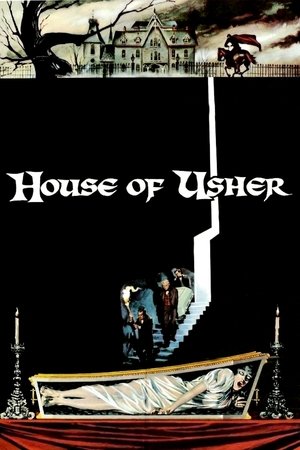
The most important sustained collaboration of Price's horror career began when Roger Corman cast him as Roderick Usher in House of Usher (1960). Corman wanted to move beyond the extremely inexpensive monster films he had been directing for American International Pictures and create a more ambitious Gothic production based on Edgar Allan Poe. Price was ideal for a character requiring intelligence, sensitivity and instability rather than conventional monstrosity. His presence immediately gave Corman's new Gothic world the authority it needed.
The success of House of Usher opened one of the defining cycles of 1960s American horror. Price returned for The Pit and the Pendulum (1961), playing Nicholas Medina, a man living under the psychological weight of his father's history as an inquisitorial torturer. The film allows Price to move gradually from vulnerability toward madness, using emotional instability rather than immediate villainy as the engine of the performance. Gothic architecture, family secrets and Corman's increasingly mobile camera surround him with a world in which the past is physically impossible to escape.
The cycle continued through Tales of Terror (1962), The Raven (1963), The Haunted Palace (1963), The Masque of the Red Death (1964) and The Tomb of Ligeia (1964). The connection with Poe was sometimes extremely loose, and The Haunted Palace is fundamentally derived from H. P. Lovecraft despite borrowing its title from Poe, but the films developed a consistent Gothic identity around decaying families, forbidden knowledge, madness, death and environments saturated with memory.
Price was essential because he could play this material at several different temperatures. In one film he could be tormented and sympathetic, in another cruel and aristocratic, and in another openly comic. The Raven allows him to participate in supernatural comedy alongside Boris Karloff and Peter Lorre, while The Masque of the Red Death gives him one of his coldest characters in Prince Prospero, a wealthy Satanist who treats the suffering caused by plague as evidence of his own superiority.
The Masque of the Red Death and Evil Without Excuses
Many Price characters become dangerous because something has happened to them. They have been betrayed, disfigured, humiliated, bereaved or driven toward obsession. Prince Prospero in The Masque of the Red Death is more disturbing because the film offers far less need to explain him. He possesses wealth, intelligence and social authority and uses all three to cultivate cruelty. While disease destroys the population outside his castle, Prospero surrounds himself with privilege and amusement, treating other human beings as instruments for philosophical experimentation.
The performance demonstrates the value of Price's refinement particularly clearly. Prospero does not need to shout or behave like a conventional madman. His calm is part of the horror because cruelty has become intellectually organized. He speaks as someone who believes he has correctly understood the universe and that other people are simply too weak to accept its brutality. Price's natural elegance therefore becomes morally poisonous rather than reassuring.
The production was also one of the most visually accomplished of Corman's Gothic films. Rich color, elaborate interiors and ceremonial imagery move the cycle away from the more restricted appearance of its earliest entries. Price occupies that visual world naturally because his performance has always contained an element of theatre. Prospero seems to be staging his own reality, controlling costumes, rooms, rituals and people until the arrival of the Red Death exposes the limits of that control.
The Last Man on Earth and Horror After Civilization
The Last Man on Earth (1964) moved Price away from castles and ancestral curses into a devastated modern world. Adapted from Richard Matheson's I Am Legend, the film casts him as Robert Morgan, apparently the last uninfected human survivor after a plague has transformed the rest of society into nocturnal creatures. Instead of aristocratic authority, Price must carry long stretches of isolation, routine and exhaustion.
The role is important because it shows how effectively he could function without the social performance that usually surrounded his characters. Morgan spends his days killing infected creatures, disposing of bodies and maintaining the procedures that allow him to survive. His voice remains unmistakable, but there are fewer people available for him to charm, intimidate or deceive. The cultivated host has been left without an audience.
The film also occupies an important position in the evolution of apocalyptic horror. Its vision of an infected population, abandoned streets and a lone survivor living according to repetitive defensive routines anticipates imagery that would become increasingly common in later plague and zombie cinema. Price's involvement connects classical Gothic stardom to a more modern form of horror in which catastrophe is biological, social and global rather than confined to an isolated mansion.
Witchfinder General and the Removal of Camp
By the late 1960s, Price had become so strongly associated with ornate Gothic performance that a younger director could use the audience's expectations against him. Michael Reeves did exactly that in Witchfinder General (1968). Price plays Matthew Hopkins, a historical figure who exploited fear of witchcraft during the English Civil War, travelling through communities and profiting from the interrogation, torture and execution of supposed witches.
The performance is striking because Reeves strips away many of the qualities audiences had learned to enjoy in Price. Hopkins is not a witty host or a wounded aristocrat surrounded by spectacular Gothic machinery. He is controlled, practical and cruel. The violence around him has little of the theatrical pleasure associated with Castle or the Poe cycle. Torture occurs in fields, villages and ordinary rural spaces, making brutality feel embedded in society rather than contained inside a supernatural fantasy.
Price's restraint is essential to the film because Hopkins does not appear possessed or conventionally insane. He has simply discovered a social system that rewards what he does. The performance expanded the possibilities of Price's horror persona at a moment when genre cinema was changing rapidly, demonstrating that the same authority used in Gothic melodrama could become even more disturbing when placed inside a harsher and more realistic conception of violence.
Dr. Phibes and Revenge as Grand Performance
The Abominable Dr. Phibes (1971) returned Price to elaborate theatrical horror but transformed it through black comedy, extravagant design and increasingly inventive murder. Dr. Anton Phibes is a brilliant musician and theologian believed to be dead after an accident. Horribly disfigured, he survives and begins murdering the doctors he blames for the death of his wife, designing each killing around the biblical plagues of Egypt.
The premise could hardly be better suited to Price. Phibes is cultured, obsessive, grief-stricken and spectacularly theatrical, but the film complicates performance by limiting the character's conventional speech. His damaged face forces him to communicate through an artificial mechanism, turning Price's famous voice into something technologically mediated. The audience hears the familiar sound while watching a face that barely moves with it, creating a strange separation between body and personality.
The murders become works of design. Animals, blood and elaborate mechanisms transform revenge into macabre installation art, while Phibes inhabits an extraordinary environment filled with mechanical musicians and ceremonial spaces. His violence is horrifying, but it is also aesthetic. He does not simply want his victims dead; he wants their deaths to complete an imaginative system. Dr. Phibes Rises Again (1972) continued the character's story and confirmed that Price had created another horror figure distinct from the Poe cycle.
Theatre of Blood: Vincent Price Turns Criticism into Murder
Theatre of Blood (1973) may be the film that most completely converts Vincent Price's public image into horror material. He plays Edward Lionheart, a Shakespearean actor who has been ridiculed by critics and apparently killed himself after being denied an important award. Lionheart survives and begins murdering his critics through elaborate methods inspired by deaths in Shakespeare's plays.
The role is built around the tension between Price's theatrical background and the reputation horror had given him. Lionheart believes himself to be a great classical actor misunderstood by an arrogant critical establishment. Price, meanwhile, had genuinely spent years watching his serious dramatic abilities become overshadowed by his identification with horror. The film does not simply cast him as a murderer; it turns the cultural perception of Vincent Price into part of the story.
That self-awareness gives the film unusual richness. Lionheart changes costume, voice and identity repeatedly as he stages each murder, allowing Price to parody theatrical traditions while demonstrating exactly the range his character claims critics have ignored. The deaths are grotesque and often comic, but the resentment underneath them gives the performance an emotional foundation. Horror becomes revenge against the act of critical classification itself.
Madhouse and the Horror Star Looking at Himself
Madhouse (1974) continues this fascination with Price's own image. He plays Paul Toombes, an actor famous for portraying a fictional horror character called Dr. Death. After personal tragedy and psychological collapse, Toombes returns to acting while a series of murders appears to imitate deaths from his old films. The boundary between performer, screen character and murderer gradually becomes unstable.
The concept works because audiences already understood Price as a man whose identity had fused with horror. The fictional Dr. Death functions as an exaggerated version of the problem Price had faced for decades: a role becomes famous enough to consume the actor behind it. Old film footage and memories of Price's previous work deepen the sense that Madhouse is not merely telling a fictional story but examining the machinery through which horror stars become permanent cultural objects.
Peter Cushing's presence adds another layer of genre history, bringing together two performers whose careers had helped define different branches of Gothic horror. By the mid-1970s both men represented an older tradition at a time when the genre was rapidly changing around them. Madhouse uses that history directly, turning nostalgia for horror cinema into part of its atmosphere rather than pretending its stars arrived without a past.
A Voice That Became Horror
As Price grew older, the voice that had always been central to his acting became increasingly capable of carrying his horror identity without his physical presence. Its rhythm, warmth and theatrical precision allowed him to move between menace and humor almost effortlessly. He could sound amused by the nightmare he was describing without completely undermining it, making him an ideal narrator, host and performer for projects that wanted to evoke classical macabre entertainment.
Tim Burton used precisely this cultural memory in the stop-motion short Vincent (1982), about a young boy who imagines himself as Vincent Price. Price narrates the film, effectively lending his voice to a fantasy about the cultural idea of Vincent Price himself. The relationship would later continue when Burton cast him in Edward Scissorhands, but Vincent already demonstrates how far the actor had moved beyond ordinary stardom. His name had become shorthand for a complete Gothic imagination.
The same period brought perhaps the most widely heard use of his voice. Michael Jackson's Thriller included Price's spoken performance near the end of the track, placing him inside one of the most successful works in popular music history. The recording introduced his macabre delivery to an audience far larger than the theatrical market for his horror films and helped preserve his association with Halloween and the supernatural for generations born long after House of Wax or the Poe cycle.
House of the Long Shadows and the Gathering of Horror History
House of the Long Shadows (1983) brought Price together with Christopher Lee, Peter Cushing and John Carradine, assembling several generations of classical horror stardom inside a single production. The film's significance comes partly from the extraordinary concentration of genre history represented by its cast. These actors had played monsters, hunters, madmen, aristocrats and supernatural figures across decades of horror cinema, and by the early 1980s their presence carried associations larger than the characters written for them.
For Price, the film confirms how his career had shifted from contemporary horror star to living representative of horror history. New forms of the genre had emerged through slashers, possession films, special-effects spectacles and increasingly graphic independent cinema, yet the older performers remained culturally recognizable. Their presence connected those newer audiences with a tradition reaching back through Hammer, American International Pictures and the earlier Gothic cycles that had shaped popular horror.
Price continued appearing in macabre projects while increasingly accepting roles that played upon his established image. Horror remained part of his work even as television, cooking, art, music and voice performance expanded the range of his public life. The genre had become only one part of his identity, but it remained the part audiences recognized most immediately.
Tim Burton, Edward Scissorhands and the Final Gothic Image
Price's appearance in Edward Scissorhands (1990) provides an unusually appropriate final major image for his film career. He plays the Inventor who creates Edward, an artificial young man left unfinished with scissors instead of hands after his creator dies. The role is small, but Burton uses Price with enormous awareness of film history. The Inventor lives inside a Gothic castle above a brightly artificial suburb, connecting the world of classical horror directly to Burton's modern fairy tale.
The casting reverses many of Price's earlier roles. He is not the threatening aristocrat, murderous artist or tormented scientist. He is a gentle creator whose death leaves his creation incomplete and alone. Yet the laboratory, castle and artificial human being inevitably recall older horror traditions, allowing Price's presence to transform the film into a quiet conversation with the genre that had defined him.
There is something fitting about Price ending his major screen career in a film by a director who openly loved the cinema and persona associated with him. Burton had already turned Price into the subject and narrator of Vincent; now he gave him a role that treated Gothic imagery with affection rather than parody. The monster tradition Price had inhabited for decades had passed into the work of filmmakers raised on his movies.
Price died on October 25, 1993. By then the transformation from actor to horror icon had long been complete, but his career remained much broader than the stereotype surrounding it. He had been a stage actor, noir performer, art collector, lecturer, writer and passionate cook as well as one of the most recognizable figures in horror cinema. That breadth helps explain why his horror performances possessed such unusual texture: the cultivated qualities were not simply part of an invented screen persona but reflected genuine interests and knowledge that followed him throughout his life.
Vincent Price's Style and Legacy
Vincent Price's horror style depended upon balance. He could exaggerate without completely losing control, play humor without making the horror meaningless and make elaborate dialogue sound pleasurable rather than burdensome. His performances frequently acknowledge the theatricality of the situations around him while continuing to respect the emotional logic of the character. That ability allowed him to survive enormous changes in horror cinema because he could operate inside seriousness, camp, Gothic romance, black comedy and exploitation without belonging exclusively to any one of them.
His greatest characters also reveal a recurring pattern. Jarrod in House of Wax, Roderick Usher, Nicholas Medina, Prince Prospero, Matthew Hopkins, Anton Phibes and Edward Lionheart are powerful for different reasons, yet each allows Price to place intelligence at the center of horror. Even when they are insane, cruel or consumed by revenge, they are rarely empty mechanisms for violence. They explain themselves, create systems, construct rituals and turn murder into an extension of worldview. The horror comes partly from understanding them too well.
His influence can be felt whenever horror combines menace with theatrical sophistication, particularly in characters who invite the audience to enjoy their presence even while behaving monstrously. Price helped demonstrate that a horror star did not have to disappear beneath makeup or play a single recurring creature. A voice, posture and manner of looking at another person could become just as recognizable as any monster design.
More importantly, he never treated horror as an embarrassment that had interrupted a more respectable career. Even when typecasting limited certain opportunities, he continued approaching the genre with professionalism and eventually embraced the affection audiences attached to his work. That relationship allowed Vincent Price to become something rarer than a performer remembered for several successful horror films. He became part of the atmosphere of horror itself, a figure whose presence could make terror feel elegant, theatrical and strangely inviting without ever removing the darkness underneath it.
Known Among Horror Fans For
Notable Horror Collaborators
Notable collaborators and creative partners throughout Vincent Price's horror career.
 Roger Corman
Defining Director
Price's most important recurring horror director. Their collaborations include House of Usher, The Pit and the Pendulum, Tales of Terror, The Raven, The Haunted Palace, The Masque of the Red Death and The Tomb of Ligeia, forming the core of the American International Pictures Gothic cycle.
DH
Daniel Haller
Production Design Collaborator
A central visual architect of Price's Corman period. Haller designed the Gothic environments of House of Usher, The Pit and the Pendulum, Tales of Terror, The Raven, The Haunted Palace and The Masque of the Red Death.
RM
Richard Matheson
Screenwriting Collaborator
A major writer behind Price's American Gothic period. Matheson wrote House of Usher, The Pit and the Pendulum, Tales of Terror, The Raven and The Comedy of Terrors, giving Price several of his defining horror roles.
 Les Baxter
Composer Collaborator
A recurring musical collaborator throughout Price's American International Pictures horror period. Baxter scored House of Usher, The Pit and the Pendulum, Tales of Terror, The Raven and The Comedy of Terrors.
 Gordon Hessler
Horror Director
Hessler directed Price in three consecutive horror productions for American International Pictures: The Oblong Box, Scream and Scream Again and Cry of the Banshee.
 Peter Lorre
Frequent Horror Co-Star
Price and Lorre formed a memorable horror-comedy partnership across Tales of Terror, The Raven and The Comedy of Terrors, combining Gothic menace with increasingly self-aware black comedy.
Vincent Price Horror Movies
Acting (59 credits)
2023
2022
2022
2018
1988
1988
1987
1986
1986
1985
1984
1984
1983
1983
1983
1983
1981
1979
1975
1974
1973
1972
1971
1971
1970
1970
1970
1970
1969
1969
1968
1968
1965
1965
1964
1964
1964
1963
1963
1963
1963
1962
1962
1961
1961
1960
1959
1959
1959
1959
1958
1955
1954
1953
1949
1948
1940
1939