




2008
Stuart Gordon
Horror Director · Biography · Horror Filmography · Family · Collaborators · Credits
Horror subgenres & themes
Most represented across this person's horror filmography:
BODY HORROR
• CANNIBAL
• EVIL DOLL
• HALLOWEEN
Biography
Stuart Gordon and the Theatre of Flesh
Stuart Gordon brought something unusually theatrical to horror cinema. Bodies burst, twisted, dissolved and returned from the dead in his films, but the gore was rarely presented as simple decoration. Violence became performance. Actors fought with prosthetics, monsters entered physical spaces with them, rooms became stages for escalating disaster and grotesque effects were often timed with the precision of comedy. Gordon understood that horror could be excessive without becoming empty, and that an audience could laugh at something horrifying without ceasing to feel its physical impact.
His reputation rests most heavily on Re-Animator and From Beyond, two H. P. Lovecraft adaptations that helped establish a distinctive form of 1980s body horror built around scientific obsession, sexual anxiety and practical effects. Yet Gordon's horror career extended much further, through Dolls, The Pit and the Pendulum, Castle Freak, Dagon, his episodes of Masters of Horror and even the disturbing realism of later films such as King of the Ants and Stuck.
What makes Gordon especially important is that cinema was not his original artistic home. Before becoming a horror filmmaker, he spent years directing experimental theatre, staging politically confrontational productions and learning how to control audiences through space, actors and live physical spectacle. When he finally moved into film, he did not abandon that background. He simply discovered that prosthetic heads, resurrected corpses and Lovecraftian creatures could become another form of stage machinery.
Chicago, Experimental Theatre and the Origins of Confrontation
Stuart Gordon was born in Chicago in 1947 and developed his artistic identity during the political and cultural upheaval of the 1960s. While attending the University of Wisconsin, he founded an experimental company called the Screw Theater and began treating performance as something capable of directly confronting social and political boundaries rather than merely entertaining an audience.
One of the defining events of this period came in 1968, when Gordon staged an antiwar reinterpretation of Peter Pan. Captain Hook became a political figure modeled on Chicago mayor Richard J. Daley, psychedelic imagery replaced traditional children's theatre and the production culminated in nudity. Gordon and several performers, including his future wife Carolyn Purdy, were arrested on obscenity charges. The charges did not ultimately define his career, but the episode established something fundamental about the way he approached art: the audience should not necessarily feel comfortable.
Gordon and Purdy later founded the Organic Theater Company in Chicago, where he spent years developing new work and directing dozens of plays. The company became an important part of the city's theatre culture and helped launch material by writers including David Mamet. Gordon directed the first professional production of Mamet's Sexual Perversity in Chicago, while the Organic also developed Bleacher Bums, which Gordon co-wrote and directed.
This theatrical background would remain visible throughout his films. Gordon preferred actors who could commit fully to heightened material, and he frequently staged scenes around physical interaction rather than passive observation. When a body was mutilated or a creature entered a room, the effect was not simply something photographed by the camera. It became an event around which performance, timing and audience reaction were organized.
From the Stage to Re-Animator
Gordon did not direct his first feature until Re-Animator in 1985, but the film displays none of the uncertainty usually associated with a debut. Working with producer Brian Yuzna and writers Dennis Paoli and William Norris, Gordon adapted H. P. Lovecraft's serialized story about Herbert West, a medical student obsessed with defeating death. The source material was written decades earlier, but Gordon recognized that its combination of science, arrogance and bodily violation could be transformed into contemporary horror.
Jeffrey Combs plays Herbert West as a man whose intelligence has almost completely replaced ordinary social behavior. He is not simply a mad scientist in the conventional Gothic sense. West believes his work is rational, necessary and superior to the emotional objections of everyone around him. Death is a technical problem and corpses are experimental material. The more disastrous his experiments become, the more convinced he appears that the real failure lies only in the procedure needing further refinement.
Bruce Abbott provides the more conventional emotional perspective as Dan Cain, while Barbara Crampton plays Megan Halsey, whose relationship with Dan becomes entangled in West's experiments. David Gale's Dr. Carl Hill provides another form of scientific arrogance, transforming the struggle between West and his academic rival into something increasingly grotesque even before Hill begins functioning independently from his own body.
The combination created one of the defining horror comedies of the decade, but Gordon never treated the material as parody. The actors perform the danger seriously, while the comedy emerges from escalation, timing and the sheer extremity of what occurs. A resurrected cat is funny because the characters genuinely struggle to survive it. A decapitated scientist becomes absurd because he continues behaving as though intellectual authority still matters after losing his body.
Grand Guignol, Gore and the Logic of Excess
Re-Animator established Gordon's relationship with gore immediately. Blood is not simply evidence that violence has taken place. It becomes part of the staging. Bodies are thrown, cut, revived and destroyed while performers interact directly with prosthetic effects. The physicality recalls the Grand Guignol tradition, where theatrical horror depended upon giving an audience the sensation that something impossible and disgusting had occurred only a few feet away.
Gordon's theatre experience allowed him to understand that shock becomes stronger when an effect has rhythm. He often delays the grotesque reveal just long enough for the audience to imagine what may happen, then extends the result beyond the point normally considered tasteful. The second stage is important. A conventional horror film might stop once the shocking image has been delivered. Gordon frequently continues until horror begins touching comedy.
This method explains why his films can remain disturbing even when viewers are laughing. The joke does not erase the bodily violation. It grows from the fact that Gordon refuses to stop showing the consequences. The audience becomes aware of its own contradictory reaction, simultaneously repulsed by the image and entertained by the filmmaker's commitment to pushing it further.
The approach would become one of Gordon's signatures. He rarely seemed interested in asking whether a concept had become too extreme. He was more interested in finding the precise point where excess stopped behaving predictably.
Jeffrey Combs and the Gordon Actor
Jeffrey Combs became Gordon's most important recurring performer. The collaboration began with Herbert West, but Gordon repeatedly found different uses for Combs's intensity, precise diction and ability to make intellectual obsession physically visible. Combs could appear completely controlled while giving the impression that something dangerous was accelerating underneath the surface.
Gordon later reunited him with Barbara Crampton in From Beyond and Castle Freak, creating one of the most recognizable actor-director networks in modern cult horror. The same faces returned in radically different roles, giving Gordon's films a repertory quality closer to theatre than to conventional studio casting.
This was not accidental. Gordon had spent much of his stage career working with ensembles and understood the value of actors whose instincts he already knew. Repeated collaboration allowed him to push performers quickly into difficult material because the relationship did not need to be rebuilt from the beginning on every production.
Combs eventually became important to Gordon's theatrical return as well, playing Edgar Allan Poe in Nevermore after portraying Poe in Gordon's Masters of Horror adaptation of The Black Cat. Their collaboration therefore moved from Lovecraftian film horror back into the live-performance environment from which Gordon's career had originally emerged.
From Beyond and the Horror of Perception
From Beyond (1986) returned Gordon to Lovecraft almost immediately after Re-Animator, again working with Dennis Paoli, Brian Yuzna, Jeffrey Combs and Barbara Crampton. The premise begins with a machine called the Resonator, created to stimulate the pineal gland and allow human beings to perceive creatures occupying another dimension alongside ordinary reality.
What initially appears to be an experiment in expanded perception rapidly becomes a transformation of the body itself. Dr. Edward Pretorius, played by Ted Sorel, is consumed by the dimension the machine reveals and returns as an increasingly unstable organism driven by appetite. Combs's Crawford Tillinghast also begins changing physically, demonstrating that perception cannot be expanded safely without transforming the person doing the perceiving.
The film takes one of Lovecraft's recurring ideas, that human beings are protected by the limitations of their senses, and makes it violently physical. Knowledge does not simply drive characters insane. It alters flesh. The brain develops new organs, bodies become elastic and sexual desire becomes entangled with mutation.
Barbara Crampton's Dr. Katherine McMichaels is particularly important to the film's mixture of horror and sexuality. The Resonator does not only reveal monsters. It amplifies sensation and desire, making the boundary between scientific curiosity and erotic compulsion increasingly unstable. Gordon turns Lovecraftian forbidden knowledge into something the characters experience through the entire nervous system.
Sex, Science and Transformation
Gordon repeatedly returned to characters who attempt to separate intellectual curiosity from physical consequence. Scientists in his films believe they can observe, classify or control phenomena that eventually enter their own bodies. Herbert West thinks death can be treated as chemistry. Tillinghast and Pretorius think perception can be expanded mechanically. The investigators in later Lovecraft adaptations repeatedly discover that understanding the forbidden object does not provide protection from it.
This interest distinguishes Gordon's body horror from purely biological mutation. The body usually changes because somebody wanted to know something. Scientific ambition, sexual curiosity and intellectual arrogance become mechanisms through which transformation enters the story.
The erotic dimension is equally important because Gordon rarely treats sexuality as separate from horror. Desire creates vulnerability, but it can also become a form of transformation in itself. From Beyond makes that connection explicit, while later films repeatedly return to shame, repression and appetite as forces capable of becoming physically dangerous.
Gordon's films therefore contain a surprisingly consistent moral structure beneath their apparent chaos. The problem is rarely curiosity itself. The problem is the belief that curiosity creates entitlement to control whatever is discovered.
Dolls and the Dark Fairy Tale
Dolls (1987) allowed Gordon to approach horror from a more openly fantastical direction. A group of travelers becomes stranded during a storm and takes shelter in an isolated mansion inhabited by an elderly toymaker, his wife and an enormous collection of dolls. The toys eventually reveal that they are capable of judging, punishing and violently attacking the adults inside the house.
The film is gentler in tone than Re-Animator or From Beyond, but it retains Gordon's fascination with physical effects and theatrical spaces. The mansion becomes a giant stage filled with miniature performers. Dolls crawl from shelves, assemble themselves into groups and attack with an unsettling mixture of childhood familiarity and mechanical movement.
The story also reverses the usual relationship between child and monster. The young heroine Judy is one of the few characters capable of responding to the toys with imagination rather than cruelty or disbelief. The adults who have lost empathy become the figures most vulnerable to punishment. Horror therefore grows from the destruction of childhood imagination rather than from childhood itself.
Gordon's affection for old fairy tales is visible throughout the film. The violence can be severe, but it follows a moral logic closer to cautionary folklore than to the nihilism of many contemporary slashers. Bad adults are punished, imagination has value and objects associated with childhood acquire dangerous authority when treated without respect.
Brian Yuzna and the Independent Horror Partnership
Producer Brian Yuzna became one of the central figures behind Gordon's move into cinema. Their collaboration began with Re-Animator and continued through projects that combined genre filmmaking with a willingness to take creative risks unlikely to survive conventional studio development.
The partnership was important because Gordon was entering film relatively late compared with many first-time directors. He brought years of theatre experience but needed collaborators who understood the economics and practical structure of independent genre production. Yuzna helped provide that bridge.
Their relationship also extended beyond horror. Gordon, Yuzna and writer Ed Naha developed the story that became Honey, I Shrunk the Kids, originally conceived as a project Gordon was expected to direct. Although he ultimately did not direct the finished Disney film, the concept demonstrates how naturally his interest in altered scale, physical effects and dangerous domestic spaces could move into family adventure.
The connection is revealing because Gordon's imagination was broader than his reputation as a horror specialist suggested. Horror became his most famous territory, but the technical and theatrical instincts underlying it could be adapted to science fiction, fantasy, comedy or family filmmaking.
Robot Jox and Spectacle Beyond Horror
Robot Jox expanded Gordon's filmmaking into science fiction on a scale far removed from the medical rooms and Gothic houses of his earlier work. The story imagines a future where international disputes are settled through enormous piloted robots fighting formalized battles, combining political satire with miniature effects and mechanical spectacle.
The film is not horror, but it demonstrates Gordon's continuing interest in physical effects and bodies controlled by technology. The machines become extensions of the pilots, while combat reduces geopolitical conflict to personal physical competition. Once again, supposedly rational systems create forms of violence that rapidly exceed the structures designed to contain them.
The production also reveals Gordon's willingness to move between genres while maintaining the same fascination with constructed spectacle. The director who had staged resurrected corpses as physical effects now applied similar enthusiasm to miniature cities and giant mechanical fighters.
This flexibility would remain characteristic of his career. Gordon never entirely escaped the horror label, but his strongest non-horror films repeatedly demonstrate that the underlying filmmaker was interested less in one genre than in situations where ordinary human control begins breaking down.
The Pit and the Pendulum and Gordon's Edgar Allan Poe
After repeatedly adapting Lovecraft, Gordon turned directly to Edgar Allan Poe with The Pit and the Pendulum (1991). The film uses Poe's famous title and imagery inside a larger narrative involving the Spanish Inquisition, religious authority, torture and sexual repression. Lance Henriksen plays Torquemada, turning institutional power into a form of personal obsession.
Gordon's approach differs sharply from Roger Corman's earlier Gothic Poe cycle. Where Corman often emphasized color, aristocratic decay and psychological atmosphere, Gordon focuses more directly on the body under pressure. Torture instruments, religious punishment and physical confinement become the mechanisms through which ideology is made visible.
Torquemada is frightening because cruelty has been given moral justification. Violence is not committed secretly by someone who knows he is evil. It is performed by an authority figure convinced that punishment serves a higher purpose. Gordon repeatedly found this kind of certainty dangerous, particularly when a character believed that intelligence, faith or professional status placed him beyond ordinary moral limits.
The film therefore fits naturally into Gordon's larger horror work despite exchanging Lovecraftian science for religious fanaticism. In both cases, horror emerges when absolute conviction meets a vulnerable human body.
Castle Freak and the Horror Inside the Family
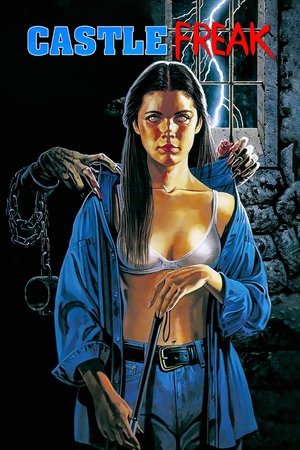
Castle Freak (1995) reunited Gordon with Jeffrey Combs and Barbara Crampton in a story much more intimate and emotionally bleak than the exuberant madness of Re-Animator. Loosely inspired by Lovecraft's The Outsider, the film follows an American family that inherits an Italian castle without realizing that a horribly abused man has been imprisoned beneath it for years.
Combs plays John Reilly, a father whose family is already damaged before the supernatural or monstrous elements begin. His young son has died in an accident for which John carries responsibility, his daughter has been blinded and his marriage is collapsing beneath grief and resentment. The castle does not create the family crisis. It gives the existing crisis another physical form.
The creature eventually known as Giorgio is terrifying, but Gordon refuses to make him merely an unexplained monster. His physical condition is the result of prolonged abuse, confinement and family cruelty. The horror therefore contains a chain of responsibility extending across generations. Violence produces more violence because it has been hidden rather than confronted.
The film's atmosphere is harsher than Gordon's earlier horror comedies. Humor is minimal, the sexuality is disturbing rather than playful and the physical environment feels cold and oppressive. Gordon demonstrates that the same director capable of extravagant splatter could create horror from guilt, family damage and the consequences of cruelty.
Italy, Castles and the Physical Gothic
Several Gordon productions benefited from European locations and the production infrastructure associated with Charles Band's Empire Pictures and later Full Moon. Italian castles, stone corridors and old buildings gave his films physical spaces that could not easily have been reproduced through inexpensive studio construction.
Gordon used these locations aggressively. Architecture rarely functions as neutral background. Staircases hide threats, basements contain evidence of past crimes and walls separate characters from histories they do not yet understand. The physical building becomes part of the narrative mechanism.
This interest again connects Gordon's cinema with theatre. A stage director must understand where bodies exist in relation to entrances, exits and objects. Gordon's horror frequently depends upon exactly that spatial awareness. The audience understands where a character can escape before the escape route disappears.
His Gothic films therefore feel tactile even when their plots involve supernatural or grotesque ideas. Stone, wood, metal and flesh occupy the same world, allowing impossible events to remain grounded in physical surroundings.
Dagon and the Return to Lovecraft
Dagon (2001) brought Gordon back to Lovecraft after several years away from direct adaptations. Despite the title, the film draws primarily from The Shadow over Innsmouth, relocating the story to a remote Spanish fishing community where visitors gradually discover that the inhabitants have transformed through generations of worship and interbreeding with sea creatures.
The setting becomes one of the film's greatest strengths. Rain, narrow streets, decaying buildings and the isolated coastal environment create a sense that the protagonists have entered a community operating according to rules older than the modern world surrounding it. Escape becomes difficult not because of one monster but because nearly everyone in the town belongs to the same hidden system.
The transformations are particularly effective because they exist at different stages. Some inhabitants appear almost human, while others have progressed much further toward aquatic forms. This creates the impression of an entire population changing gradually rather than a single creature appearing as an exception.
Gordon also preserves one of Lovecraft's central horrors: the possibility that the outsider is not as separate from the forbidden world as he believes. Identity itself becomes unstable once family history is revealed. The protagonist does not merely discover monsters. He discovers that the distinction between himself and the monsters has always been incomplete.
Dennis Paoli and the Cinematic House of Lovecraft
Dennis Paoli became Gordon's most important writing collaborator in horror. Beginning with Re-Animator, their partnership continued through From Beyond, Castle Freak, Dagon and Gordon's later Lovecraft and Poe projects for television and theatre.
The collaboration was crucial because Gordon rarely approached Lovecraft as sacred text. The stories provided concepts, atmosphere and philosophical foundations, but Gordon and Paoli felt free to restructure characters, introduce sexuality, expand female roles and convert literary suggestion into physical cinema.
This freedom allowed their adaptations to remain recognizably Lovecraftian without becoming museum pieces. Re-Animator behaves like a contemporary medical horror film. From Beyond turns metaphysical perception into erotic body horror. Castle Freak transforms a literary idea of alienation into family tragedy. Dagon relocates Innsmouth to modern Europe while preserving the terror of inherited identity.
The result became something close to a shared cinematic Lovecraft world long before interconnected genre universes became an industrial obsession. Miskatonic University, forbidden experiments and recurring performers created connections that fans could recognize even when the stories were formally separate.
King of the Ants and Horror Without the Supernatural
King of the Ants (2003) moved Gordon into crime and psychological violence, but the film retains enough brutality and transformation to remain closely connected to his horror sensibility. Chris McKenna plays Sean Crawley, a young man drawn into criminal work who agrees to commit murder and then discovers that the people who hired him would rather eliminate him than pay.
The resulting abuse becomes prolonged and physical, breaking Sean down before pushing him toward revenge. There are no resurrected corpses or interdimensional creatures. Human beings are sufficient. Gordon demonstrates that his interest in bodily violation did not require supernatural explanation.
The film also returns to one of his recurring themes: a character enters a system believing he understands the transaction and discovers that the rules were never designed to protect him. Sean thinks violence can be treated as work, only to learn that once he has crossed the moral boundary required by the job, there is no professional structure preventing the same violence from being turned against him.
The transformation that follows is psychological as much as physical. Gordon shows how repeated humiliation and pain can reorganize identity, creating a monster through human treatment rather than scientific experiment or ancient curse.
Edmond and the Darkness Outside Genre
Gordon reunited with the work of David Mamet for Edmond (2005), starring William H. Macy as a middle-class businessman who abandons his ordinary life and descends into increasingly violent, racist and self-destructive behavior. The film is not conventional horror, but its view of human behavior can be more disturbing than many supernatural stories.
The project reconnects Gordon directly with his theatre history. Decades earlier he had helped bring Mamet's work to professional stages in Chicago. Now he was translating another Mamet text into film, carrying theatrical dialogue and confrontational behavior into a much darker cinematic environment.
Gordon's handling of the material demonstrates that the sensibility visible in his horror films was never dependent upon monsters. He remained fascinated by people who become convinced that ordinary moral boundaries no longer apply to them, whether through scientific genius, religious certainty, sexual obsession or personal frustration.
The difference is that Edmond offers no creature onto which the audience can transfer blame. The ugliness belongs entirely to human choice.
Masters of Horror and Dreams in the Witch-House
The anthology series Masters of Horror gave Gordon another opportunity to return directly to Lovecraft with Dreams in the Witch-House. The episode follows graduate student Walter Gilman, whose search for inexpensive housing leads him into an old building connected with witchcraft, impossible geometry and forces capable of crossing between dimensions.
The story fits Gordon naturally because intellectual curiosity once again opens access to something the protagonist cannot control. Mathematical investigation becomes a pathway into supernatural horror, continuing the connection between knowledge and bodily danger already established in Re-Animator and From Beyond.
The shorter television format forces Gordon to compress the progression from investigation to nightmare, but many of his characteristic elements remain present. A decaying building hides impossible spaces, apparently rational research becomes evidence of supernatural reality and the protagonist's desire to understand what is happening places him more deeply inside the threat.
The episode confirmed how persistent Lovecraft remained throughout Gordon's career. He returned to the writer not because one successful adaptation had created a marketable formula, but because the underlying themes continued matching his own interests decades later.
The Black Cat and Jeffrey Combs as Edgar Allan Poe
Gordon's second Masters of Horror episode, The Black Cat, turned from Lovecraft to Edgar Allan Poe and placed Jeffrey Combs in the role of Poe himself. Instead of adapting the story as a detached period tale, Gordon and Dennis Paoli integrated elements of the writer's life into the narrative, allowing Poe to become the protagonist of his own nightmare.
The approach creates an unusual relationship between artist and story. Poe's financial problems, drinking, emotional instability and devotion to his wife Virginia become inseparable from the macabre imagery associated with his fiction. Gordon treats artistic creation as something emerging directly from fear, guilt and personal suffering.
Combs's performance proved strong enough that Gordon later developed Nevermore, a one-man stage production in which the actor portrayed Poe before a live audience. The project completed an important circle in Gordon's career. A filmmaker who had moved from experimental theatre into horror cinema returned to the stage through the same literature and performers that had defined his horror reputation.
This continuity demonstrates that Gordon never considered theatre and film separate artistic identities. They were different mechanisms for confronting an audience with stories about obsession, death and the unstable limits of reason.
Stuck and the Horror of Human Indifference
Stuck (2007), Gordon's final feature film, was inspired by a real case involving a driver who struck a man and left him trapped in the windshield of her car rather than immediately seeking help. Mena Suvari plays Brandi, while Stephen Rea plays Tom, the homeless man who becomes physically embedded in the damaged vehicle.
The premise is horrifying precisely because it requires no supernatural explanation. Much of the film concerns the increasingly terrible decisions made after the initial accident. A situation that might have remained a tragedy becomes something more monstrous because self-preservation repeatedly takes priority over another person's suffering.
Gordon approaches the material with the same mixture of discomfort and dark humor visible throughout his career. The physical image of Tom trapped in the windshield is grotesque, but the deeper horror lies in how quickly other characters begin treating a human being as a problem that needs to be hidden.
The film makes an appropriate final feature because it reduces Gordon's cinema to one of its most basic principles. Horror does not require a monster if ordinary people can convince themselves that another person's body no longer deserves moral consideration.
Re-Animator: The Musical and the Return to Live Gore
Years after the original film, Gordon returned to Herbert West through Re-Animator: The Musical. Co-writing the book and directing the stage production allowed him to translate the film's practical gore and black comedy back into the live environment that had shaped his early career.
The adaptation did not attempt to make the material respectable by reducing the blood. Instead, the production embraced the physical chaos and even created areas where audience members could expect to be sprayed during the performance. The relationship with the crowd therefore became direct in a way cinema could never entirely reproduce.
This was a natural destination for Gordon. The gore effects of Re-Animator had always behaved theatrically, with physical objects, carefully timed reveals and performers reacting in the same space. Returning the material to the stage revealed how much of its original cinematic energy had come from theatre in the first place.
It also demonstrated that Gordon's affection for the film extended beyond nostalgia. Herbert West remained a useful character because the basic joke and horror were still effective: a brilliant man treats death as a technical inconvenience and remains unable to understand why everyone else finds the consequences disturbing.
Carolyn Purdy-Gordon and a Life Built Through Collaboration
Carolyn Purdy-Gordon was present near the beginning of Stuart Gordon's artistic career and remained part of it across decades. Their relationship began in the experimental theatre world, where both were involved in the controversial Peter Pan production, and continued through the creation of the Organic Theater Company and numerous later films.
Purdy-Gordon appeared in several of her husband's genre productions, often in memorable supporting roles. The recurrence reinforces the repertory quality of Gordon's work. Friends, collaborators and family members reappeared in different contexts, giving the films a continuity that existed behind the fictional stories.
Their partnership also reflects how completely Gordon's theatre and film careers were connected. The artistic community surrounding him did not simply disappear when he began directing movies. Many of the working relationships, instincts and attitudes developed in theatre continued influencing his cinematic productions.
Gordon's filmography can therefore be understood less as the work of an isolated auteur than as the output of a recurring creative network built around performers, writers, producers and artists who understood his particular combination of seriousness and excess.
Horror as Performance Rather Than Realism
Gordon rarely attempted to make horror invisible. His creatures, gore effects and transformations often invite the audience to examine how spectacular they are. This does not mean he rejected realism completely. It means that he understood horror could become more powerful when viewers were allowed to enjoy the act of presentation itself.
The distinction is especially clear in Re-Animator. The film does not ask viewers to forget they are watching an elaborate sequence involving fake blood, prosthetics and actors performing against impossible physical situations. Instead, it builds pleasure from how confidently those elements are staged.
This theatrical approach protects Gordon's work from a common problem in effects-driven horror. Once a special effect stops appearing completely realistic, the scene does not necessarily collapse because realism was never the only objective. Performance, timing, surprise and invention continue carrying the sequence.
That is why many of his most famous effects remain entertaining despite enormous technological changes. Their value lies not only in whether the illusion convinces the eye, but in how effectively the film constructs an event around it.
Humor Without Parody
Gordon's relationship with comedy was equally distinctive. His horror films are frequently funny, but they rarely behave like parodies attacking the conventions of the genre from outside. The characters usually believe completely in what is happening to them. Humor emerges from extremity, personality and the inability of rational behavior to survive increasingly irrational circumstances.
Herbert West is funny because he remains professionally irritated while surrounded by catastrophes entirely caused by his work. The humor does not require him to wink at the audience. His seriousness creates the joke. The same principle appears across Gordon's cinema, where characters maintain rigid confidence while reality becomes progressively more impossible.
This allows the horror to remain intact. If the characters treated the monsters as jokes, physical danger would disappear. Gordon instead makes the audience responsible for deciding when to laugh.
The result is a tonal balance that influenced a large amount of later cult horror. Gore could be spectacular and funny without becoming consequence-free, and comedy could coexist with genuine disgust inside the same sequence.
Stuart Gordon's Style and Legacy
Stuart Gordon died on March 24, 2020, leaving behind a body of work that moved continuously between theatre, horror, science fiction, crime and dark drama. He never became a mainstream filmmaker in the conventional sense, but his influence extended far beyond the budgets and theatrical reach of many of his films.
His Lovecraft adaptations remain especially important because they solved a problem that had defeated many filmmakers. Lovecraft's horror often depends upon ideas described as impossible to visualize, yet Gordon rarely attempted literal reverence. He found cinematic equivalents. Forbidden knowledge became physical transformation, unknowable entities became practical creatures and cosmic terror entered through laboratories, hospitals, castles and fishing villages.
His recurring collaborators were essential to that achievement. Jeffrey Combs gave intellectual obsession a face, Barbara Crampton brought strength and emotional grounding to material that could easily have become pure exploitation, Dennis Paoli repeatedly translated literary concepts into cinematic structure and Brian Yuzna helped create the production environment in which Gordon's first major horror experiments could exist.
More broadly, Gordon demonstrated how closely horror and theatre can resemble one another. Both depend upon controlling what an audience sees, delaying revelation, manipulating space and understanding precisely when discomfort should be extended rather than relieved. His years on stage taught him to treat the viewer as an active participant whose anticipation mattered as much as the effect itself.
That is the quality connecting Re-Animator, From Beyond, Dolls, Castle Freak, Dagon and the darker films of his later career. Gordon was interested in the moment when a situation crosses a boundary and cannot be returned to normal. A scientific experiment works too well, a hidden family history becomes physical, curiosity exposes another dimension or a terrible accident becomes worse because someone chooses concealment over compassion. Once that boundary has been crossed, Gordon rarely offers an easy retreat. He keeps the audience inside the room and allows the consequences to perform.
Known Among Horror Fans For
Notable Horror Collaborators
Notable collaborators and creative partners throughout Stuart Gordon's horror career.
 Jeffrey Combs
Defining Horror Actor
Gordon's most important recurring horror performer. Combs starred in Re-Animator, From Beyond, The Pit and the Pendulum and Castle Freak, and later portrayed Edgar Allan Poe in Gordon's The Black Cat.
 Barbara Crampton
Frequent Horror Actor
Crampton became one of the defining performers of Gordon's horror cinema through Re-Animator, From Beyond and Castle Freak.
DP
Dennis Paoli
Defining Screenwriting Collaborator
Paoli was Gordon's principal horror writing collaborator, working with him on Re-Animator, From Beyond, The Pit and the Pendulum, Castle Freak, Dagon, Dreams in the Witch-House and The Black Cat.
 Brian Yuzna
Producing Collaborator
Yuzna was a central production partner during Gordon's breakthrough horror period, producing Re-Animator, From Beyond and Dolls while also collaborating on the adaptation of From Beyond.
 Mac Ahlberg
Cinematography Collaborator
Ahlberg helped establish the visual language of Gordon's early horror cinema as cinematographer on Re-Animator, From Beyond and Dolls.
 Richard Band
Musical Collaborator
Band scored several key Gordon horror productions, including Re-Animator, The Pit and the Pendulum, Castle Freak and Dreams in the Witch-House.
Stuart Gordon Horror Movies
Directing (14 credits)
2008
2007
2005
2005
2001
1996
1995
1991
1990
1988
1986
1986
1985
Acting (13 credits)
2020
2020
2019
2015
2015
2014
2014
2013
2010
2009
2008
1995
1991
Writing (11 credits)
2007
2005
2005
1998
1998
1996
1996
1993
1988
1986
1985
Production (3 credits)
2002
1998
1988
Other Crew (1 credits)
2022