A late-1980s mondo documentary whose images of social excess and bodily harm exposed the unstable boundary between reportage and exploitation.
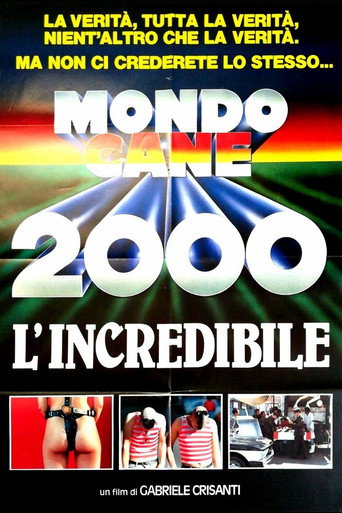
Mondo Cane 2000 - L'incredibile (1988) belongs to a late phase of Italian mondo filmmaking, when the original cycle's promise of disturbing discoveries had become an established commercial language. The feature gathers episodes involving sexuality, drug trafficking, animal experimentation and human exploitation under a title that invokes the notorious 1962 Mondo Cane. Its Italian production synopsis frames the material around a question about modern consumer society: the supposedly civilized world may prove as disturbing as the practices it labels savage. That premise gives the collection a recognizable organizing idea, although the force of the film still depends on successive shocks.
The documentary is significant chiefly as evidence of the mondo format's survival into the late 1980s. It follows the earlier revival Mondo cane oggi - L'orrore continua (1985), while shifting attention toward alleged social scandals and disturbing images of bodies. Italian archival records establish the production's official identity and an eighteen-and-over theatrical classification. They provide less evidence about the provenance of individual sequences. A responsible account therefore separates the film's assertions, the interpretation of its montage and the events independently demonstrated by surviving documentation.
A Late Mondo Production
The film was produced by General Cine International and distributed in Italy by Life International. The Archivio del Cinema Italiano names Gabriele Crisanti as director and identifies a screenplay attributed to Luigi Mangini, with editing by Cesare Bianchini and music by Claudio Cimpanelli. Another established Italian catalogue, Cinematografo, also names Crisanti as director, although its transcription of the writer's surname differs. These records give a firm basis for discussing the 1988 production without inventing an elaborate development history or assigning specific footage to particular camera crews. No substantial first-hand account of the shoot was located among the sources used for this guide.
The relationship to the previous Mondo Cane films is clearest in the title and presentational method. The original 1962 success had made globe-spanning accounts of unfamiliar behavior a recognizable attraction. Crisanti's film continues to arrange discontinuous subjects into a spectacle of moral and physical extremity. It also belongs to a later marketplace in which the mondo label could describe sensational compilations as readily as travel documentaries. Its position within that broader tradition is supported by Giuseppe Previtali's study of how such films blur documentary evidence and theatrical construction. That historical context should not be mistaken for proof of specific scenes being staged.
Consumer Culture and the Exotic
The contemporary Italian synopsis supplies an unusually explicit statement of purpose. It contrasts the idea of supposedly untouched nature with the contradictions of affluent modernity, then moves through drug transportation, sexual commerce and the exploitation of vulnerable people. The title's imagined year 2000 suggests a society moving toward greater absurdity and violence. Those claims are part of the film's own rhetoric, however, rather than verified conclusions about the places and communities on screen. Its presentation invites audiences to recognize a pattern of social decay within an assortment of incidents selected for their sensational potential.
Cinematografo's description also records footage concerning a public gay and lesbian gathering in New York, adult entertainment and experiments on monkeys. Placing a gathering associated with sexual minorities beside abuse, suffering and criminal activity creates an editorial association; it does not demonstrate that these subjects are morally equivalent. This is one of the recurring hazards of mondo narration and sequencing. An audience receives numerous fragments from distinct situations while being encouraged to treat them as evidence of a single disturbing reality. The horror effect arises partly from that forced proximity and from the certainty with which a compilation appears to classify other people's lives.
Documentary Images and Shock
Graphic medical imagery and animal experimentation mark the film's strongest connection with the later shockumentary tradition. Italian synopses identify vivisection, organ trafficking and the movement of illegal drugs among the attractions offered to viewers. Such descriptions establish what the film advertises or depicts; they do not authenticate a reported crime, establish the consent of a photographed person or prove the circumstances in which a surgical image was obtained. The distinction is particularly important when the material concerns exploitation or injured bodies. Repeating the narrator's assertions as established historical events would reproduce the uncertainty on which this kind of spectacle trades.
Previtali's research treats the mondo genre as a useful test case for the reliability of moving images, including the possibility that ostensibly factual material is manufactured or redirected by presentation. Applied to Mondo Cane 2000, this perspective draws attention to the controlling role of selection and juxtaposition. A photograph or shot can show a real body while its implied explanation remains unsupported. The film's frightening quality thus involves more than visible injury: it depends on a documentary voice that presents disturbing sights as privileged access to hidden social realities. Available records do not justify identifying particular sequences here as either fabricated or independently authenticated.
Censorship and Contemporary Response
The clearest primary evidence about the film's public circulation comes from the Italian censorship file preserved by the University of Milan's CHANGES project. An application was submitted on August 2, 1988, and the commission issued its decision on August 8. It authorized exhibition with admission restricted to viewers aged eighteen or older. The published reason referred to especially explicit erotic material and numerous tense sequences. The decision concerns an age restriction attached to an approved release; it must not be presented as a nationwide prohibition or used to infer unlisted cuts to the theatrical print.
A contemporary critical judgment survives through Segnalazioni Cinematografiche, reproduced in Cinematografo's archive. The notice sharply criticized the film's vulgarity and its disjointed documentary form. That response offers evidence of reception at the time, while the censorship record indicates how officials classified its potentially disturbing material. Together they reveal different institutional encounters with the same work: moral assessment on one side, an exhibition decision on the other. Its historical place is consequently that of a late, documented extension of the mondo formula, retaining the genre's interest in graphic spectacle without the original film's position as a pioneering popular event.