Faces of Death VII (1992)

HORROR FILM Documentary
SUBGENRES SHOCKUMENTARY
Runtime
84 min
Release
January 1, 1992
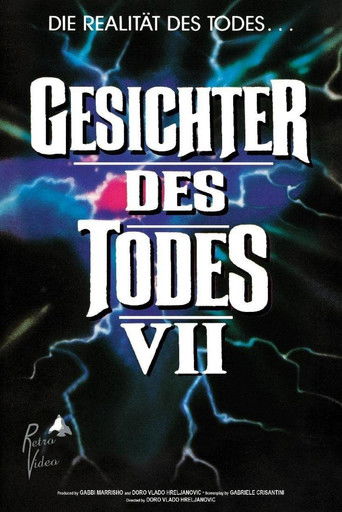
Faces of Death VII (1992) poster
Director
Plot

Circulated under a seventh Faces of Death title in Germany, this shock compilation draws substantially on material associated with Nick Bougas's earlier Death Scenes. Historical crime photographs, images of public figures and other archival records are presented as a collection of disturbing evidence. The edition was not a newly filmed seventh installment by John Alan Schwartz, and its precise selection and editing differ in ways that are not fully documented. Its relationship to the main series lies chiefly in the title and regional repackaging of existing footage.

Film Guide & Analysis

A German-language 1992 shock compilation built from Nick Bougas's Death Scenes material, with a numbering that obscures its separate production history.

Faces of Death VII (1992), also circulated under the German title Gesichter des Todes VII, is a video-era shock documentary assembled largely from material associated with Nick Bougas's Death Scenes (1989). Its numbering suggests another continuation of John Alan Schwartz's notorious series, although the underlying work belongs to a separate production history. The distinction is essential to understanding the film: familiar images of violent death and historical catastrophe were given a new commercial identity, extending the reach of an established horror label without establishing a corresponding new chapter in its original filmmaking cycle.

The German-language edition is catalogued as an approximately 84-minute release. Available descriptions associate it with historical figures, Hollywood deaths, crime photographs and wartime imagery. Much of that material traces back to Bougas's earlier compilation, hosted by Anton LaVey. The precise editing and provenance of individual extracts are less securely documented than the creation of Death Scenes itself. A history of the seventh-titled installment must therefore separate the verified origins of its source film from claims about this particular reassembly.

From Death Scenes to a Numbered Release

The most substantial surviving production evidence concerns the work from which this edition borrows. Bougas developed Death Scenes around a scrapbook maintained by a homicide detective, containing disturbing crime photographs. Records preserved by the Church of Satan describe Bougas showing that collection to Anton LaVey in San Francisco and subsequently supplying the proposed narrator with a script, a video and reproductions of the images. The archive also records an intended late-1989 sales date. These details describe a distinct American project completed before the 1992 German title entered circulation.

The original video's presentation depended heavily on LaVey's voice and public persona. His involvement gave the photographs an ominous explanatory framework, encouraging viewers to regard the collection as a guided examination of actual deaths. In the later German compilation, material associated with that film circulates under a familiar franchise label. The available records do not establish that Schwartz directed new footage for this release or that Bougas oversaw every change made to it. Production credits reproduced in catalogues cannot, by themselves, resolve those questions about editorial responsibility.
Crime Photography, Montage and Apparent Evidence

The images were not created primarily as horror entertainment. The scrapbook behind Death Scenes preserved photographs associated with police investigations, while the broader assemblage incorporated material concerning public figures and historical violence. Reusing such records for a shock compilation changes how viewers encounter them. Pictures once connected to particular investigations appear in rapid succession, organized by the promise of exceptional deaths. The history of the image may be real without making every claim attached to its presentation dependable. Identification, dating and explanation remain separate tasks that a sensational voice-over cannot automatically perform.

Film scholar Nicolò Gallio's research on representations of death in audiovisual media places productions such as Death Scenes within the wider shockumentary and mondo traditions. His analysis examines how compilation structures, narration and repeated images shape the experience of supposedly direct evidence. That framework is useful here because the seventh-titled film relies on reused material whose meaning changes through selection. Connections drawn between an archival photograph and a particular event require documentation independent of the compilation. Repetition under a new title can enhance an image's notoriety without revealing anything further about its original circumstances.

German Circulation and the Problem of Series Identity

The 1992 release belongs to a period when the Faces of Death name had become a recognizable signifier of forbidden or extreme video material. Applying a numbered title to footage derived from Death Scenes placed a separate American production within that commercial framework. Catalogued versions of Bougas's film and the German compilation also have differing running times, a warning against assuming that one was transferred unchanged into the other. Surviving descriptions do not permit a dependable shot-by-shot account of the differences, and no independently verified original production dossier for the German edit has emerged from the consulted sources.

This is a case of franchise identity being created through distribution and repackaging. The name associates the video with Schwartz's earlier shockumentaries, but its photographic source and original presenter lead back to Bougas's production. Claims about legal restrictions, censorship cuts or exact premiere dates require documents specifying this edition rather than another installment with a similar title. None of the available authoritative sources establishes such a record for the 1992 compilation. Its defensible historical significance lies in the circulation of older death imagery across changing labels, languages and home-video contexts.

References

  1. Church of Satan - Historical Archive The Cinematic Adventures of Anton LaVey

    Peggy Nadramia examines correspondence and production materials for Nick Bougas's 1989 Death Scenes, documenting the police scrapbook, Anton LaVey's involvement and the planned video release. Context for the source production, not independent verification of the 1992 German edit.

  2. University of Bologna - Institutional Repository Framing Death. La morte in diretta, tra cinema e media digitali

    Nicolò Gallio's 2013 doctoral research on the cinematic treatment of real death, mondo films, shockumentaries and the recycling of violent images; provides scholarly context for Death Scenes and its later repackaging.

Connections

Cast

View Full Cast & Crew →

Release & Distribution

Release History (1)

Release DateTerritoryRelease TypeFormatDistributorCertificationNotes
1992-01-01 Germany Premiere — — —