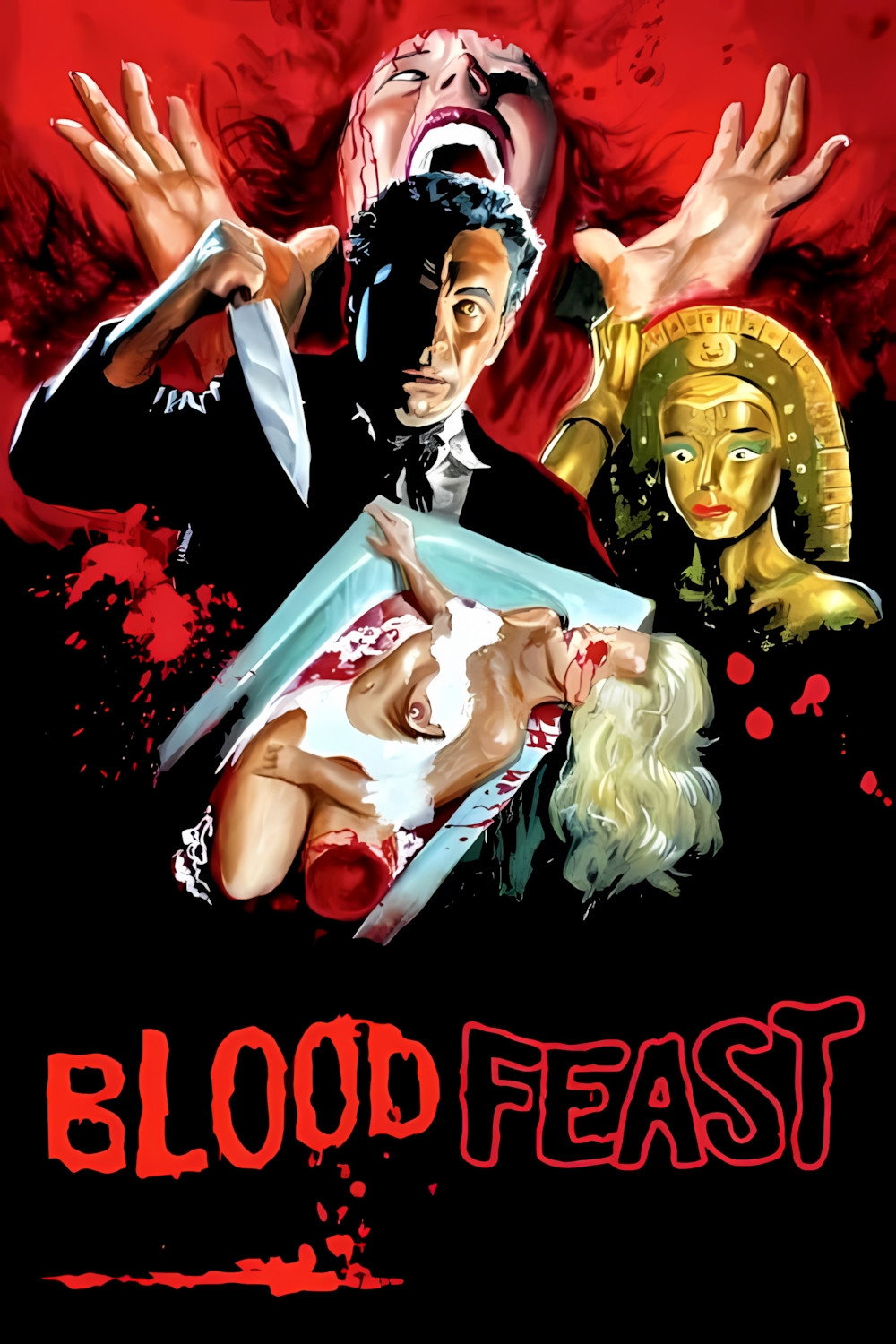
Blood Feast (1963)

US
Runtime
67 min
Release
July 6, 1963
Budget
$24,500
Revenue
$4,000,000
Blood Feast (1963) poster
Production Company
Friedman-Lewis Productions
Plot

In the sleepy suburbs of Miami, seemingly normal Egyptian immigrant Fuad Ramses runs a successful catering business. He also murders young women and plans to use their body parts to revive the goddess Ishtar. The insane Ramses hypnotizes a socialite in order to land a job catering a party for her debutante daughter, Suzette Fremont, and turns the event into an evening of gruesome deaths, bloody dismemberment and ritual sacrifice.

Alternative Titles
Banquete de Sangue (Brazil) — Portuguese 血之盛宴 (China) 血的圣宴 (China) — Chinese Orgie sanglante (France) — French Feast of Flesh (United Kingdom) 血的聖宴 (Hong Kong SAR China) — Chinese Vérlakoma (Hungary) — Hungarian 血の祝祭日 (Japan)
Show all 11 alternative titles 피의 향연 (South Korea) — Korean Кровавый пир (Russia) — Russian Egyptian Blood Feast (United States)

Trailers & Videos

2 videos

Film Guide

The origins of modern splatter: how Herschell Gordon Lewis and David F. Friedman developed Blood Feast through low-budget production, practical gore, drive-in marketing and provocation.

Blood Feast (1963), directed by Herschell Gordon Lewis and produced with David F. Friedman, occupies a pivotal position in the development of American exploitation horror. Its central innovation was to make the graphic aftermath of violence the primary attraction of a commercially distributed feature. Earlier cinema had shown blood and bodily injury, but Lewis organized an entire horror film around sustained, brightly colored displays of mutilation. The murders interrupt a deliberately simple crime story about an Egyptian-themed caterer preparing a ritual feast, and their spectacle was promoted openly to audiences. This approach helped establish the modern splatter film as a recognizable form of low-budget horror.

The film was conceived within the economics of regional independent production, using the drive-in circuit and provocative advertising to reach viewers outside the major studios' normal prestige market. Its rough performances, abrupt editing and inexpensive effects are inseparable from that background. Lewis approached the project as a calculated commercial experiment, while the film's startling violence created a historical importance far beyond its production resources. Blood Feast is therefore best understood through its manufacturing methods, distribution strategy and changing reception, as well as through its images of dismembered bodies.

The Emergence of the Gore Film

Blood Feast appeared during a period when American independent producers had to find subjects that could be sold to theater owners without competing directly with Hollywood's more expensive attractions. Horror already had an established commercial audience, and films such as Psycho (1960) had demonstrated how a single shocking murder could become the center of public discussion. Lewis pursued a different degree of visibility. Instead of relying mainly on the reaction to violence or on images shown after the event, he placed the mutilation itself within the shot and made its prolonged visibility a distinctive selling point.

The claim that Blood Feast was the first splatter film concerns a specific production and exhibition model, rather than the first appearance of screen blood or bodily destruction. Earlier avant-garde, horror and crime films had used disturbing imagery, sometimes with exceptional directness. Lewis and Friedman made explicit gore the repeated organizing attraction of a feature intended for regular commercial circulation. The distinction explains why the film became a reference point in histories of exploitation, even though its technique and performances were often criticized. Its place in the genre developed from the conjunction of what appeared on screen and the promise that its publicity made to paying customers.

The story's exotic ritual imagery belongs to the same strategy of differentiation. Fuad Ramses announces devotion to Ishtar, whom the film presents through an invented Egyptian cult. Ishtar is historically a Mesopotamian deity, and the film's mythology should not be mistaken for a faithful depiction of ancient religion. Its invented archaeological language supplies a pretext for ceremonial violence in contemporary Florida, allowing a sensational premise to operate within an otherwise familiar American setting.

Lewis, Friedman and the Search for a New Market

Before Blood Feast, Lewis and Friedman had worked together in the market for inexpensive sexploitation and so-called nudie-cutie pictures. Their films depended on rapid production, relatively small crews and a clear understanding of what local exhibitors could advertise. Lewis's background in advertising also shaped his view of feature filmmaking: the campaign needed to create a strong reason to buy a ticket. In a substantial later interview with The A.V. Club, he described the commercial problem that prompted the change in genre. The earlier market had become crowded, while studio horror generally avoided explicit physical mutilation.

The idea took shape while the filmmakers were working in Miami. Lewis recalled noticing the artificial sphinx outside the Suez Motel where they were staying. That inexpensive decorative object helped suggest the Egyptian identity of the killer. He also remembered thinking about conventional gangster-film deaths, in which gunshot victims often collapsed with little visible injury. Together, the sphinx and the perceived absence of blood in mainstream screen violence offered the ingredients for a marketable premise. These are Lewis's retrospective accounts of the project's origins, rather than a documented record of every creative decision made during development.

Contemporary trade reporting, preserved in the American Film Institute's historical record, confirms that Friedman viewed gore as a potentially more accessible market than sex films subject to widely varying local censorship rules. That prediction proved imperfect, especially overseas, but it reveals the commercial reasoning behind the experiment. Lewis and Friedman were seeking exhibitors willing to book a product whose controversial content could be advertised as an attraction. The horror formula grew directly from their experience selling marginal films within the American independent distribution system.

Production in Miami and the Improvised Screenplay

The production was mounted in Florida during 1963 with resources usually described in retrospective accounts as approximately $24,000 to $25,000. Recollections differ over exactly how many days were spent shooting; both the director and producer later emphasized an exceptionally compressed schedule, while contemporary summaries provide a longer accounting of principal photography. The reliable conclusion is that the film was made at unusual speed by an extremely small unit. Its cast and locations reflect the practical availability of people and spaces already familiar to the filmmakers.

According to the production history assembled by Turner Classic Movies, Blood Feast was made without a conventional completed shooting script, and dialogue was developed from notes. Allison Louise Downe received the screenplay credit; Lewis and Friedman later associated her contribution with the decision to introduce the worship of Ishtar. The story follows Fuad Ramses, a caterer who kills young women in preparation for a banquet arranged by the Fremont family. Police investigation, romantic scenes and ritual exposition connect the murders, but relatively little screen time is devoted to elaborating the mystery or complicating the killer's motives.

The haste is visible in the acting and staging, particularly in the contrast between Mal Arnold's theatrical Ramses and the more restrained behavior of the police and their acquaintances. The film also used people employed in other capacities: Scott H. Hall, originally working with the crew, stepped into the part of the police captain when the intended performer failed to appear. Such improvisations are important production facts rather than eccentricities to be exaggerated into aesthetic intentions. Blood Feast repeatedly privileges getting the required scene on film over the polished continuity and dramatic development expected of a higher-budget feature.

Color Photography and Practical Gore Effects

The film's sensational impact depended on its use of color. Lewis considered the red of ordinary stage blood insufficiently convincing for photography and recalled commissioning a special mixture through a Miami cosmetics company. Turner Classic Movies records that the resulting preparation included Kaopectate among its ingredients. The blood was designed to register forcefully on color stock, producing an emphatic contrast with bathrooms, clothing and relatively unremarkable domestic interiors. The aim was to make the substance itself impossible to overlook, even when the mechanism of a particular effect remained crude.

The most frequently discussed sequence involves the removal of a woman's tongue. Production accounts identify the material used on camera as a sheep's tongue obtained in the Tampa area. That episode illustrates how the film achieved its physical effects through inexpensive, readily available objects rather than elaborate mechanical prosthetics. Other murders involve severed limbs, exposed internal organs and staged ritual injury. These set pieces are held long enough for viewers to register the artificial flesh and the bodies surrounding it, making visibility a core element of the spectacle.

The same economy governs the film's camera placement and cutting. Instead of carefully hiding every trick, Lewis frequently brings the violent action into comparatively direct view, then uses edits and the reactions of nearby characters to assemble the event. There is little attempt to establish a consistent naturalistic texture between the constructed wounds and the actors' bodies. That inconsistency has become part of the film's critical identity, but the effect of its original theatrical presentation must be considered in historical context. For audiences encountering a feature openly devoted to repeated dismemberment, the willingness to show the act could be more important than technical persuasiveness.

Fuad Ramses, Ritual Violence and Gender

Fuad Ramses is an unusual early figure in the history of the screen serial killer. He is a businessman operating within an everyday American city, yet he pursues a ritual objective that gives his crimes a superficially supernatural explanation. His catering service places him in contact with the family whose celebration he hopes to transform into a blood sacrifice. The murders are therefore linked to food preparation and ceremonial consumption, turning the title into a direct description of the intended climax. Ramses does not acquire the psychological complexity associated with some later screen killers; his dramatic function is to deliver one violent set piece after another.

The film repeatedly directs its violence toward young women, and its publicity treated their threatened bodies as a selling point. That emphasis reflects exploitation cinema's methods of combining sexualized presentation with prohibited spectacle. A historically grounded reading must acknowledge the gendered distribution of injury without attributing a coherent feminist critique to the production. Lewis's own accounts consistently identify differentiation and audience provocation as his primary commercial concerns. The Egyptian setting, meanwhile, relies on sensational stereotypes and an invented account of Ishtar worship rather than serious historical research.

The mixture of ritualism and modern police investigation also keeps the plot accessible to viewers who come chiefly for the effects. Officers seek a recognizable murderer, while Ramses behaves as though he is conducting an ancient ceremony. The gap between those frameworks produces the film's peculiar tone: a straightforward police procedural repeatedly gives way to elaborate acts of ceremonial mutilation. Later horror filmmakers would develop more complex versions of the serial-killer narrative, but Blood Feast's defining priority was already clear. The mechanism of the killings matters less than their capacity to interrupt ordinary life with a display of bodily destruction.

Drive-In Release, Publicity and Commercial Claims

Blood Feast began its American theatrical circulation at a drive-in in the Peoria, Illinois, area in July 1963. Lewis later explained that the comparatively distant opening allowed the partners to test the audience's reaction away from their Chicago base. Its advertising emphasized material more explicit than conventional horror promotions, while the much-repeated publicity gimmick of distributing printed vomit bags reinforced the impression that attendance might be a physical ordeal. The bags, remembered independently in the accounts of Lewis and Friedman, were part of a deliberate effort to sell the experience around the picture as aggressively as the picture itself.

Friedman's carnival-influenced showmanship was especially important. In a retrospective interview published by the Los Angeles Times, he recalled the rapid production, the response of people who saw early footage and the use of sickness as a promotional theme. Lewis likewise described promotional campaigns and newspaper advertising as an essential component of his business model. These testimonies help explain why the drive-in theater was a suitable exhibition space: distributors and theater owners could promote an event built around novelty, provocation and word of mouth without securing the approval or prestige attached to major studio releases.

Exact financial totals demand caution. Later descriptions often attribute several million dollars in returns to the film, while period trade reporting preserved by the AFI cited markedly smaller receipts at specific moments in its distribution life. Gross rental income, total ticket sales and profit have also been treated inconsistently in retrospective accounts. What is well established is that the experiment generated sufficient attention and commercial activity to support further gore productions by Lewis and Friedman. Its wider openings and subsequent circulation made the film more than an isolated local curiosity, but claims of a precise lifetime box-office total require evidence that the surviving summaries do not consistently supply.

Censorship, British Classification and Later Circulation

The history of Blood Feast complicates Lewis's retrospective claim that gore initially fell outside the restrictions applied to sexploitation. American exhibitors could sometimes book material that existing rules had not anticipated, but regional and overseas authorities did not respond uniformly. Contemporary reports summarized by the AFI record a British ban during the original distribution period. The film later became associated with the United Kingdom's video-nasty controversy, when the availability of violent titles on home video prompted new scrutiny and attempts to restrict circulation. These distinct episodes should not be compressed into one continuous censorship decision.

The British Board of Film Classification's surviving record provides concrete evidence of later changes. In 2001 the BBFC required four cuts to shots of a woman being whipped before approving a home-video release with an 18 classification. The record links those cuts to concerns arising from an earlier prosecution under the Obscene Publications Act. In 2005 the board waived the previous cuts for another home-entertainment submission. This history concerns specific submitted video versions and regulatory decisions; it does not mean that every circulating copy had an identical running time or that the original American release was altered in precisely the same way.

Home-video circulation eventually made Lewis's work easier to see outside the drive-in environment for which it had been produced. Reissues, retrospective screenings and high-definition presentations also allowed audiences to revisit effects and performances that originally functioned as part of a sensational theatrical campaign. The film's continuing visibility demonstrates how the cultural status of exploitation material can change: a work once sold principally through the promise of forbidden images later became the subject of serious historical writing and institutional repertory programming.

Critical Reception and the Splatter Tradition

The earliest substantial critical responses to Blood Feast were hostile to its filmmaking as well as its graphic content. Period reviews discussed in historical research attacked its construction, performances and sensationalism. Later criticism has not generally rehabilitated those weaknesses as hidden technical mastery. Writing for BFI's Sight and Sound, Stephen Thrower argued instead that the film's unruly combination of coarse filmmaking and extravagant violence produces a disruptive mixture of disgust and grotesque humor. Its critical history therefore involves separating artistic evaluation from the significance of a particular industrial and generic breakthrough.

The film became a point of reference for subsequent low-budget horror by showing that graphic mutilation could be both the central content of a feature and its principal marketing identity. Lewis and Friedman continued the experiment with Two Thousand Maniacs! (1964) and Color Me Blood Red (1965), commonly grouped with Blood Feast as an early gore cycle. Later slasher and splatter films developed very different narrative methods and production techniques, and the existence of a broad genre does not by itself prove direct influence in every case. The more defensible claim is that Blood Feast demonstrated the commercial possibilities of repeated explicit screen violence within American independent horror.

Its cult reputation was also sustained by later filmmakers and viewers who valued the film's defiant bad taste. John Waters publicly embraced Lewis's work, while interviews from the 2000s show Lewis looking back at the original venture primarily as a successful marketing decision. These views need not be reconciled into a single judgment of quality. Blood Feast remains historically important because its mode of production, practical imagery and sensational exhibition strategy helped define the language and business of splatter cinema, despite its widely acknowledged dramatic and technical shortcomings.

References

  1. BFI / Sight and Sound RIP Herschell Gordon Lewis, the Godfather of Gore

    Stephen Thrower examines the origins of Blood Feast, the shift from sexploitation to gore, its drive-in success, and its role in the subsequent splatter tradition.

  2. Turner Classic Movies Insider Info (Blood Feast) — Behind the Scenes

    Richard Harland Smith reconstructs the Miami shoot, screenplay improvisation, makeup materials, practical effects, locations and promotional gimmicks from interviews and production commentary.

  3. The A.V. Club Herschell Gordon Lewis

    Nathan Rabin’s extended original interview documents the director’s account of the Suez Motel inspiration, custom stage blood, rapid production, Peoria opening and marketing strategy.

  4. Los Angeles Times Blood! Guts! Gall!

    Frederick Burger’s in-depth reportage includes first-hand testimony from producer David F. Friedman on Blood Feast’s origins, production costs, theatrical promotion and later commercial life.

Cast

View Full Cast & Crew →

Release & Distribution

Production Companies (1)

  • Friedman-Lewis Productions

Distributors (1)

  • Bob Murawski

Release History (6)

Release DateTerritoryRelease TypeFormatDistributorCertificationNotes
1963-07-06 Canada Limited Theatrical — — 18A
1963-07-06 United States Theatrical — — — Peoria, Illinois
2000-02-22 United States Physical VHS, DVD — — VHS & DVD
2002-10-28 United Kingdom Physical DVD — 18 DVD
2017-10-10 United States Physical Blu-ray — — Blu-ray
2020-08-02 Germany Physical — — 18
You'll Recoil and Shudder as You Witness the Slaughter and Mutilation of Nubile Young Girls - in a Weird and Horrendous Ancient Rite!