From Dennis Wheatley’s Novel to Hammer
Dennis Wheatley’s The Devil Rides Out appeared in 1934 and established the Duc de Richleau as a leading figure in the author’s supernatural adventures. The novel presents occult practices through an elaborate mixture of ceremonial magic, Christian language, esoteric speculation and sensational danger. Its villain, Mocata, belongs to a fictional world shaped by early-twentieth-century fears of clandestine magical societies. Scholarship by Ethan Doyle White traces the story’s witches’ sabbath imagery to wider traditions of literary demonology. Such material is relevant to the history of horror fiction, but its descriptions of actual occult communities must be understood as inventions and inherited stereotypes rather than reliable ethnography.
Christopher Lee helped make the book attractive to Hammer. He knew Wheatley personally and encouraged the company to adapt his work, an initiative documented in later production histories. Developing the screenplay proved less immediate. An earlier version by John Hunter did not satisfy the producers, and the subject of overt devil worship raised concerns about contemporary British censorship. Hammer eventually commissioned Richard Matheson, already experienced in supernatural and science-fiction screenwriting, to prepare the version that reached the screen.
Wheatley visited Elstree Studios on 15 September 1967 while The Devil Rides Out and another Hammer adaptation, The Lost Continent, were in production. Elstree & Borehamwood Museum records his meeting with Lee, Fisher and producer Anthony Nelson Keys, together with the author’s favourable response to the finished adaptation. This visit provides a documented connection between novelist and filmmakers without implying that Wheatley personally directed the screenplay process. The film was part of Hammer’s effort to work beyond the established Dracula and Frankenstein cycles while retaining the visually emphatic style associated with those earlier successes.
Richard Matheson and the Shape of the Story
Matheson condenses Wheatley’s expansive adventure into a direct succession of threats and countermeasures. De Richleau and Rex Van Ryn investigate Simon’s new acquaintances, discover an occult circle and attempt to prevent his formal initiation. Tanith, another prospective member of Mocata’s group, becomes the focus of a rescue that also develops into a romantic attachment with Rex. The screenplay repeatedly changes the protagonists’ circumstances without requiring them to abandon their initial goal. An inquiry at a private house leads to the sabbath, a temporary escape leads to psychic pursuit, and the final confrontation makes the rules of protection decisive.
The novel contains additional travel and occult exposition, including a more extensive international plot, that the film does not reproduce. Ryan Harvey’s close comparison identifies the removal of a planned geopolitical conspiracy and changes to the final action. These alterations make the film less dependent on the accumulation of esoteric information that structures passages of Wheatley’s prose. Instead, viewers learn the supernatural rules when they become necessary: a pentacle must not be crossed, an apparent visitor may be an illusion, and someone under Mocata’s influence can become dangerous to others. This approach gives the film a clear progression of suspense despite the unfamiliar vocabulary of its fictional magic.
The adaptation also makes physical encounters central to scenes that could have remained verbal contests. A car breaks into the sabbath to interrupt an initiation, and the Eaton home becomes the site of a sustained supernatural attack. Both sequences translate ritual danger into cinematic movement and spatial boundaries. Matheson’s dialogue allows de Richleau to explain essential ideas, although the character’s expertise can make other members of the group dependent on his instructions. The underlying conflict is therefore partly about who possesses knowledge and whether that knowledge is used to protect or command another person.
Terence Fisher and Production at Elstree
Production took place in 1967, with the main work undertaken at the Associated British studios in Elstree. Location research identifies outdoor photography in Black Park, Buckinghamshire, for the sabbath, as well as country-house exteriors in Hertfordshire. The English estates and motor roads provide a setting distinct from Hammer’s familiar medieval castles. Cars, observatories and rooms designed for comfortable domestic life become places where supernatural danger is discovered.
Fisher directs the activity through a succession of clearly organized spaces. Simon’s house initially appears to be a fashionable location for a private gathering, but the observatory reveals symbols and arrangements that alter its meaning. The nocturnal sabbath takes the story into the open countryside, where the protagonists can be seen watching a ceremony from a distance before intervening. The Eaton home offers the opposite problem: familiar rooms are kept under surveillance by forces that appear to cross the limits of walls and doors. This movement from investigation to confrontation gives the supernatural increasingly immediate access to the characters.
Bernard Robinson’s production design and Arthur Grant’s Technicolor photography support those shifts in scale. Formal interiors and polished objects sit beside ritual diagrams, candles and threatening night landscapes. Fisher’s direction does not rely on constant camera movement; he often gives the viewer time to register the arrangement of a room before an interruption changes its significance. The film’s visual construction can consequently be separated from general claims that all Hammer horror is alike. Here ritual knowledge is expressed through the precise placement of figures inside landscapes and protective enclosures, a method especially visible during the long night at the Eatons’ house.
Christopher Lee, Charles Gray and Hypnotic Command
The casting reverses one of the most familiar relationships in Hammer horror. Lee, widely associated with Dracula and other threatening figures, plays the knowledgeable defender, while Charles Gray embodies a villain whose greatest power is often exercised without physical contact. De Richleau can be severe and intimidating, traits that help make his competence credible without turning him into an uncomplicated figure of reassurance. Lee’s authority matters because the other characters must accept rules they cannot test safely. The performance asks the audience to trust someone whose knowledge of darkness is nearly as complete as the villain’s.
Gray gives Mocata a controlled social manner. He can discuss apparently ordinary matters with a host while attempting to place her under his influence. The encounter with Marie Eaton, played by Sarah Lawson, is particularly important to Fisher’s style. Their conversation begins in an unremarkable sitting room, then gradually turns into a struggle over Marie’s concentration and freedom. Increasingly close framings isolate Mocata’s gaze, while the threat to the people upstairs becomes apparent before anyone can intervene. The sequence has little need for visible monsters because its immediate subject is the possibility of one person taking command of another’s actions.
Patrick Mower’s Simon and Niké Arrighi’s Tanith occupy a more vulnerable position, their involvement with the circle making them both the purpose and the instruments of Mocata’s plans. Leon Greene’s Rex supplies practical initiative, while Richard and Marie Eaton offer shelter that becomes increasingly dangerous to provide. Their daughter Peggy intensifies the consequences of supernatural attack within an ordinary family. These relationships sustain the human stakes of the conflict, even though the narrative is principally organized around de Richleau’s knowledge. The concern is as much the destruction of individual will as the spectacle of demons appearing before the camera.
The Sabbath, Baphomet and Occult Imagery
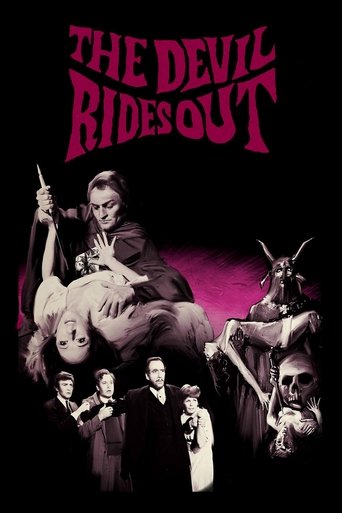
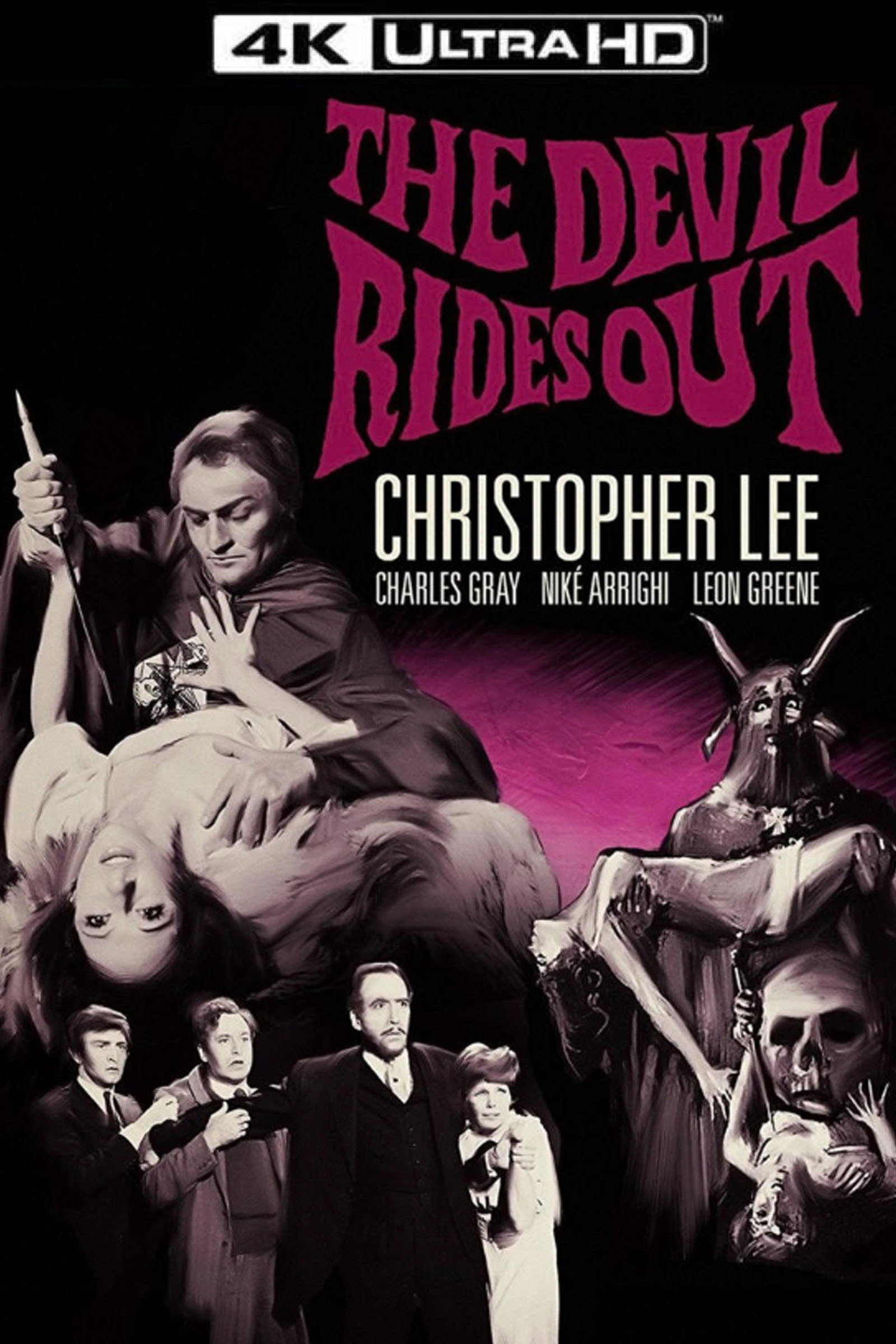
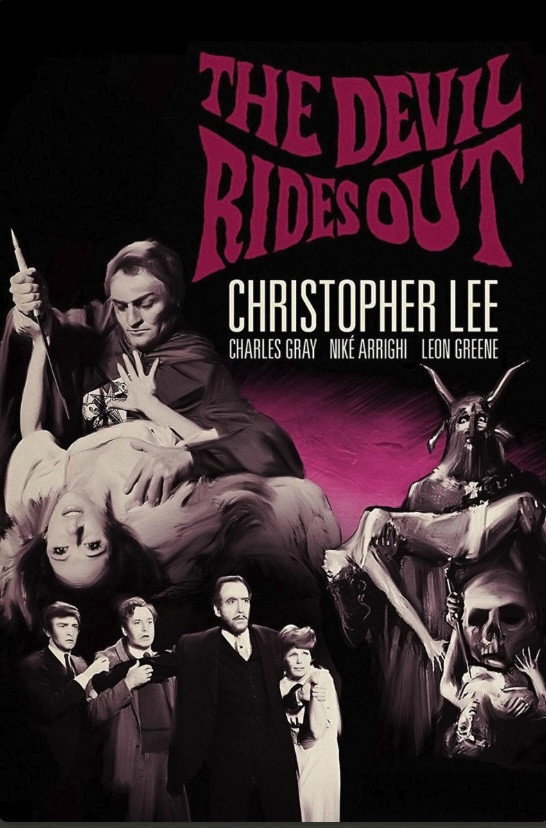
The outdoor sabbath is among the film’s defining sequences. Initiates assemble around a fire while Mocata supervises rites that culminate in the appearance of a horned figure, identified within the story as the Goat of Mendes or Baphomet. The supernatural event makes the cult’s claims visibly consequential within the film’s fictional world. De Richleau’s intervention turns a secret ceremony into an action scene, joining a relatively restrained depiction of the gathering to the direct threat of a summoned creature. The sequence provides one of the clearest departures from Hammer’s familiar images of aristocratic vampires and laboratory-created bodies.
Ethan Doyle White’s research distinguishes the film’s ceremony from the more sexually explicit and elaborate gathering described in Wheatley’s novel. The adaptation shows fully clothed participants and limits the depiction of sexuality while retaining robes, ritual speech, a goat and an infernal manifestation. It also introduces expressions influenced by modern Wiccan practice, drawing from different strands of occult culture to construct a fictional Satanic rite. The ceremony should therefore be read as a designed screen representation, not evidence that contemporary practitioners conducted rituals in this fashion.
That historical context is especially important where ritual scenes use associations between spiritual danger and cultural otherness. Wheatley’s prose contains racialized descriptions of the alleged sabbath, and Doyle White discusses how such ideas informed twentieth-century representations of occult groups. The film softens some of the novel’s explicit content but retains a sinister, exoticized understanding of collective ritual. Its narrative assumes that the protective magic practised by de Richleau and the coercive practices directed by Mocata have objectively different moral purposes. These distinctions govern the story, but they do not make its invented occult hierarchy a neutral account of actual religious history.
Photography, Editing and James Bernard’s Score
Arthur Grant’s colour photography distinguishes brightly appointed homes from the more uncertain spaces of the sabbath and supernatural siege. During Mocata’s conversation with Marie, the camera’s progression toward close views makes hypnosis visible through changes in framing rather than through a continuous optical display. The spectator observes control taking hold before the people elsewhere in the house understand its extent. The protective circle later reverses this arrangement: the group is shown together in a limited area, while the space beyond the boundary becomes unpredictable. These formal choices give supernatural principles a physical shape that can be understood without elaborate explanation.
Editing contributes to the contrast between knowledge and exposure. Encounters with the cult are intercut with the attempts of de Richleau and Rex to protect their friends, allowing information gained by one group to change the urgency of another’s actions. The siege sequence instead restricts movement, repeatedly testing whether characters can remain inside the circle despite terrifying distractions. The result is suspense built around a prohibition that the audience understands. Fisher’s camera and the film’s cutting return attention to the same vulnerable border, so an apparently minor shift of position can carry more danger than a large-scale attack.
James Bernard composed the score, with Philip Martell credited for musical supervision. Bernard’s music gives the confrontation a ceremonial weight, using emphatic orchestral writing to mark the presence and apparent reach of supernatural power. During moments of hypnotic influence and ritual action, musical intensity extends the danger beyond what is immediately visible. The main-title material also announces the film’s occult subject before its plot has fully begun. Accounts of the music’s dramatic function are supported by the finished soundtrack and contemporary production credits; identifying particular studio instruments or recording methods would require separate documentary evidence.
Practical Effects and the Supernatural Siege
The climax at the Eaton home depends on special effects as well as on the performances and spatial rules established earlier. A giant spider appears among the threats, followed by the terrifying prospect of the Angel of Death on horseback. These visitations challenge the occupants to remain inside their protective circle, where fear itself can become dangerous if someone crosses the boundary. The effects are not equally convincing in every shot, and later commentators have noted the limits of certain optical composites. Their narrative function, however, is clear: the apparitions test the characters’ capacity to follow instructions while danger appears to take many different shapes.
Michael Stainer-Hutchins is credited with special effects, while historical production accounts also discuss work by Hammer technicians and the makeup used for the Goat of Mendes. The goat-headed creature combines costume and performance with the film’s designed ritual environment; the supernatural siege makes greater use of composited imagery. It would be misleading to attribute every completed effect to one individual on the basis of general credits. The practical elements and photographic interventions have different functions, with the former giving the sabbath its tangible centre and the latter allowing impossible visitors to appear inside the domestic setting.
The later history of these images is unusually significant. In 2012 a StudioCanal Blu-ray presentation digitally changed several optical-effects shots, including material associated with the spider, the Angel of Death and the climax. Darren Stockford documented the changes soon after release and questioned the absence of the original presentation on that edition. A subsequent American Blu-ray supplied a new transfer retaining the period effects and also included the digitally revised version. These are different presentations of the same film, and modern alterations must not be described as effects executed during the 1967 production.
Release, Critical Standing and Hammer’s Occult Legacy
The Devil Rides Out reached British cinemas in July 1968, after its photography had been completed the previous year. It circulated in the United States as The Devil’s Bride, a distinct release title rather than a separate feature. Contemporary British classification records identify an adult X certificate for the original cinema presentation, whereas later home-video editions carried different certificates. The film is commonly catalogued at approximately 95 minutes, although video formats and presentation speeds have produced differing stated durations. Such discrepancies should not automatically be treated as proof of censorship or missing scenes.
Its reputation has developed around the commitment of the principal actors, Fisher’s command of suspense and the striking difference between Lee’s heroic role and his familiar Hammer monsters. The British Film Institute has highlighted the performances of Lee and Gray when identifying major achievements from the studio’s horror period. Later criticism has also discussed the relative weakness of some effects shots and the tension between the film’s earnest occult mythology and the changing expectations of late-1960s audiences. Those observations concern different elements of the work and need not be flattened into a single verdict about its quality or initial box-office performance.
The film belongs to the growing visibility of Satanic horror around the release of Rosemary’s Baby (1968), although the projects have different origins and approaches to religious fear. Hammer would return to Wheatley with To the Devil a Daughter (1976), whose production and contemporary setting followed another course. The Devil Rides Out remains a distinctive example of occult horror organized around rules, counter-rituals and the vulnerability of the will. Its historical place is also illuminated by the restoration debate: subsequent viewers have been able to compare the expressive ambition of the original effects with later attempts to revise them.