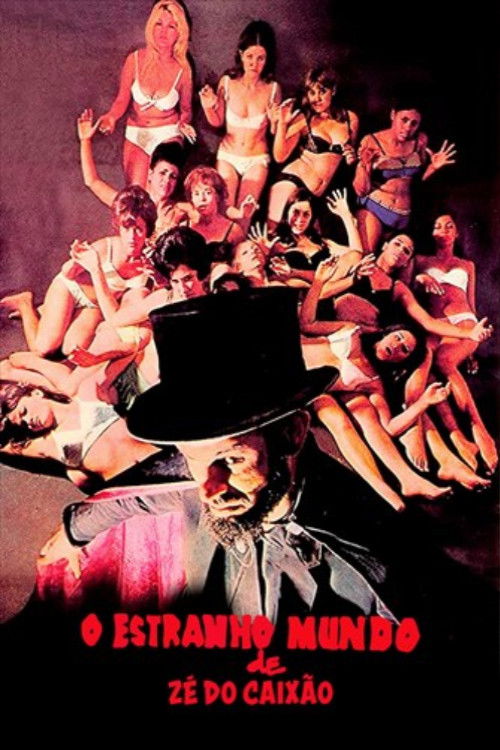
The Strange World of Coffin Joe (1968)

BR
HORROR FILM
SUBGENRES HORROR ANTHOLOGY
Runtime
80 min
Release
November 25, 1968
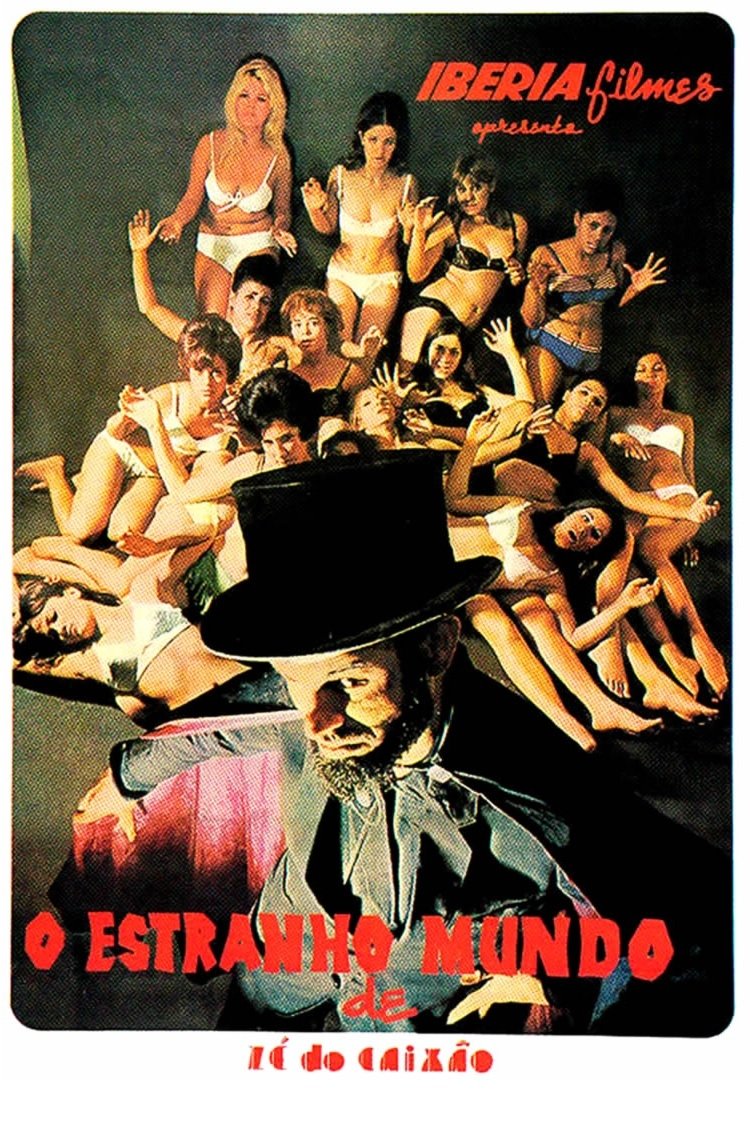
The Strange World of Coffin Joe (1968) poster
Plot

Coffin Joe presents an anthology film which tells three macabre tales, all delightfully demented, perverted and grotesque.

Alternative Titles
科夫·乔的恐怖世界 (China) — Chinese Le monde étrange de Coffin Joe (France) Le monde étrange de Zé do Caixão (France) — French Lo strano mondo di Zé do Caixão (Italy) — Italian

Film Guide & Analysis

An in-depth look at the production, anthology structure, censorship, transgressive philosophy, Coffin Joe persona and restoration of The Strange World of Coffin Joe (1968).

The Strange World of Coffin Joe, originally titled O Estranho Mundo de Zé do Caixão, is a 1968 Brazilian horror anthology directed by José Mojica Marins from stories developed by Marins and screenplays by Rubens Francisco Lucchetti. Divided into three independent episodes — O Fabricante de Bonecas (The Dollmaker), A Tara (Obsession) and A Ideologia (Theory or Ideology) — the film moves through murder, fetishism, necrophilia, sadism and cannibalism while repeatedly returning to the idea that supposedly civilized behaviour can conceal primitive desires.

Despite its title, the film is not a conventional continuation of the narrative begun in At Midnight I’ll Take Your Soul and This Night I’ll Possess Your Corpse. Zé do Caixão functions primarily as a framing presence associated with the stories rather than as the protagonist of another chapter in his search for the perfect woman. Marins instead uses the anthology form to extend the philosophy and imagery surrounding his creation beyond a single character. The result is one of the clearest examples of how the Coffin Joe identity was expanding during the late 1960s from a movie villain into a broader Brazilian horror persona.

Production & the Collaboration with R. F. Lucchetti

The film emerged during one of the most productive periods of Marins's career. His first two Coffin Joe features had already established a highly personal form of Brazilian horror built from low-budget filmmaking, religious provocation, physical cruelty and the philosophical declarations of a protagonist who rejects conventional morality. For the new project Marins collaborated with writer Rubens Francisco Lucchetti, who had become fascinated by his work after seeing At Midnight I’ll Take Your Soul.

Lucchetti later recalled that Marins invited him to write a film composed of three episodes. Marins supplied the basic ideas, sometimes little more than story concepts, and Lucchetti developed them into screenplays. Their collaboration became much broader than this single feature: during the same period Lucchetti worked as Marins's writer and press adviser and contributed to television programmes and publications connected to the Coffin Joe image.

The production was made in São Paulo by Produtora e Distribuidora Ibéria. Marins and George Michel were credited as producers, with Michel also appearing prominently in the second episode. Giorgio Attili handled cinematography and Eduardo Llorente edited the film. The Cinemateca Brasileira records the production as a 35mm black-and-white feature, continuing the stark monochrome visual world associated with much of Marins's earlier horror work.

The anthology structure gave the production a practical advantage as well as an artistic one. Instead of sustaining a single elaborate narrative, Marins could build three compact worlds around strong central images and final revelations. The episodes differ considerably in rhythm, but all move toward bodily or psychological transgression.

Three Tales of Desire and Violence

The Dollmaker is the most conventionally structured of the three stories. A craftsman renowned for producing unusually realistic dolls lives and works with his daughters. Criminals learn that he supposedly keeps money in his home and invade the property, only to discover that the daughters and their father are considerably more dangerous than expected. The final revelation explains the disturbing realism of the dolls and transforms an apparently familiar crime narrative into a grotesque story about bodies being converted into raw material.

The episode works through reversal. The intruders initially appear to possess complete physical control of the household, and the women seem to be their intended victims. Marins gradually reverses those positions until the attackers themselves become objects. The concept anticipates a recurring characteristic of anthology horror: a relatively simple narrative built around one macabre idea whose full meaning is withheld until the closing moments.

A Tara is radically different. George Michel plays a balloon seller who becomes obsessed with a woman played by Íris Bruzzi. The episode is largely constructed without conventional dialogue and observes his fascination from a distance, particularly his fixation on her feet and on a pair of shoes she loses. After the woman is murdered, his obsession continues beyond death and ultimately leads him into her tomb.

Rather than relying on a final shock in the same manner as The Dollmaker, A Tara develops through repetition and prolonged observation. The balloon seller follows the woman through ordinary public spaces but remains socially and physically separated from her. Her death does not end the fantasy; it removes the barrier created by her independent existence. The resulting necrophilic imagery makes the episode less a conventional supernatural story than a study of desire continuing after the person who inspired it has ceased to be alive.

A Ideologia and the Philosophy of Coffin Joe

The third and longest episode, A Ideologia, moves closest to the philosophical territory associated with Zé do Caixão. Marins plays Professor Oãxiac Odéz, whose name itself echoes Coffin Joe through a reversal of “Zé do Caixão.” The professor argues that instinct ultimately dominates reason, morality and even love. When another intellectual rejects that position, Oãxiac decides to demonstrate his theory.

The disagreement leads the professor and his wife into a controlled environment in which they are exposed to increasingly brutal scenes. Violence becomes an experiment designed to strip away civilized behaviour. The purpose of the ordeal is not simply to hurt the couple but to prove that moral principles collapse when the body is subjected to sufficient hunger, fear and desire.

This is where the film most clearly transfers Coffin Joe's worldview into another form. The character who dominates the episode is not literally presented as the graveyard undertaker of the earlier films, yet his reasoning belongs to the same intellectual territory. Both reject conventional morality as an artificial restraint imposed upon biological existence. Both attempt to demonstrate their beliefs through physical experiments performed on other people.

The episode pushes this logic into cannibalism and ritualised cruelty. Marins uses shock not merely as a narrative surprise but as part of an argument within the film: if human beings can be reduced to instinct under sufficiently extreme conditions, then civilization itself becomes fragile. Whether the experiment genuinely proves the professor's position is less important than the spectacle of a character trying to turn philosophical nihilism into physical evidence.

Censorship and the Military Dictatorship

The film was produced during the Brazilian military dictatorship, and its relationship with censorship became especially important. The official Cinemateca record documents its submission to Federal Censorship and its eventual restriction to viewers over eighteen. The surviving history of the censorship process, however, shows that securing release involved more than receiving an adult classification.

A Ideologia created the greatest difficulties. Its combination of sexual behaviour, torture, cannibalism and explicitly anti-moral reasoning was particularly vulnerable to authorities concerned with protecting accepted religious, social and familial values. Material was removed, and the ending became a major point of negotiation between the filmmakers and the censors.

Research into the censorship files shows how closely the authorities examined the film's representation of behaviour they regarded as abnormal or socially dangerous. The problem was not simply graphic violence. The professor's attempt to prove that morality and love could be overcome by instinct challenged the normative ideas that censorship was itself intended to defend. The third episode therefore became a confrontation between Mojica's deliberately transgressive worldview and an institution designed to preserve acceptable representations of social order.

The censorship history subsequently became part of the film's own afterlife. Material omitted from theatrical circulation was referenced elsewhere in the Coffin Joe universe, and the associated magazine later promoted a photographic version of A Ideologia partly on the basis that readers could see images that had been removed from cinemas. Modern restorations have also preserved an alternative ending, making it possible to examine how the film existed before and after official intervention.

The Brazilian theatrical release finally took place in São Paulo on November 25, 1968. The timing is historically significant: the film reached cinemas only weeks before the issuing of Institutional Act Number Five in December, which dramatically intensified authoritarian control and political repression in Brazil.

Horror, Bodies & Black-and-White Imagery

The three stories are united less by plot than by Marins's fascination with bodies as objects that can be transformed, possessed, desired or destroyed. Eyes become components of manufactured objects. Sexual desire survives death. Hunger and terror become tools for dismantling moral behaviour. The body repeatedly undermines the idea that human beings can remain governed entirely by rational or social rules.

Giorgio Attili's black-and-white photography supports that emphasis through high contrast and relatively direct staging. Marins's filmmaking does not depend upon elaborate visual polish. Rooms frequently become theatrical spaces in which performers, objects and bodies are arranged for maximum confrontation. Close views of faces and physical details become particularly important when the narrative reaches its moments of revelation.

The film also shifts styles between episodes. The Dollmaker functions like a compact macabre tale built around a twist. A Tara depends much more heavily on visual observation and repetition. A Ideologia becomes almost a philosophical chamber of horrors, progressively replacing discussion with demonstrations of degradation. The anthology format therefore allowed Marins to experiment with several approaches without abandoning the obsessive themes that connected them.

Violence is similarly variable. Some of the strongest images are not technically elaborate but gain force through duration, performance or conceptual extremity. This economy was fundamental to Marins's cinema. Limited production resources were repeatedly redirected toward ideas and images difficult to find in mainstream Brazilian filmmaking of the same period.

Coffin Joe Beyond the Feature Films

The title O Estranho Mundo de Zé do Caixão became more than the name of this film. During the same period, Marins and Lucchetti were developing Coffin Joe across other media. A television programme used the character as a presenter of horror material, and Lucchetti subsequently conceived a comic publication built around the same principle: Zé do Caixão could introduce stories without necessarily being their protagonist.

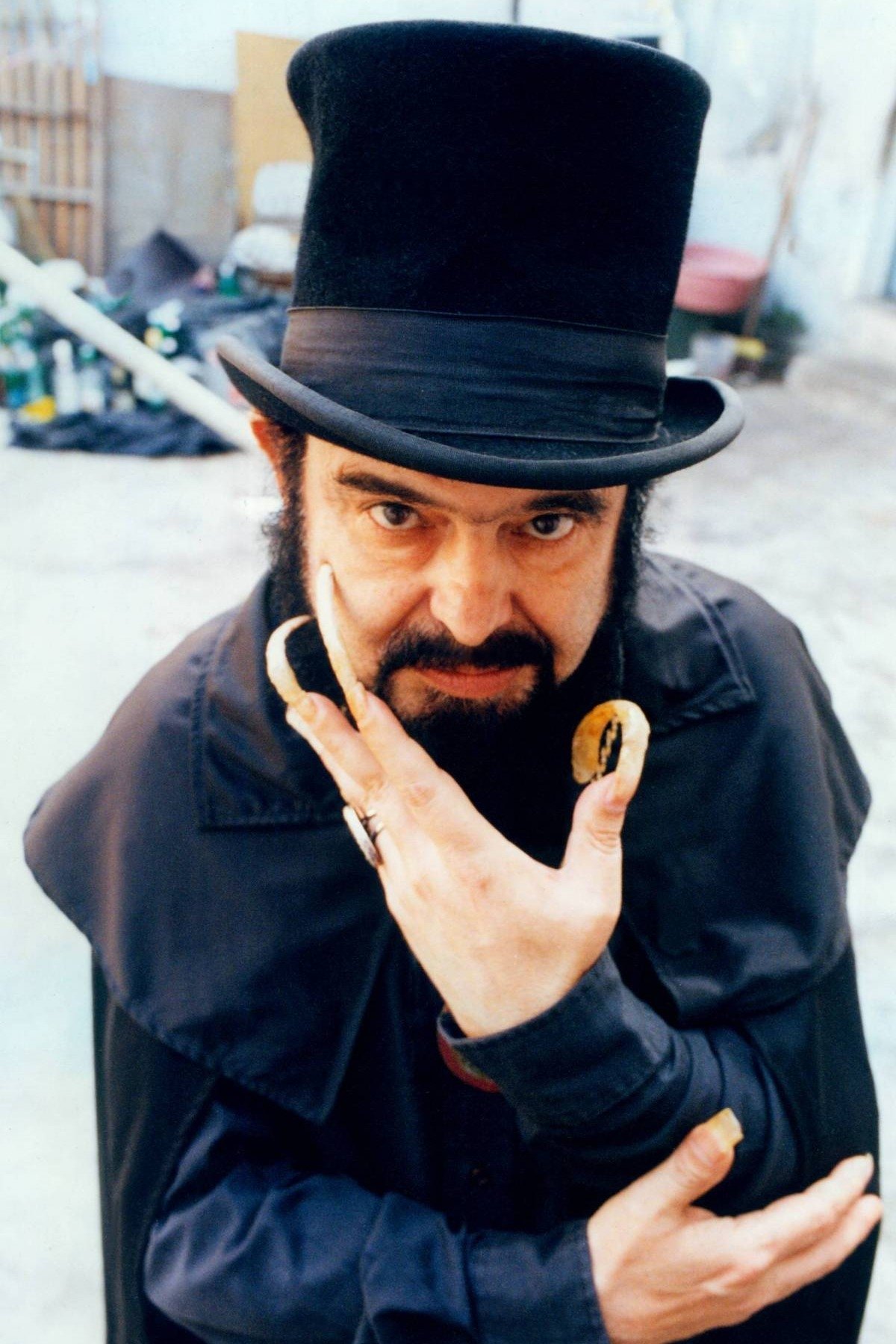
That shift was significant for the character's longevity. In At Midnight I’ll Take Your Soul, Zé is a specific fictional undertaker pursuing his own goals. By the late 1960s, Marins himself could appear in costume as a horror host, public personality and guide into unrelated grotesque stories. The boundaries between José Mojica Marins, the fictional Zé do Caixão and the public image surrounding both became increasingly fluid.

The Strange World of Coffin Joe therefore occupies an important transitional position. It belongs to the same creative period as the first Coffin Joe films, but its anthology structure demonstrates that the concept no longer depended entirely on narrative continuity. The “strange world” could encompass any story compatible with Marins's interests in death, taboo, cruelty and challenges to conventional morality.

This expansion also helps explain the durability of the character within Brazilian popular culture. Coffin Joe became capable of functioning as villain, philosopher, presenter and emblem of horror. The film is consequently important not because it advances the central Coffin Joe storyline, but because it demonstrates how rapidly the persona was evolving beyond it.

Restoration & Legacy

For many years, international knowledge of Marins's films depended heavily on imperfect prints and home-video transfers. The Strange World of Coffin Joe later became part of a major restoration project devoted to his surviving work. A new 4K restoration was completed in Brazil by Cinecolor using a 35mm interpositive and a surviving 35mm print, under the supervision of producer Paulo Sacramento and with support from Arrow Films.

The restoration is particularly valuable because the surviving materials themselves reflect the complicated history of the film. Age, censorship, different versions and decades of circulation made preservation of Mojica's work more difficult than the preservation histories of many better-funded productions. The modern restoration does not erase that history but makes the film available in a form substantially closer to its original photographic character.

Its position within Marins's filmography remains distinct from the central Coffin Joe trilogy. At Midnight I’ll Take Your Soul created the character, This Night I’ll Possess Your Corpse expanded his mythology, and decades later Embodiment of Evil completed that narrative line. The Strange World of Coffin Joe instead demonstrates what could happen once the character became larger than his own story.

The film's three episodes also preserve a concentrated sample of the material that made Mojica so difficult to assimilate into respectable genre cinema of his period: exploitation, sexuality, blasphemy, bodily mutilation, philosophical provocation and a willingness to treat socially forbidden desires as legitimate subjects for horror. Combined with its censorship history and its connection to television and comics, that makes The Strange World of Coffin Joe an important document of the moment when Brazilian horror began building one of its first genuinely transmedia icons.

Cast

View Full Cast & Crew →

Release & Distribution

Release History (1)

Release DateTerritoryRelease TypeFormatDistributorCertificationNotes
1968-11-25 Brazil Theatrical — — 18