Development and Franchise Identity
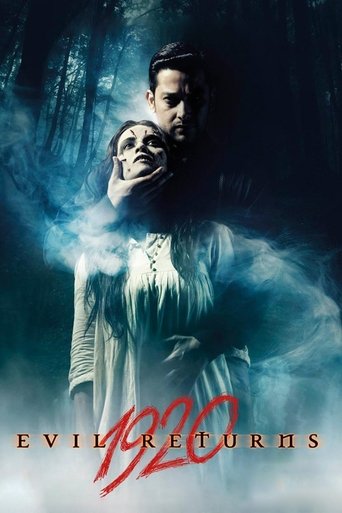
The relationship between the two 1920 films was defined publicly before the second picture opened. In an October 2012 interview with Koimoi, Bhatt stated that their stories and characters were unrelated. He argued that the title carried a recognizable promise of Gothic atmosphere, possession and music, and compared the approach with other Indian film brands whose successive entries were narratively independent. This makes Evil Returns a franchise continuation, despite the absence of events that directly extend the 2008 film's story. Its period setting serves as a common identifying feature rather than evidence of a shared plot.
Bhushan Patel directed the new film after working as a cinematographer, including on Bhatt's 3D horror production Haunted (2011). For his first feature as director, he took on a project associated with a producer already established in Hindi supernatural cinema. The central romance joins Jaidev's memories of a woman he believes lost to the mystery of Smriti's missing past. Possession consequently enters the story through an existing emotional wound. The setup provides a reason for Jaidev to resist warnings about his guest even as the disturbances around her intensify.
Swedish Locations and the Abandoned 3D Plan
The production used Swedish locations to represent India in the early twentieth century. In an interview published by Glamsham on the release date, Aftab Shivdasani explained that the filmmakers selected sites with few visibly country-specific markers. He singled out the castle and exterior landscapes as elements intended to give the film a more expansive look than its predecessor. The strategy places the characters within European Gothic architecture while asking the setting to function as an Indian historical environment. The distance between the real location and the fictional geography is therefore a documented production choice.
Patel also discussed why the film was released in two dimensions, at a time when Bhatt's nearby productions had made use of stereoscopic photography. He had considered shooting in 3D, but the necessary equipment and personnel were occupied with other projects. Waiting would have delayed filming, and Patel rejected a later conversion from 2D as aesthetically unsatisfactory. His remarks distinguish an abandoned production possibility from a cut or missing three-dimensional version: the completed feature was photographed and released as a conventional 2D film. The decision reflects a concrete scheduling constraint rather than a change made after a finished 3D production.
Romance, Possession and Gothic Horror
Evil Returns builds its supernatural threat around a woman whose memory fails her. Jaidev takes Smriti into his household after finding her unconscious, while his sister Karuna becomes increasingly alarmed by the disturbances that follow. The poet's wish to help the stranger is complicated by an older romance that he has never been able to resolve. These relationships bring suspicion into the home before the possession becomes fully apparent. The film uses uncertainty about a woman's identity alongside physical signs of spiritual intrusion, joining romantic melodrama to a narrative of escalating danger.
Its horror scenes rely on an established vocabulary of possession: altered facial expressions, violent behavior, inexplicable movement and the intervention of a figure with knowledge of spirits. The period clothes, large residence and surrounding wooded areas reinforce the Gothic design. Such elements were also central to the first 1920, a resemblance that critics noticed immediately. The changed geography and characters give the film a different fictional situation, but its supernatural machinery remains close to the earlier installment. The distinction helps explain how the filmmakers could present the picture as a new story while preserving the attractions associated with the franchise.
Release, Music and Contemporary Reception
The film opened in Indian cinemas on November 2, 2012. A release-day assessment by trade critic Komal Nahta recorded its adult classification and reported a promising opening in several markets, while stopping short of a definitive lifetime commercial total. He singled out the film's more active second half and considered its frightening sequences effective, despite describing the underlying story as familiar. His review also identified Chirantan Bhatt's songs and Amar Mohile's background score, noting the latter's contribution to the horror scenes. Those contemporary credits establish the distinction between the songs and the dramatic scoring without supplying enough detail to reconstruct either composer's working process.
Critical response was divided. Shubhra Gupta, reviewing the film for The Indian Express on the day of release, considered its repeated doors, ominous sounds and possession imagery too reminiscent of the first 1920. She found the attempts at terror unintentionally comic. Nahta's more favorable assessment placed greater value on the shocks and narrative turns. Their disagreement concerns the effectiveness of familiar conventions rather than the film's membership in the horror genre. Available production testimony and contemporary criticism support an account of a commercially oriented Gothic franchise entry; they do not establish a broader historical influence or justify an expansive legacy claim.