Production & Industrial Context
Il mostro di Frankenstein was produced in Turin by Albertini-Film, a company established in 1919 through the activities of Luciano Albertini and the German film executive Ernst Hugo Correll. Albertini was already recognized for his extraordinary athletic abilities and his screen appearances as Sansone, a strongman figure associated with adventurous exploits and spectacular physical confrontations. Correll, who subsequently became an important figure in the German film industry, was closely involved in the enterprise. Testa’s adaptation of Frankenstein consequently emerged from a production environment whose established commercial identity was rooted in action and acrobatic performance.
The screenplay has been associated with Giovanni Drovetti and Giovanni Bertinetti, writers whose professional activities crossed literature, theatre and cinema. Alessandro Faccioli’s historical research emphasizes Bertinetti’s interest in physically dynamic storytelling and his collaboration with Albertini. Bertinetti regarded popular cinema as a medium capable of communicating willpower, action and physical determination. His literary interests extended to adventure fiction and theatrical entertainment. These circumstances help explain why a story associated with scientific experimentation and Gothic anxiety could become a vehicle for the established strongman persona rather than a straightforward reconstruction of Shelley’s narrative.
The production belonged to a wider period of experimentation within Italian silent cinema, when literary adaptations circulated alongside fantastic adventures, historical spectacles and popular serial entertainment. Frankenstein’s story offered recognizable elements of the macabre, but its conflict between creator and creature could also accommodate scenes of combat. The surviving evidence indicates that the filmmakers placed considerable importance on the physical power of the monster and the heroic abilities of Albertini’s character. Any reconstruction of the film’s detailed shooting methods or visual effects remains speculative because the completed images are no longer available.
Narrative & Adaptation of Mary Shelley
The surviving narrative evidence describes a scientist named Frankenstein who succeeds in creating a living human being through an artificial process. According to a synopsis reproduced by film historian Vittorio Martinelli, the creature is assembled using the body of a criminal and subsequently turns against its creator. Its violent behavior leads to a succession of destructive encounters. The decisive intervention comes from Sansone, portrayed by Luciano Albertini, whose physical abilities allow him to challenge and ultimately overcome the gigantic creature. The synopsis establishes the central premise and outcome, although the complete arrangement of scenes cannot be independently reconstructed.
This version of Frankenstein departed substantially from the narrative priorities of Shelley’s 1818 novel. The presence of Sansone introduced an additional heroic figure whose function was to confront the monster directly. The scientist’s ethical responsibility for his creation remained part of the premise, but the athletic struggle became central to the surviving description of the story. Faccioli identifies this mixture as characteristic of a broader Italian approach to fantastic subjects, in which literary sources were adapted to the requirements of popular adventure cinema. The criminal origin assigned to the creature’s body also supplied an explanation for its violent behavior that differs from the more complex account of rejection and suffering developed in Shelley’s novel.
A contemporary review published in Kines provides further evidence about the characterization of the monster. The reviewer objected to the discrepancy between intertitles presenting the creature as unintelligent and actions suggesting considerable awareness. The monster was described as experiencing fear, seeking clothing, understanding commands and displaying unexpected familiarity with physical combat. These observations indicate that the screen creature possessed recognizable human behaviors despite its designation as a monstrous artificial being. They also demonstrate why the film cannot safely be reduced to a conventional narrative of a mindless monster pursuing victims.
Monster Iconography & Surviving Images
The visual appearance of Il mostro di Frankenstein is known principally through a surviving production photograph and an illustrated Belgian promotional leaflet. The photograph shows Umberto Guarracino as the monster apparently attacking a woman with a length of washing line inside a dilapidated room. His physique appears powerful and predominantly human, with a bald head and angular facial features. The setting contains visible architectural divisions and contrasting areas of light and darkness. These details provide limited evidence of the film’s treatment of threatening space, although a single image cannot establish its overall cinematographic style.
Russ Hunter has examined the photographic evidence in relation to Gothic imagery and the emergence of German Expressionist cinema. The surviving composition contains visual elements that invite comparison with contemporary experiments in lighting and spatial distortion. Such similarities remain suggestive rather than conclusive. No complete sequence survives to demonstrate whether the film consistently used comparable arrangements or whether the photograph represents an exceptional promotional composition. The Belgian illustration depicts a monster with a similarly muscular appearance in a cave-like setting, but the drawing cannot be treated as direct evidence of the precise framing or action of a filmed scene.
Guarracino’s creature differs from the image later made internationally familiar by Boris Karloff in James Whale’s Frankenstein (1931). The Italian monster appears physically mobile and suited to athletic confrontation, characteristics consistent with Albertini-Film’s production identity. The Kines reviewer also praised the performer’s work despite criticizing the script. Together, the surviving photograph and contemporary testimony suggest a forceful screen presence whose characterization combined violence with recognizable responses to the surrounding world. Claims about elaborate laboratory effects, specific methods of creature animation or sustained Expressionist direction cannot be verified from the available material.
Censorship, Distribution & Contemporary Reception
Production was completed in Turin during 1920, and the film was submitted to Italian censorship authorities on 26 November of that year. Further consideration of possible cuts followed in December. The available historical record does not establish the precise nature of every intervention or prove that censorship alone caused the delay before commercial distribution. Russ Hunter identifies an Italian release on 4 September 1921, although other filmographic records report 4 July. This discrepancy illustrates the difficulty of reconstructing exhibition chronology from surviving documentation. The completed film is generally associated with an approximate running time of 39 minutes, but its original length before any alterations remains uncertain.
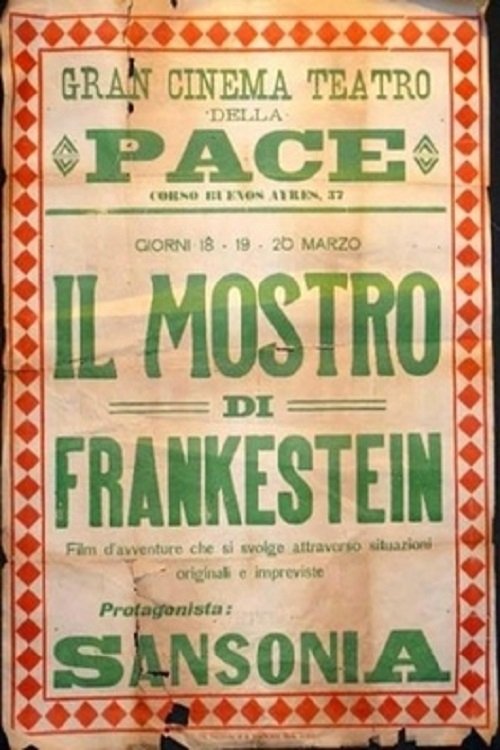
Contemporary publicity demonstrates that Il mostro di Frankenstein circulated beyond its initial Italian release. Posters from Milan cinemas advertised the production in 1922, while later provincial material indicates screenings as late as October 1926. An advertisement published in Port Said in August 1922 promoted the film under the French title Le Monstre de Frankenstein and highlighted Albertini’s established identity as Sansone. Correspondence preserved in the Itala Film archive concerns promotional materials, negatives and title cards, with documentation extending into the middle of the decade. The Museo Nazionale del Cinema identifies a file covering correspondence from September 1920 to November 1926, establishing a substantial archival record despite the disappearance of the film itself.
The surviving contemporary review from Kines, published on 10 September 1921, was sharply critical of the screenplay. The reviewer considered the combination of philosophy, sentiment, religion and adventure dramatically inconsistent, particularly when the monster’s demonstrated intelligence contradicted its description in the intertitles. Nevertheless, the criticism acknowledged the power of the central premise and praised the monster’s performer. Advertisements adopted a different emphasis, presenting the production as an exciting adventure designed around physical conflict. The contrast between the critical response and commercial promotion is especially valuable because it reveals competing ways of understanding a film that cannot now be viewed.
Lost Film Status & Italian Horror Historiography
Il mostro di Frankenstein is considered lost, with no surviving moving-image print presently identified. Its historical reconstruction depends on photographs, promotional documents, contemporary commentary and administrative correspondence. These sources establish the film’s existence, production circumstances and elements of its narrative, but they cannot replace direct examination of the finished work. The absence of a viewable copy also prevents reliable analysis of editing, camera movement, special effects and the visual development of individual scenes. Its reported running time and fragmentary storyline provide insufficient evidence for a detailed scene-by-scene reconstruction.
The film has often been presented as the earliest Italian horror feature, an identification examined critically by Russ Hunter in a 2017 study published in the Journal of Italian Cinema & Media Studies. Hunter argues that its presumed generic identity remains ambiguous because surviving promotional material strongly emphasizes adventure and athletic performance. Alessandro Faccioli similarly places the production within an Italian silent tradition in which fantastic subjects crossed the boundaries separating comedy, melodrama and physical spectacle. Their research complicates the familiar historical narrative that identifies the origins of Italian horror almost exclusively with Riccardo Freda and Mario Bava’s I vampiri.
Its significance is therefore most securely established as an early Italian cinematic treatment of Frankenstein and an example of how Gothic material entered popular screen entertainment before horror became an internationally standardized commercial category. The film belongs to a small group of silent-era Frankenstein adaptations that includes the Edison production Frankenstein (1910) and the lost American feature Life Without Soul (1915). These works reveal different approaches to the same literary creation, long before the Universal cycle established the monster’s most familiar cinematic iconography. The disappearance of Testa’s production limits aesthetic judgment, but its documented circulation and surviving contemporary reception demonstrate that Gothic and monstrous subjects were already part of Italian filmmaking during the early 1920s.