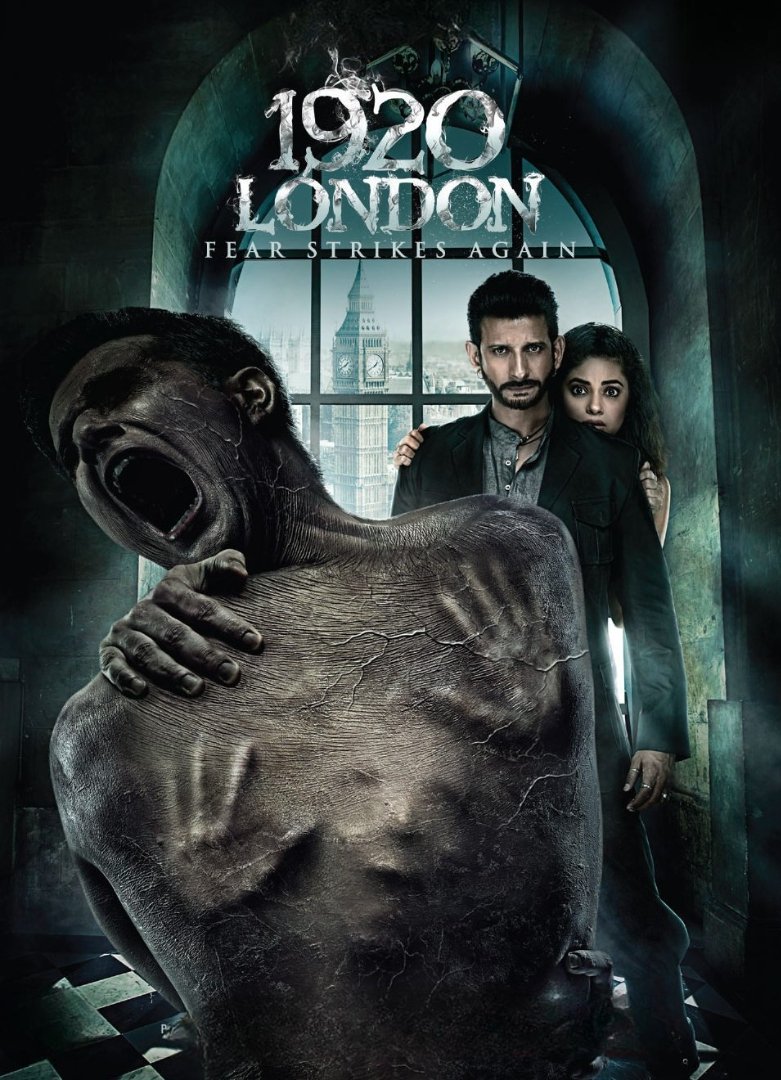
Shivangi lives in London with her husband Veer Singh. One day, he receives a gift from Rajasthan. From then, strange things happen with Veer and his condition deteriorates.
Alternative Titles
1920 伦敦 (China) — Chinese1920 London: Der Schrecken kehrt zurück (Germany) — German1920 倫敦 (Hong Kong SAR China) — Chinese1920 런던 (South Korea) — KoreanЛондон 1920 (Russia) — Russian
▤
Film Guide & Analysis
A troubled production and an occult love triangle connect London and Rajasthan in the third 1920 horror film.
Tinu Suresh Desai’s 1920 London (2016) extends Vikram Bhatt’s Hindi-language supernatural horror series through a story of possession, estranged lovers and ritual intervention. Its central danger begins in an apparently secure marriage: Shivangi lives in London with her husband Veer until a mysterious gift from Rajasthan precedes his physical and psychological deterioration. Her attempt to save him eventually brings her back to India and into contact with Jai Singh Gujjar, a former lover associated with occult healing. The film combines an English period setting with the ceremonial practices and family hierarchies of a Rajasthani supernatural melodrama.
As the third entry following 1920 (2008) and 1920: Evil Returns (2012), the film inherits the series’ emphasis on possession but shifts the afflicted character from a young woman to a husband. Contemporary interviews reveal that its romantic story was a deliberate production priority, despite the franchise’s established horror identity. The project also endured an unusually protracted completion process, with reported financing difficulties and disagreements over production credit. These circumstances, together with the response to its supernatural imagery, make 1920 London a useful case study in the intersection of Hindi popular melodrama and mid-2010s franchise horror.
Development and Interrupted Production
Vikram Bhatt provided the story for a third 1920 film while directing duties passed to Tinu Suresh Desai. Meera Chopra recalled that the screenplay attracted her because it offered a substantial female role, and that Bhatt invited her to hear the project before she agreed to join. The film was among the earliest Hindi productions she signed, though another title reached cinemas first. In an interview conducted shortly before release, she described a lengthy filming period and approximately fifty days of work in London. Her recollection locates a substantial period of work in Britain before the film reached audiences in 2016.
The production’s difficulties were documented in a February 2016 report by Roshmila Bhattacharya for Mumbai Mirror. Nitin Bhatkar of ASA, an early co-producing company, said that filming halted after the project exceeded its budget, with a few shooting days and post-production still unfinished. Phantom Films and Reliance Entertainment later participated in completing the picture. The report presented the credit dispute through statements from Bhatkar and Bhatt, without documenting an agreed resolution. The prolonged interruption helps explain why publicity in late 2015 and early 2016 referred to prospective opening dates that preceded the eventual May release.
A London Setting and Romantic Priority
The English location is important to the film’s presentation of 1920s privilege. Shivangi and Veer inhabit a world of formal interiors, period clothes and expensive domestic furnishings before the haunting disrupts their marriage. Rajasthan introduces a different social environment: Shivangi’s aristocratic family, its resistance to her previous relationship and the authority accorded to spiritual specialists. The movement between the two places gives the possession story its narrative structure. The ghostly threat first intrudes upon the couple’s London residence, but the attempted cure requires Shivangi to return to the familial and ritual world she had left behind.
Chopra described Bhatt’s creative brief to the actors as an instruction to approach the material as a love story, with horror forming part of that larger design. Her testimony is significant because the supernatural plot repeatedly returns to competing obligations between husband, family and former lover. She also recalled a three-day nighttime graveyard shoot in London disrupted by rain during its first two days. The finished film’s decorated interiors, old-fashioned vehicles and formal costumes were among the few qualities singled out favorably by contemporary critics, even when they rejected the film’s attempts at terror.
Possession, Ritual and Performance
The possession of Veer distinguishes this entry from its two predecessors, whose female characters were central to the spectacle of demonic affliction. Here the most visibly altered body belongs to the husband, played by Vishal Karwal, while Shivangi becomes the person pursuing a remedy. The symptoms invite medical concern before the family turns toward ritual explanations and occult practitioners. Jai, played by Sharman Joshi, enters the story as an exorcist whose former relationship with Shivangi complicates his involvement. The supernatural investigation consequently draws its suspense from the same personal history that sustains the romantic conflict.
Desai’s horror sequences employ deteriorating facial makeup, threatening apparitions and abrupt disturbances, alongside scenes of magical confrontation. Reviewers specifically remarked on the progressive change in Veer’s appearance, a device that makes his worsening condition visible before the story exposes its supernatural cause. Joshi explained that Desai designed the bearded appearance of Jai to suit his role as a figure of occult authority. The soundtrack also draws on an established Indian cinematic association with mystery: Joshi discussed the film’s reworking of “Gumnaam Hai Koi,” from the 1965 film Gumnaam. Its use belongs to the film’s broader mixture of recognisable popular-film music and supernatural spectacle.
Release and Contemporary Reception
1920 London opened in India on 6 May 2016, after earlier announcements had suggested March or April. Its release completed a transition from an initially interrupted production to the third theatrical installment in the 1920 series. The franchise connection was a significant part of the film’s marketing, but its story was constructed around a new group of characters rather than a direct continuation of the previous protagonists’ lives. The period setting and possession motif provided the recognisable connection.
Contemporary notices were predominantly unfavorable. Reviewing the release for Filmfare on 7 May, Rachit Gupta praised aspects of the English locations and period production design but found the supernatural imagery, background sound and romantic-song interruptions ineffective. Its emphatic makeup, exorcism encounters and shifts between Gothic surroundings and song-driven romance were central to that response. In his account, the lavish locations could not compensate for familiar shocks and an uneasy balance between songs and sustained suspense.