Carrie (2013)

US
HORROR FILM Drama
4.0/10 4 votes
Runtime
100 min
Release
October 16, 2013
Budget
$30,000,000
Revenue
$82,394,288
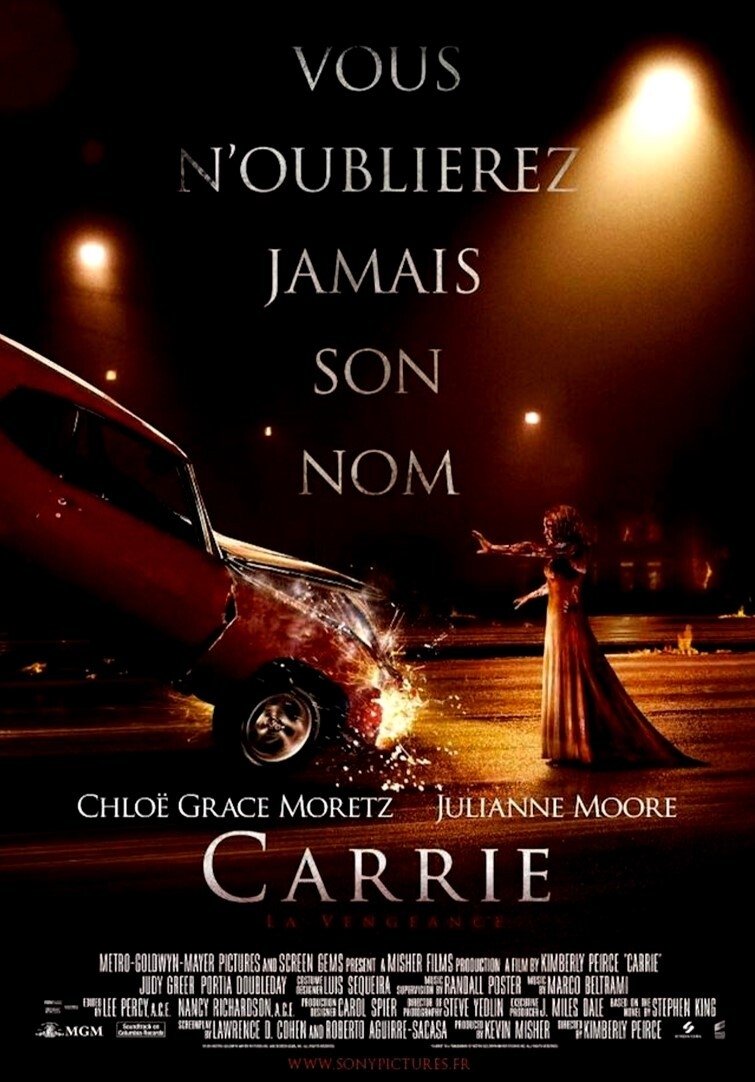
Carrie (2013) poster
Director
Plot

Carrie White lives under the authority of her intensely religious mother Margaret and struggles to form friendships at high school. When she experiences her first menstrual period in the school showers, her frightened reaction becomes an opportunity for other students to mock her, and footage of the incident circulates online. Carrie gradually learns to control a telekinetic ability that responds to her emotional distress. Sue Snell attempts to make amends by arranging for Carrie to attend the prom with Tommy Ross. Chris Hargensen, meanwhile, refuses to accept the consequences of her bullying and prepares a new humiliation with Billy Nolan. The approaching school celebration places Carrie’s brief chance at acceptance in direct conflict with a plan designed to isolate her again.

Alternative Titles
Քարրիե (Armenia) Carrie - Stephen King (Australia) — Stephen King Collection Carrie, la vengeance (Belgium) Кери (Bulgaria) Carrie, a Estranha (Brazil) 魔女嘉莉 (China) — Chinese Carrie, la vengeance (France) კერი (Georgia)
Show all 27 alternative titles ქერი (Georgia) 血腥嘉莉 (Hong Kong SAR China) קארי (Israel) — Hebrew Lo sguardo di Satana - Carrie (Italy) キャリー (Japan) 캐리 (South Korea) Kerė (Lithuania) — Lithuanian Kerija (Latvia) — Latvian Keri (Serbia) Телекинез (Russia) สาวสยอง (Thailand) — Thai แคร์รี่ย์ (Thailand) แคร์รี่ย์ สาวสยอง (Thailand) Carrie: Günah Tohumu (Türkiye) — Turkish 魔女嘉莉 (Taiwan) — Chinese Керрі (Ukraine) — Ukrainian Carrie 04 Carrie (United States) — Series Carrie la vengeance (United States) Cơn Thịnh Nộ Của Carrie (Vietnam) — Vietnamese

Trailers & Videos

3 videos

Film Guide & Analysis

Kimberly Peirce reimagines Stephen King: Chloë Grace Moretz, Julianne Moore, cyberbullying, telekinetic spectacle and the 2013 reception.

Carrie (2013), directed by Kimberly Peirce, revisits Stephen King's novel through a teenager whose telekinetic powers develop alongside her struggle for independence. Chloë Grace Moretz plays Carrie White, a socially isolated high-school student who is ridiculed after experiencing her first menstrual period in the school shower. At home she lives under the control of Margaret, her intensely religious mother, played by Julianne Moore. A classmate's remorse briefly offers Carrie the possibility of friendship, but another group plans a cruel humiliation at the senior prom. Their actions trigger a violent disaster that transforms the rituals of school popularity into supernatural horror.

Produced by MGM and Screen Gems and shot in the Toronto area in 2012, the film brings the story into a world of camera phones and online humiliation while retaining the central conflict between maternal control and adolescent self-determination. Peirce described the project as a new adaptation of the 1974 novel and a story of a young woman discovering extraordinary abilities. Its practical and digital effects increase the scale of the destruction.

Development and a New Reading of Stephen King

MGM approached Kimberly Peirce after her work on Boys Don't Cry (1999) and Stop-Loss (2008). She initially questioned the need to revisit material already associated with Brian De Palma's influential film of 1976. In an interview with the University of Chicago Magazine, Peirce recalled rereading King's first published novel several times before identifying three areas she wanted to develop: the cruelty of the students, the intimate mother-daughter relationship and the emergence of powers that Carrie might learn to control. She spoke of the premise as a superhero origin story, but that description of the character's development should not be mistaken for a change in the film's fundamentally tragic horror narrative.

The credited screenplay writers are Lawrence D. Cohen, who had adapted the novel for De Palma, and Roberto Aguirre-Sacasa. Their involvement connects the production with the earlier film, but the result is an independent retelling rather than a sequel to Carrie or The Rage: Carrie 2 (1999). Peirce emphasized the opportunity to show a teenage performer growing into the role; Moretz was much closer to Carrie's school age than Sissy Spacek had been during the original production. This casting decision informed the director's approach to shyness, first desire and the unfamiliarity of the girl's body. The challenge was to build an identifiable young person before her increasingly visible powers could overwhelm the characterization.

Carrie, Margaret and a Household Governed by Fear

Moretz plays Carrie as a girl whose ordinary attempts to take part in school life have been constrained by years of isolation. The opening birth sequence establishes Margaret's conviction that her daughter represents sin, making the later arguments over clothing, friends and menstruation the continuation of a much older fear. Carrie does not know how to interpret changes in her body when her first period begins, and her classmates answer her panic with humiliation. The violence of that response is inseparable from the ignorance enforced at home. Peirce's account of preparing Moretz emphasizes reducing the actor's ordinary confidence and allowing her to inhabit a character who has little experience of being accepted.
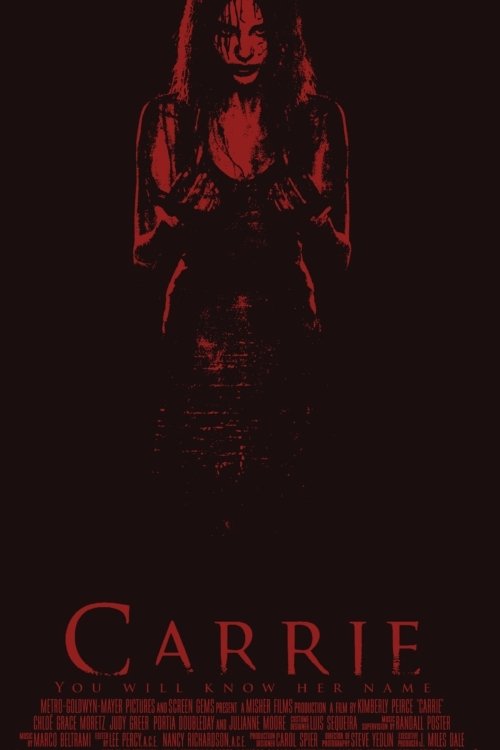

Julianne Moore gives Margaret a more physically self-punishing presence than a conventional authoritarian parent. Her religious language accompanies scratching, blows and attempts to control Carrie's movement, while her affection repeatedly becomes a justification for confinement. Peirce explained in the University of Chicago interview that Moore's ability to ground Margaret in recognizable emotions allowed the performance to become more extreme without losing its internal logic. The relationship remains dangerous even when the mother appears sincerely concerned for her child. It is the certainty that she knows what is best for Carrie that makes her control difficult to challenge.

Judy Greer plays Ms. Desjardin, the teacher who disciplines the girls responsible for the locker-room attack. Gabriella Wilde's Sue Snell recognizes her own participation and asks her boyfriend Tommy Ross, played by Ansel Elgort, to take Carrie to the prom. Portia Doubleday's Chris Hargensen responds to punishment by plotting revenge with Billy Nolan, played by Alex Russell. Their opposing motives create the film's principal suspense: some students are making a genuine attempt at repair, while others use the same social occasion to cause irreversible harm.

Bullying, Recorded Images and Public Humiliation

One of the remake's clearest changes is the use of a camera phone to record Carrie's distress in the changing room. The video spreads beyond the immediate witnesses, giving the original insult a persistent digital presence and making the possibility of public exposure central to the prom-night trap. Peirce identified this modernization as one reason the novel still spoke to contemporary experience. The device is grounded in the film's events rather than presented as evidence that recording technology alone causes cruelty. Students choose to document suffering and then use the resulting image as an instrument of status and retaliation.
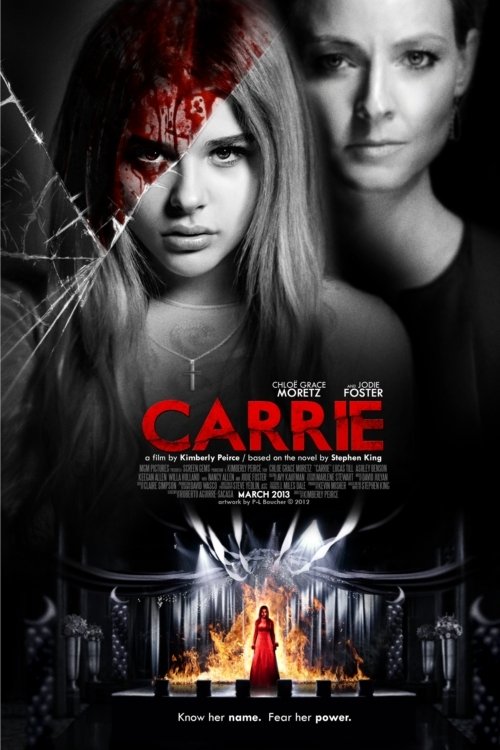
Chris's plan develops from the consequences of the school's attempt to intervene. Her exclusion from the dance encourages a more elaborate reprisal, while Sue's decision to stay away from the prom is intended to remove any suggestion that Tommy's invitation is a trick. The two reactions give the narrative its emotional tension. Carrie cannot easily distinguish a genuine gesture of kindness from another humiliation because her experience has taught her to expect the latter. Tommy's courteous behavior gradually changes that expectation, allowing the prom to matter as an event in which she might be accepted rather than merely survive.

Cinematography, Production Design and Emerging Powers

Steve Yedlin photographed the film, with production design by Carol Spier and editing credited to Lee Percy and Nancy Richardson. The spaces are arranged around two forms of restriction: Carrie's home, where Margaret controls movement and speech, and the high school, where students monitor one another's social position. The household's religious imagery and cramped rooms make apparently ordinary domestic objects threatening, while the gymnasium becomes the site where public celebration and concealed hostility meet. The film frequently brings the camera close to Moretz as Carrie tests her developing abilities, shifting the emphasis from a distant display of magic to a discovery experienced through the performer's movement.


Peirce spoke of the growing powers as a progression. Carrie learns that she can influence small objects and then experiments with more consequential acts, giving her a limited form of mastery before the catastrophic loss of control at the prom. Compared with the 1976 film, the remake more often displays telekinesis as a deliberate physical action. This choice can make the character's relationship with her abilities easier to follow, although it also reduces some of the mystery that had surrounded their earlier cinematic treatment. The contrast is a matter of direction and performance, not evidence that the original film lacked supernatural effects.

The Prom Catastrophe and Practical-Digital Effects

The destruction of the prom remains the story's decisive horror sequence. Chris and Billy arrange a container of pig's blood above the stage where Carrie and Tommy will stand after being named king and queen. The tension depends on the difference between the audience's knowledge of the trap and Carrie's increasing happiness. The falling blood interrupts what briefly seemed to be an ordinary rite of passage, and the recording of the shower-room incident is used to renew her humiliation in front of the assembled students. The resulting violence is more extensive and openly spectacular than the private manifestations of power that preceded it.

A contemporary visit to the set published by ComingSoon records Moretz discussing the physical blood-dump effect. She recalled that several gallons of liquid would fall onto her during the scene, an important reminder that the image was not created entirely in a computer. Peirce later explained to the Directors Guild that her effects strategy combined real stunts with digitally constructed destruction. A performer engulfed in flames was achieved with a stunt double and protective gel, while a fissure opening in the road beneath a car was created through computer imagery. The division of methods reflects practical safety and budget decisions made for individual shots.

The gym becomes a field of improvised weapons as Carrie directs fixtures, electricity and falling objects against those around her. The film increasingly presents her as an active agent of destruction, with close views of her expression and movements linking her rage to the violence. This changes the balance of empathy and fear: the spectator has witnessed the cruelty that provoked her, but the scale of her retaliation also threatens people who were not responsible for the prank. The sequence gives the remake its clearest technical identity while inviting comparison with De Palma's differently staged split-screen catastrophe.

The Ending, Sue Snell and the Cost of Survival

After leaving the burning school, Carrie confronts the people who planned her humiliation and returns to the house in which her mother has controlled much of her life. Margaret's belief that her daughter has become an instrument of evil leads to another attempt to kill her. Carrie retaliates with telekinesis, and the household collapses under the force of her grief. The return to the domestic setting makes the climax more than a public act of revenge. The supernatural ability that briefly promised an escape from helplessness has become destructive inside the relationship that first made Carrie afraid of herself.

Sue arrives during the collapse, and Carrie recognizes that Sue is pregnant. She uses her power to send the younger woman out of immediate danger, making an act of protection part of a finale otherwise dominated by killing. The theatrical ending then moves to the aftermath and Carrie's grave, where an unsettling sound and the cracking stone prevent a completely peaceful resolution. The film's ending differs in its details from the 1976 version and from the documentary structure of King's novel, even while maintaining the catastrophe as the event through which Carrie's life becomes publicly known. No continuation of the 2013 plot is required to interpret that final image.

Release, Contemporary Reception and Historical Position

Carrie opened in Los Angeles and New York on October 18, 2013, according to the American Film Institute's record. The film received an R rating and runs approximately 99 minutes. The AFI credits Peirce, producer Kevin Misher, cinematographer Yedlin, composer Beltrami and the two credited editors, confirming the personnel behind its studio production. A Directors Guild account published the following year reported a worldwide gross approaching $85 million against a budget of approximately $30 million. Those are reported production and box-office figures, not a complete audited calculation of profitability after distribution and marketing expenses.

Betsy Sharkey's Los Angeles Times review of October 17, 2013, provides a clear example of the mixed initial response. She praised Moretz and Moore and recognized the use of contemporary technology, but argued that the film remained too close to De Palma's version to establish a comparably original interpretation. Her criticism should be treated as one contemporary judgment rather than a unanimous assessment. Peirce's own interviews indicate that she had deliberately returned to King's novel in order to foreground the mother-daughter relationship and the gradual discovery of power. The disparity between that creative intention and a critic's reaction is part of the film's reception history.

References

  1. American Film Institute Carrie (2013) - AFI Catalog

    Institutional credits and release record documenting the cast, screenplay, production personnel, October 2013 opening, running time and classification.

  2. University of Chicago Magazine Channeling Carrie

    Amy Monaghan original interview with Kimberly Peirce covering her return to the novel, casting, maternal conflict, updating bullying and postproduction.

  3. Directors Guild of America Women's Movement?

    Amy Dawes 2014 interview and production account recording Peirce budget figures, practical and digital effects decisions, and worldwide gross.

  4. ComingSoon From the Set of Kimberly Peirce's Carrie: Observations & Interviews With the Cast & Crew

    Edward Douglas contemporaneous set interview with Chloë Grace Moretz describing the prom blood effect, preparation for the lead role and the mother-daughter focus.

  5. Los Angeles Times Carrie Hasn't Evolved Much Since 1976

    Betsy Sharkey October 2013 theatrical review assessing the performers, cyberbullying, visual effects and closeness to the De Palma film.

Connections

Cast

View Full Cast & Crew →

Release & Distribution

Distributors (1)

  • Sony Pictures US

Release History (84)

Release DateTerritoryRelease TypeFormatDistributorCertificationNotes
2013-10-16 Philippines Theatrical — — —
2013-10-17 Czechia Theatrical — — 15+
2013-10-17 Israel Theatrical — — —
2013-10-17 Thailand Theatrical — — —
2013-10-18 Canada Theatrical — — R movie rate is: M
2013-10-18 Ethiopia Theatrical — — —
2013-10-18 Jamaica Theatrical — — —
2013-10-18 Poland Theatrical — — 18
2013-10-18 United States Theatrical — — R
2013-10-18 Uruguay Theatrical — — —
2013-10-23 Egypt Theatrical — — —
2013-10-24 Costa Rica Theatrical — — —
2013-10-24 Guatemala Theatrical — — —
2013-10-24 Honduras Theatrical — — —
2013-10-24 Hungary Theatrical — — 18
2013-10-24 Nicaragua Theatrical — — —
2013-10-24 Panama Theatrical — — —
2013-10-24 Puerto Rico Theatrical — — —
2013-10-24 Singapore Theatrical — — —
2013-10-24 El Salvador Theatrical — — —
2013-10-25 Estonia Theatrical — — —
2013-10-25 Venezuela Theatrical — — —
2013-10-31 Denmark Theatrical — — 15
2013-10-31 Cambodia Theatrical — — —
2013-10-31 South Korea Theatrical — — 19
2013-10-31 North Macedonia Theatrical — — —
2013-10-31 Portugal Theatrical — — M/16
2013-11-01 Finland Theatrical — — K-16
2013-11-06 Peru Theatrical — — —
2013-11-07 Argentina Theatrical — — —
2013-11-07 Netherlands Theatrical — — 16
2013-11-08 Indonesia Theatrical — — —
2013-11-08 Iceland Theatrical — — —
2013-11-08 Japan Theatrical — — —
2013-11-08 Lithuania Theatrical — — —
2013-11-08 Latvia Theatrical — — —
2013-11-08 Türkiye Theatrical — — —
2013-11-08 Vietnam Theatrical — — —
2013-11-13 Australia Theatrical — — MA 15+
2013-11-13 Belgium Theatrical — — 18
2013-11-14 Hong Kong SAR China Theatrical — — —
2013-11-14 Croatia Theatrical — — —
2013-11-14 Kazakhstan Theatrical — — Е16
2013-11-14 Malaysia Theatrical — — —
2013-11-14 New Zealand Theatrical — — —
2013-11-14 Russia Theatrical — — 16+
2013-11-14 Slovenia Theatrical — — —
2013-11-15 Colombia Theatrical — — —
2013-11-15 Norway Theatrical — — 18
2013-11-21 Serbia Theatrical — — —
2013-11-28 United Arab Emirates Theatrical — — —
2013-11-28 Bolivia Theatrical — — —
2013-11-28 Switzerland Theatrical — — 16
2013-11-28 Chile Theatrical — — —
2013-11-28 Dominican Republic Theatrical — — —
2013-11-28 Georgia Theatrical — — —
2013-11-28 Lebanon Theatrical — — —
2013-11-28 Serbia Theatrical — — —
2013-11-28 Ukraine Theatrical — — —
2013-11-29 United Kingdom Theatrical — — 15
2013-11-29 Ireland Theatrical — — 15
2013-11-29 Kenya Theatrical — — —
2013-11-29 Mexico Theatrical — — B-15
2013-11-29 Sweden Theatrical — — 15
2013-12-04 France Theatrical — — 16
2013-12-05 Germany Theatrical — — 16
2013-12-05 Spain Theatrical — — 16
2013-12-05 Greece Theatrical — — Κ-15
2013-12-06 Brazil Theatrical — — 16
2013-12-06 Ecuador Theatrical — — —
2013-12-06 India Theatrical — — —
2013-12-06 Taiwan Theatrical — — —
2013-12-27 South Africa Theatrical — — —
2014-01-03 Nigeria Theatrical — — —
2014-01-14 United States Physical DVD, Blu-ray — R DVD, Blu-ray
2014-01-16 Italy Theatrical — — —
2014-02-20 Greece Physical DVD, Blu-ray — — DVD, Blu-ray
2014-04-04 Germany Physical DVD — 16 DvD
2014-04-18 France Physical DVD, Blu-ray — 12 DVD & Blu-Ray
2014-09-29 Netherlands Physical Blu-ray — 16 Blu ray
2014-10-01 Netherlands Physical DVD — 16 DVD
2016-08-08 France Digital — — — VOD
2019-01-21 Netherlands TV — — 16 RTL 7
2022-10-01 France Digital — — 16 Netflix
Know her name. Fear her power.