The ABCs of Death (2013)

US
HORROR FILM
SUBGENRES HORROR ANTHOLOGY
5.6/10 5 votes
Runtime
129 min
Release
March 8, 2013
Revenue
$23,589
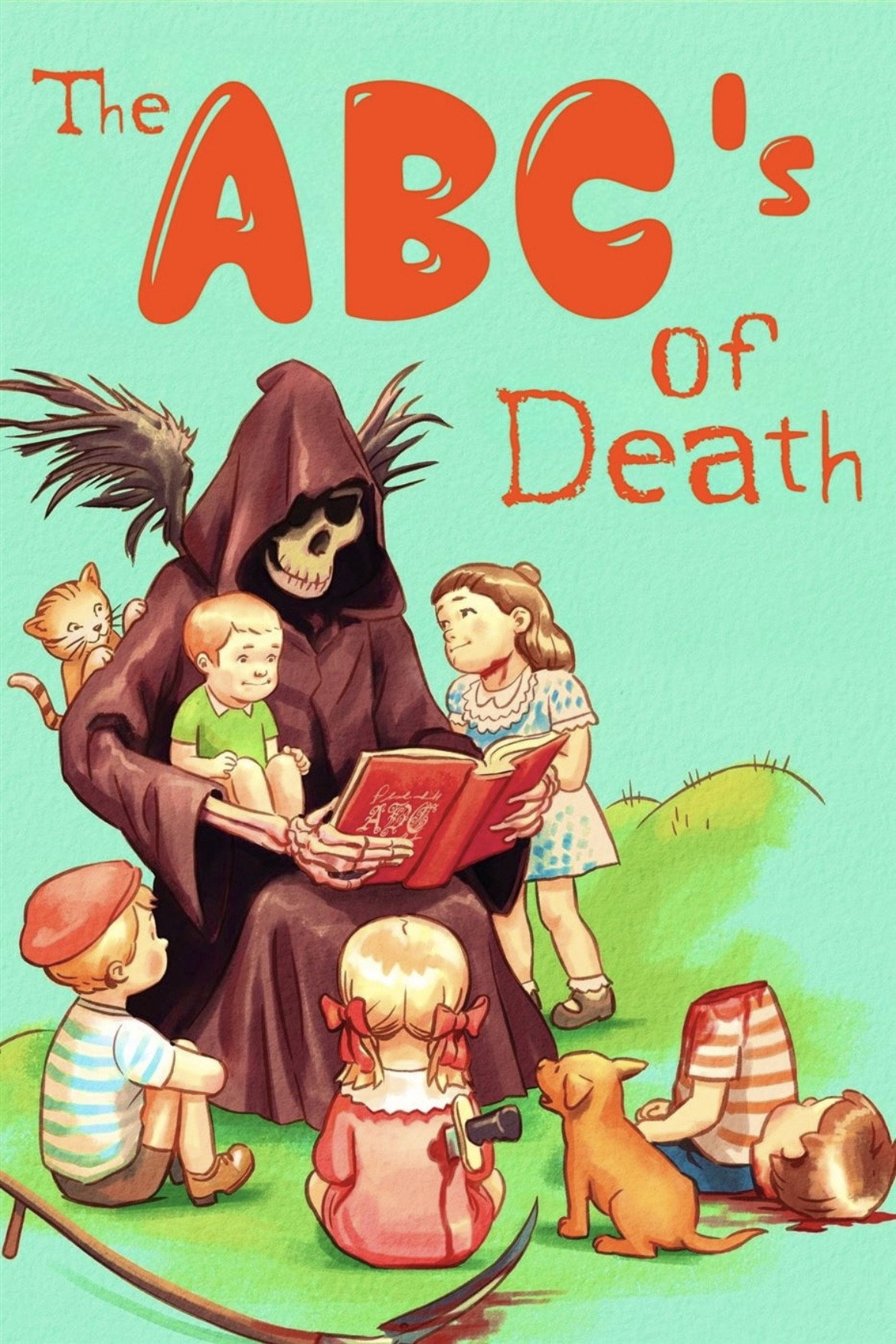
The ABCs of Death (2013) poster
Production Companies
Drafthouse Films , Timpson Films , Magnet Pictures
Plot

Twenty-six filmmakers from different countries receive a different letter of the alphabet and use it to create a short film about death. The result is an international anthology that shifts rapidly between live action, animation, bleak comedy, surrealism and disturbing violence. Each director chooses a word beginning with the assigned letter, but the meaning of that word is revealed only after the chapter, inviting the audience to guess how the story connects to its place in the alphabet. The shorts have independent characters and settings; their common framework is the alphabetical sequence and the filmmakers' contrasting responses to mortality.

Alternative Titles
Азбуката на смъртта (Bulgaria) — Bulgarian O ABC da Morte (Brazil) — Portuguese 26种死法 (China) — Chinese 22 Ways to Die (Germany) Surma aabits (Estonia) ABC of Death (France) — French 死囧樣 (Hong Kong SAR China) — Chinese Abeceda Smrti (Croatia)
Show all 20 alternative titles A halál ABC-je (Hungary) — Hungarian האלף בית של המוות (Israel) — Hebrew ABC・オブ・デス (Japan) — Japanese ABC 오브 데쓰 (South Korea) — Korean ABC de la muerte (Mexico) El ABC de la muerte (Mexico) — Spanish O ABC da Morte (Portugal) — Portuguese Азбука смерти (Russia) — Russian บันทึกลำดับตาย (Thailand) — Thai Ölümün Alfabesi (Türkiye) — Turkish 26種死法 (Taiwan) — Chinese Абетка смерті (Ukraine) — Ukrainian

Trailers & Videos

5 videos

Film Guide & Analysis

Ant Timpson and Tim League assemble twenty-six international horror shorts, one for each letter, from festival directors and a competition winner.

The ABCs of Death reached North American cinemas in 2013 after festival screenings in 2012, offering an unusually compressed survey of international horror filmmaking. Conceived by producers Ant Timpson and Tim League, the anthology gives each letter of the English alphabet to a separate filmmaking contribution. The directors build short stories around a word connected with death, and the audience discovers the selected word at the end of each episode. The premise borrows the structure of early reading books and turns it into an organizing device for violent comedy, bodily anxiety and the grotesque. Its alphabet supplies a fixed order while allowing abrupt changes of place, language and style.

The resulting film belongs to the horror anthology tradition, but its density and independence of production distinguish it from a collection of a few extended stories. The contributors were drawn from international genre cinema, and the shorts move rapidly between recognizable narrative techniques and experiments in form. Animation appears alongside live action; domestic spaces yield to stylized fantasies and disturbing confrontations. Its cultural interest lies partly in the specific community of filmmakers gathered by the producers and partly in the strain that an extreme time limit places on storytelling. The film's unevenness, widely noted at release, is inseparable from the freedom granted to its participants.

Development and the International Horror Network

The project was announced at Cannes in May 2011 as a collaboration among Drafthouse Films, Timpson Films and Magnet Releasing, with Magnolia International handling sales. Timpson and League planned twenty-five invited contributions and one place for a filmmaker discovered through an open competition. The official announcement proposed a production period beginning that June, a schedule designed to accommodate numerous separate shoots. Rather than concentrating resources on one story, the producers sought material from an existing network of genre directors whose work had circulated through festivals and specialist screenings. The concept treated their differences as part of the film's appeal.

During a Fantastic Fest interview in 2012, director Marcel Sarmiento recalled hearing that Timpson had formed the idea while looking at an alphabet book with his children. That account is a participant's retelling, while the earlier production announcement independently establishes the anthology's intended form. The connection with festival culture is more directly observable. Filmmakers associated with distinct regional horror scenes were brought into a single program with very little narrative continuity between their contributions. The project placed regional traditions on the same program, leaving each participant responsible for a complete short within severe limits.

The scale of the undertaking also created practical problems of assembly. A contemporary CHUD interview describes the discovery, before a Fantastic Fest screening, that a supplied print did not match the intended segment titles; the account says the presentation was corrected through a rapid digital re-edit. This reported incident suggests how demanding final coordination could become when the producers had to bring separately completed shorts into a reliable order. More importantly, the episode underlines the importance of the title cards: a misplaced or incorrect word changes the relationship between the film's images, the assigned letter and the final reveal.

Letters, Constraints and Comic Timing

The alphabet creates continuity without insisting that the stories inhabit one fictional universe. Participants had to fit a death-related premise into a short running time, but they could pursue widely different subjects and visual approaches. In the Fantastic Fest discussion, Ti West explained that directors could request preferred letters, although the final allocation did not always match those requests. He also recalled encouragement to keep some contributions particularly brief. The film uses those differences in duration as part of its rhythm; a short can finish before its central idea wears thin, while a more elaborate episode has room to establish a change in expectation.

West's M Is for Miscarriage is an extreme example of that compression. The filmmaker told CHUD that its shortness was deliberate and that the final word was essential to the intended effect. The audience must first interpret an ordinary-looking situation without knowing how the alphabet will classify it. This structure can produce dread, dark comedy or an abrupt reversal, depending on what the withheld word reveals. Its effectiveness varies across the collection, yet the recurring title-card mechanism makes viewers participate in the classification of each death. The letters serve as both a constraint on the filmmakers and an invitation to anticipate the next episode.

The Twenty-Sixth Director and T Is for Toilet

The open competition added another dimension to the anthology's relationship with independent horror culture. The producers reserved the letter T for a public search, opening one position beyond their established professional connections. Lee Hardcastle won with T Is for Toilet, a stop-motion story about a child's fear of using the bathroom. The competition turned a proposed feature-film slot into an opportunity for an artist working outside conventional production structures. It also invited viewers to encounter shorts before the completed anthology was released, making the selection process part of the project's early public identity.

In an interview with Perri Nemiroff published in March 2013, Hardcastle described teaching himself stop-motion because he wanted to make films without needing a large crew. He said that T Is for Toilet took approximately twenty to twenty-five days of concentrated work. Still photographs made with an inexpensive Panasonic Lumix camera were assembled into animation; the miniature sets and lighting depended on readily available materials. These details give the winning entry a distinct production history within the larger project. The short's tactile movement, handmade surfaces and grotesque exaggerations reflect its creator's working methods and distinctive material choices.

Hardcastle also connected the premise to time spent helping to care for a young child, which gave him a way to imagine a familiar room as an intimidating place. His recollection helps explain why the animation combines childish scale with adult expectations of bodily harm. The competition winner therefore illustrates the anthology's broader tension between the ordinary and the grotesque. A bathroom becomes the location of a small nightmare because the episode adopts a child's vulnerability as its perspective. What survives beyond the joke is the precision of its physical design, achieved through incremental animation and limited resources.

Contrasting Styles and Practical Horror

The alphabet brings forms of horror into close contact that would normally be encountered in separate features. Bruno Forzani and Hélène Cattet's O Is for Orgasm uses an abstract, sensual montage connected to the stylized traditions of European giallo. Ben Wheatley's U Is for Unearthed places the spectator close to the position of a threatened creature, changing the usual perspective of pursuit. Xavier Gens's X Is for XXL concentrates on the violence of the body under social pressure, while Marcel Sarmiento's D Is for Dogfight turns an apparently brutal contest into a story structured around a reversal of expectations. These variations offer useful examples of the range of the commissioned work without reducing the feature to a catalogue of its twenty-six plots.

Sarmiento explained in the 2012 group interview how the staged confrontation between a fighter and a dog was photographed. He enlisted an animal trainer and used camera placement to produce the appearance of contact without actually striking the dog. The explanation is important because it separates the viewer's impression of violence from the documented filmmaking method. Elsewhere, the anthology places stylized cruelty beside crude comedy and surreal scenarios. The abrupt succession can make apparently realistic harm feel more shocking, especially when a carefully choreographed practical scene follows an exaggerated cartoon episode. Differences in technique matter as much as differences in subject.

The formal variety also exposes the weaknesses of a project that depends on isolated contributions. A short has little opportunity to recover from an unconvincing premise, and some episodes rely on a provocative ending more heavily than on developed suspense. Others establish a coherent cinematic space almost immediately. Ed Gonzalez's contemporary Slant Magazine review identified this tension, singling out certain shorts for their transformations of expectation while questioning how much of the international talent escaped familiar genre habits. His criticism is useful because it judges the anthology by what each segment achieves on screen, not simply by the novelty of gathering so many directors.

Festival Exhibition, Release and Critical Response

Festival screenings in 2012 included Toronto and Fantastic Fest, preceding the United States limited theatrical opening on March 8, 2013 through Magnet Releasing. This chronology accounts for its appearance under both 2012 and 2013 in film listings: the earlier year belongs to the festival life of the completed feature, while the later date marks its American theatrical release. The distribution paired a specialist genre audience with wider on-demand access. The film's shape was well suited to midnight screenings, where the quick change between installments could provoke an unusually varied collective response.

Contemporary reviewers often found the concept more consistent than its execution. Gonzalez, writing for Slant Magazine in March 2013, highlighted the inventiveness of several contributions but argued that many participants remained within comfortable patterns of shock. Catherine Shoard's April review in The Guardian was less sympathetic, describing the work as overextended despite a few intentionally comic entries. These are identifiable critical judgments, not a universal verdict. They reveal the central difficulty of presenting twenty-six independent shorts as one feature: the same range that makes the program unpredictable also generates an uneven viewing experience. The program could be valued for gathering distant filmmakers even as specific segments drew criticism for crude ideas or limited development.

The Anthology Model and Its Continuation

A second feature, ABCs of Death 2 (2014), retained the alphabet structure and the invitation to filmmakers working in different branches of genre cinema. The later installment ABCs of Death 2 1/2 (2016) assembled material connected with the sequel's open competition. These subsequent films establish that the original format could be reproduced with a changing group of contributors. The idea was simple enough to survive different production teams and styles, but its success depended on the individual shorts finding more than a mechanically gruesome interpretation of a letter.

The first anthology remains a useful record of a particular period in independent horror, when festival networks, inexpensive digital tools and internet competitions could meet within one distributed feature. Hardcastle's stop-motion contribution sits beside work by established directors, while the program's shifts in tone display the opportunities and limits of short-form experimentation. Its legacy is best understood through that documented production and subsequent continuation, without assuming that it created the international anthology movement. The film made visible a community of genre practitioners and offered a format in which unfamiliar directors could share billing with recognizable names.

References

  1. Drafthouse Films via PR Newswire Drafthouse Films, Timpson Films and Magnet Releasing to Teach Moviegoers THE ABCs OF DEATH

    Original May 2011 production announcement establishing the international anthology concept, producers, festival-oriented recruitment and open director slot.

  2. CHUD FF2012 INTERVIEW: Directors of ABCs of Death

    Joshua Miller interviews contributing directors about choosing letters, editing decisions, practical shooting and assembly at Fantastic Fest.

  3. Shockya Interview: The ABCs Of Death Director Lee Hardcastle

    Perri Nemiroff interviews the competition winner about stop-motion production, equipment, miniature sets and the origin of T Is for Toilet.

  4. Slant Magazine Review: The ABCs of Death

    Ed Gonzalez discusses specific contributions and the anthology's formal contrasts and critical limitations in March 2013.

  5. The Guardian The ABCs of Death - review

    Catherine Shoard's April 2013 contemporary review evaluates the film's episodic construction and mixture of horror and comedy.

Connections

Cast

View Full Cast & Crew →

Release & Distribution

Production Companies (3)

  • Drafthouse Films US
  • Magnet Pictures US
  • Timpson Films NZ

Distributors (1)

  • Magnolia Pictures US

Release History (28)

Release DateTerritoryRelease TypeFormatDistributorCertificationNotes
2012-09-15 Canada Premiere — — 18A Toronto International Film Festival
2012-09-22 United States Premiere — — NR Austin Fantastic Fest
2012-09-25 Sweden Premiere — — — Lund Fantastisk Film Festival
2012-11-01 Finland Premiere — — — Night Visions Film Festival
2012-11-03 Belgium Premiere — — — Razor Reel Fantastic Film Festival Bruges
2012-11-16 Mexico Premiere — — — Morbido Film Fest
2012-11-17 France Premiere — — — Paris International Fantastic Film Festival
2013-01-31 United States Digital — — —
2013-02-22 Japan Premiere — — — Yubari International Fantastic Film Festival
2013-02-23 United Kingdom Premiere — — — Glasgow Film Festival
2013-03-08 United States Limited Theatrical — — —
2013-04-13 Netherlands Premiere — — — Imagine Film Festival
2013-04-14 Denmark Premiere — — — CPH: PIX
2013-04-26 United Kingdom Theatrical — — 18
2013-05-21 Philippines Physical DVD — — DVD
2013-05-22 Sweden Physical DVD — — DVD
2013-06-28 Germany Physical DVD — 18 DVD
2013-07-20 Japan Theatrical — — —
2013-09-04 Finland Physical DVD, Blu-ray — — DVD & Blu-ray
2013-09-12 Portugal Premiere — — — MOTELX - Lisbon International Horror Film Festival
2013-10-17 Netherlands Digital — — —
2013-12-04 France Physical DVD — — DVD
2014-10-01 Netherlands Physical DVD — — DVD
2016-02-11 Italy Physical DVD, Blu-ray — — DVD & Blu-ray
2016-04-09 Italy Limited Theatrical — — —
2016-04-30 Italy Limited Theatrical — — —
2021-07-30 Indonesia Physical DVD — — DVD
2022-02-15 Egypt Physical DVD — — DVD
26 directors, 26 ways to die.