Castel Film
, Dimension Films
, Stan Winston Productions
, Neo Art & Logic
Plot
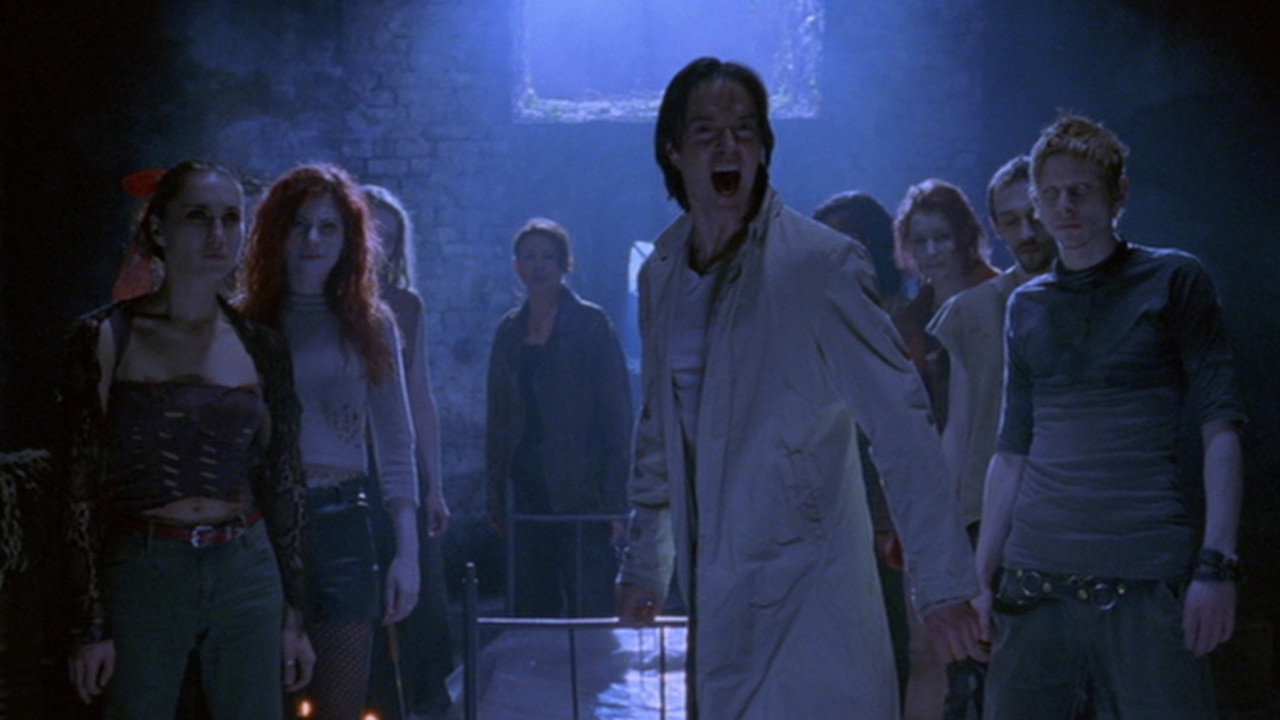
Investigative journalist Amy Klein is sent to Bucharest after a disturbing videotape appears to show a young woman returning from death. Her reporting leads to a secretive group called the Deaders and its enigmatic leader, Winter, whose followers believe they can cross the boundary between life and death. Amy follows a trail of increasingly frightening encounters while trying to determine what the group has accomplished and why she has been drawn into its activities. Her search brings her into contact with the Lament Configuration and the Cenobites.
Alternative Titles
Хелрейзър: Смъртници (Bulgaria) — BulgarianHellraiser: O Retorno dos Mortos (Brazil) 养鬼吃人7:死魂灵 (China) — ChineseHellraiser: Návrat mrtvých (Czechia) — CzechHellraiser 7: Deader (Spain) Hellraiser VII - Deader (Spain) — SpanishHellraiser 7 (France) — alternative titleHellraiser VII : Deader (France) — alternative titleShow all 27 alternative titles猛鬼追魂 7:死亡使者 (Hong Kong SAR China) — ChineseHellraiser - Halálos (Hungary) — HungarianHellraiser 7. (Hungary) מעורר השאול 7 - מת יותר (Israel) — Hebrewबेहद ख़ौफनाक शैतान । (India) — HindiHellraiser - Deader (Italy) — Italianヘルレイザー ワールド・オブ・ペイン (Japan) — Japanese헬레이저: 데더 (South Korea) — KoreanPrisikėlęs iš pragaro: Prisikėlimas (Lithuania) — LithuanianHellraiser VII: Deader (Mexico) — SpanishHellraiser VII: Sekta (Poland) — PolishHellraiser 7 - O Retorno dos Mortos (Portugal) — PortugueseВосставший из ада 7: Армия мертвецов (Russia) — RussianВосставший из ада 7: Мертвее мёртвого (Russia) Hellraiser VII Deader (El Salvador) เจาะประตูเปิดผี (Thailand) — Thai養鬼吃人7:死亡使者 (Taiwan) — ChineseПовсталий з пекла 7: Армія мерців (Ukraine) — UkrainianHellraiser 7 (United States)
Rick Bota transforms an independent resurrection story into the seventh Hellraiser film, with Bucharest locations, psychological uncertainty and Cenobite mythology.
Hellraiser: Deader (2005) belongs to the period when Dimension continued Clive Barker's horror franchise through films produced for the home-video market. Its central mystery follows Amy Klein, a journalist who investigates reports that members of a Bucharest group can die and return to life. The investigation brings her into contact with the Lament Configuration and the Cenobites, although much of the story concerns a cult whose rituals were devised outside the original Hellraiser mythology. That unusual origin makes the seventh installment valuable as a record of how an existing supernatural thriller was reshaped to carry a recognizable franchise identity.
Director Rick Bota filmed the project in Romania in 2002, but American audiences did not receive the completed feature on DVD until June 2005. Accounts from original screenwriter Neal Marshall Stevens, revising writer Tim Day, Bota and director of photography Vivi Dragan Vasile explain decisions that might otherwise look like arbitrary shifts in tone and location. Their comments describe both the attraction of the independent Deader premise and the difficulty of incorporating Pinhead without weakening its internal logic. The resulting film connects resurrection horror and psychological uncertainty with the established iconography of chains, hooks and an infernal puzzle box.
An Original Screenplay Recast as Hellraiser
Neal Marshall Stevens wrote Deader as a separate project, originally set around Manhattan's Lower East Side. According to statements collected by the Official Clive Barker Website, Dimension bought the screenplay before assigning Tim Day to work on it. Day remembered being asked first to revise the story as a stand-alone feature and receiving Japanese horror films, including Ringu and Kairo, as tonal references. He considered the original first act strong but felt that the subsequent expansion into creatures and prosthetics threatened to make the project too expensive. His revisions attempted to keep attention on Amy and make the later sequences feasible within the projected resources.
After that version stalled, the studio asked Day to turn the material into a Hellraiser film. Day had considered a different sequel continuing Kirsty Cotton's conflict with Pinhead, but that was not the direction selected. Stevens complained that the changes relocated his premise, introduced conventional jump scares and added Pinhead to a story not built around him. Bota independently acknowledged that the two mythologies competed for space. His admission is unusually revealing: the director believed the transformation compromised both the original cult story and the franchise material, even though he regarded the resulting shooting script as workable.
Bucharest as Location and Visual Environment
The setting changed because the production was to be filmed in Bucharest. Day said it would have been unconvincing to reproduce New York there, so he proposed adapting the story to the Romanian locations. The move preserved Amy's outsider perspective while bringing the investigation into unfamiliar apartments, transit spaces and underground gathering places. The city becomes a recurring contrast between everyday travel and concealed ritual activity. The transition from crowded public corridors to abandoned rooms and underground gatherings also gives Amy's search a geography of increasing isolation, shaped by the available locations.
Cinematographer Vivi Dragan Vasile described a specific solution for the underground train sequence in a 2003 Kodak interview preserved by the Barker archive. He used the actual station's greenish-blue fluorescent illumination and contrasted it with warmer red light inside the carriage. Rotating reflected light created an impression of rapid travel even though the train itself remained stationary. This account identifies a concrete visual technique, explaining how movement and disorientation were produced without a moving train. The cold lighting helps establish a hostile passage between ordinary public space and Amy's increasingly uncertain experience, an effect visible independently of the screenplay's supernatural explanations.
Resurrection, Winter and the Cenobite Mythology
The Deaders' ritual offers a different supernatural bargain from the pursuits of sensation central to Barker's early Hellraiser stories. Winter claims a power over death that attracts vulnerable followers, while Amy's investigation becomes progressively entangled with the very phenomenon she wants to explain. Day described the ritual as another possible doorway toward the Cenobites' realm. His version connects Winter to the history of the puzzle box, but the director believed that placing Pinhead above the cult leader made the original antagonist less effective. The cult thus retains a narrative presence independent of the supernatural apparatus that defines the wider franchise.
Bota's interview also explains his reluctance to place Pinhead in every sequence. He argued that a familiar monster loses much of its ability to surprise when spectators know exactly what waits in the shadows. The journalist's encounters with bodies, doubtful memories and apparent resurrection supply other forms of danger during the character's limited appearances. The director sought to generate apprehension before revealing any familiar supernatural figure, keeping the mystery centered on the reporter's contact with Winter and his followers.
Effects, Bodily Threat and Suspense
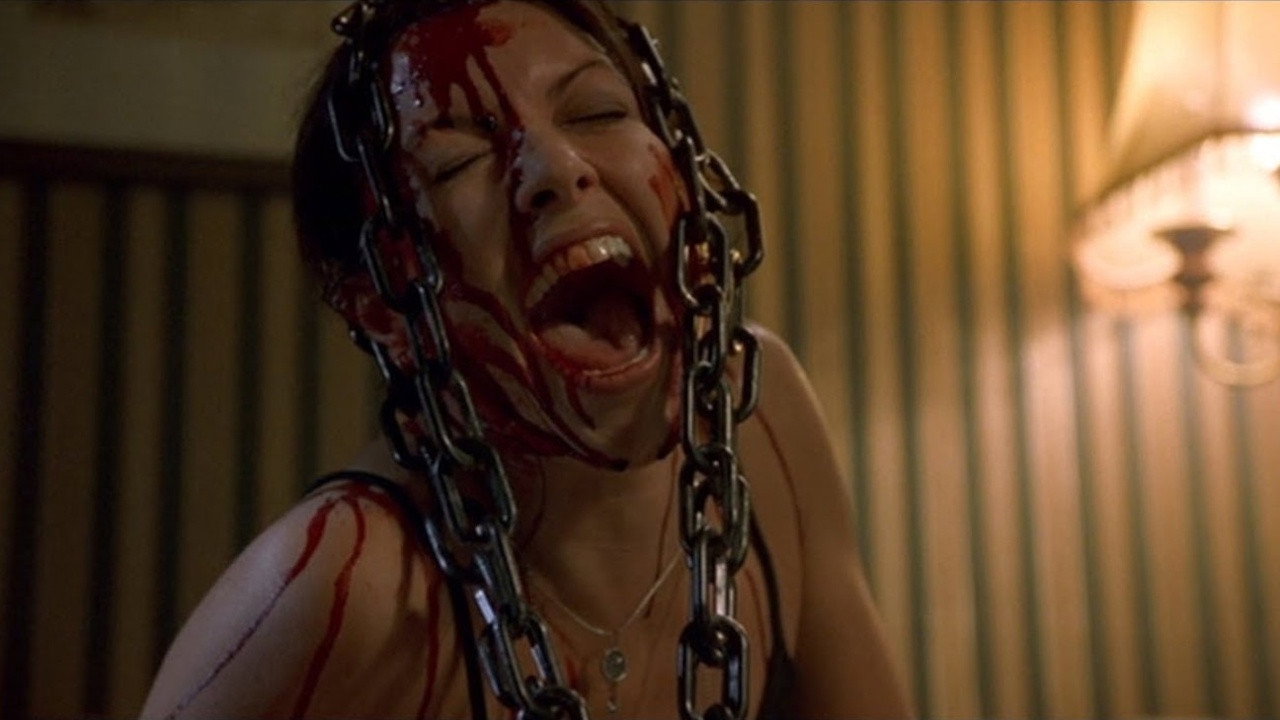
The production retained physical violence even as it pursued a more elusive mystery. Effects artist Gary J. Tunnicliffe discussed hooks, gore and new Cenobite designs in period publicity collected on the official archive. His comments identify the intended practical-effects vocabulary but do not verify the construction method behind every finished shot. Amy's bathroom ordeal uses confinement and the fear of bodily invasion, bringing the intimate vulnerability of early Hellraiser imagery into the reporter's nightmare. An ordinary private room becomes a place where Amy can no longer separate her investigative curiosity from a direct threat to her body.
Bota singled out the bathroom scene in a long JoBlo interview and credited Kari Wuhrer's performance with sustaining its intensity. He also explained his timing of Marla's sudden appearance in another bathroom encounter, where delaying an expected shock was intended to lower the audience's guard. The scenes alternate between a gradual realization that something is wrong and a sharp interruption of the character's apparent safety. That rhythm makes the bathroom material distinctive even as the relationship between the cult's powers and the Cenobites remains uncertain.
Delayed Home-Video Release and Critical Response
The film was shot in 2002 alongside work on Hellraiser: Hellworld, which was developed within the same economical production cycle. Doug Bradley later recalled recording dialogue and commentary long before Deader appeared, describing uncertainty about the repeated changes to its planned release. The seventh film finally arrived in the United States on DVD on June 7, 2005. The delay contrasted with the speed of filming, which Bota attributed to the limited resources and tightly organized schedules of Dimension's home-video sequels. The uncertain timetable affected when the existing production could reach its intended audience.
A February 2006 review by Dana Gravesen for Classic-Horror.com criticized the grafted-on Hellraiser mythology, the continuity of individual scenes and the limited effect of Pinhead's appearances. Gravesen nevertheless considered the makeup and amount of gore stronger than in some neighboring direct-to-video entries. The review's qualified praise captures a tension visible throughout the sequel: its bodily horror has greater immediate force than its explanations of Winter's authority. Deader exemplifies a period when the franchise name could be attached to a pre-existing supernatural mystery, with the puzzle box and Pinhead supplying recognition while the newly acquired story determined much of the film's action.
An extensive archive of original testimony from Neal Marshall Stevens, Tim Day, Doug Bradley, Kari Wuhrer, Gary J. Tunnicliffe and cinematographer Vivi Dragan Vasile about rewrites, Romanian locations, lighting and effects.
A substantial original interview in which Bota discusses the decision to retrofit the screenplay, Winter and Pinhead, direct-to-video production and the timing of specific scares.
Dana Gravesen's February 2006 review assesses the grafted franchise mythology, continuity problems, practical makeup, gore and Pinhead's limited dramatic role.