Boogeyman (2005)

US
Runtime
89 min
Release
February 4, 2005
Budget
$20,000,000
Revenue
$67,192,859
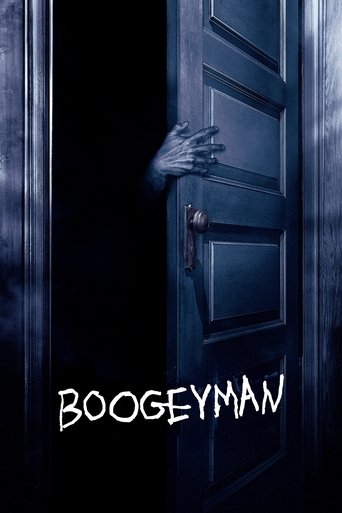
Boogeyman (2005) poster
Director
Production Companies
Pacific Renaissance Pictures , Screen Gems , Ghost House Pictures , Senator International
Plot

Every culture has one – the horrible monster fueling young children's nightmares. But for Tim, the Boogeyman still lives in his memories as a creature that devoured his father 16 years earlier. Is the Boogeyman real? Or did Tim make him up to explain why his father abandoned his family?

Alternative Titles
Торбалан (Bulgaria) — Bulgarian O Pesadelo (Brazil) — Portuguese Boogeyman : Le pouvoir de la peur (Canada) — French 恶灵空间 (China) — Chinese Boogeyman - Der schwarze Mann (Germany) — German Boogeyman: La puerta del miedo (Spain) — Spanish Boogeyman : La Porte des cauchemars (France) — French 夜半鬼開門 (Hong Kong SAR China)
Show all 23 alternative titles בוגימן (Israel) — Hebrew Boogeyman - L'uomo nero (Italy) — Italian Boogeyman - L’Uomo Nero (Italy) — Title ブギーマン (Japan) — Japanese 부기맨 (South Korea) — Korean Baubas (Lithuania) — Lithuanian Bubulis (Latvia) — Latvian Boogeyman: El nombre del miedo (Mexico) — Spanish O Pesadelo (Portugal) — Portuguese Бугимен (Russia) — Russian Boogeyman, La Puerta del Miedo (El Salvador) บูกี้แมน ตำนานสัมผัสสยอง (Thailand) — Thai Karabasan (Türkiye) — Turkish 惡靈空間 (Taiwan) — Chinese Ông Kẹ (Vietnam) — Vietnamese

Boogeyman (2005) Film Guide

Stephen Kay’s supernatural horror film: Ghost House Pictures, childhood trauma, haunted-house design, sound effects, theatrical performance and contemporary criticism.

Boogeyman (2005) is an American supernatural horror film directed by Stephen Kay and produced by Sam Raimi and Rob Tapert through Ghost House Pictures. Built around a childhood fear of the figure concealed inside a closet, the story follows a young man whose belief in a supernatural predator survives into adulthood. The film combines psychological uncertainty with increasingly explicit manifestations of the monster, using the architecture of an isolated family home as its principal source of unease. Its approach reflects the early-2000s American interest in atmospheric supernatural horror, particularly following the commercial success of Japanese-influenced productions such as The Grudge (2004).

Barry Watson plays Tim Jensen, who witnessed his father disappear into a bedroom closet when he was eight years old. Years of psychiatric treatment have encouraged him to regard the event as an explanation invented to cope with abandonment, but his fear remains. Following his mother’s death, Tim returns to his childhood home and attempts to confront the memory. Emily Deschanel portrays his former friend Kate, while Skye McCole Bartusiak plays Franny, a mysterious girl connected to the house’s history. Released by Screen Gems on February 4, 2005, the film was commercially successful despite predominantly negative reviews. Its production history documents an attempt to transform a conventional monster screenplay into a more psychologically oriented horror film.

Development and Ghost House Pictures

Boogeyman entered development during the establishment of Ghost House Pictures, the production venture associated with Sam Raimi, Rob Tapert, Joe Drake and Nathan Kahane. Tapert explained in a February 2005 interview with Dread Central that Drake and Kahane already possessed the screenplay when they approached Raimi and Tapert about forming the company. The project initially resembled a traditional 1980s monster movie. Its direction changed during development, particularly after Stephen Kay became involved. The filmmaker moved the material toward psychological horror, emphasizing the consequences of childhood terror rather than concentrating exclusively on a visible creature.

Kay was approached directly by the producers, with whom he had an existing professional relationship. He described Ghost House as a collaborative environment in which the filmmakers remained involved throughout production. Tapert was especially active during filming, while Raimi contributed more extensively toward the end because he was occupied with Spider-Man 2. Kay identified Japanese supernatural cinema as an important contemporary influence, alongside earlier American horror films such as The Exorcist and The Omen. His interest concerned the relationship between recognizable human experiences and extraordinary threats. In an interview conducted around the theatrical opening, he explained that the character’s fear was partly informed by his own experiences of anxiety.

Production took place in New Zealand, continuing Raimi and Tapert’s established working relationship with the country’s film industry. Robert Gillies supervised production design, and Bobby Bukowski served as cinematographer. Lucy Lawless was cast as Tim’s mother after the character’s importance increased during development. Kay and Watson later confirmed that additional flashback material featuring Lawless had been filmed but removed from the theatrical version. Their comments establish that the family history was explored more extensively during production, although the surviving interview does not provide sufficient evidence to reconstruct those deleted scenes as a complete alternative storyline.

Childhood Fear and the Architecture of the Haunted House

Tim’s fear is expressed through the arrangement of his adult living space. His furniture and possessions are organized to avoid enclosed compartments, while the absence of ordinary cupboard doors reflects his inability to tolerate the possibility of something concealed nearby. The childhood disappearance of his father remains an unresolved event that Tim has been encouraged to interpret psychologically. Returning home forces him to confront the environment where the experience occurred. The story repeatedly raises doubts about the reliability of his perceptions, particularly when objects and locations appear to change around him.

Kay regarded the house as an active component of the horror. He explained that its labyrinthine arrangement recalled the threatening domestic environments of The Haunting and The Texas Chain Saw Massacre. An existing rural house provided the visual foundation for the production design, while modifications to the interiors allowed the filmmakers to manipulate movement between rooms. The director wanted darkness, reflective surfaces and apparently ordinary passages to acquire threatening qualities. His use of viewpoints from inside closets introduces the suggestion of another observer sharing the room with Tim. These choices support the uncertainty surrounding the protagonist’s experiences.

The framing frequently restricts the viewer’s understanding of the available space. Watson emphasized that Kay used extreme close-ups to create an impression of confinement even when the physical set was relatively open. Doors, dark corners and the space beneath furniture consequently become recurring objects of attention. Franny’s appearances introduce a different element into this arrangement, suggesting that the house contains evidence of earlier disappearances. The character provides a connection between Tim’s individual terror and the broader supernatural threat. The film eventually moves toward a more explicit explanation of the monster, reducing some of the uncertainty sustained during its earlier encounters.

Visual Effects, Editing, and Sound Design

The film’s visual approach combines tight compositions with abrupt camera movements and rapid editing. Scenes inside closets and other restricted spaces frequently distort the viewer’s sense of distance and direction. Kay explained that he wanted these sequences to evoke the experience of panic, in which familiar surroundings become difficult to interpret. His camera movements are especially forceful when Tim crosses boundaries between rooms or confronts an apparently impossible spatial transition. The final confrontation increases the presence of digital effects, giving the supernatural threat a more substantial physical form than its earlier appearances.

Sound was an important component of the production. Kay praised the New Zealand sound team for constructing layered effects that could generate discomfort before an audience consciously identified their source. He described one particularly piercing sound as involving a reversed violin combined with additional processed material, while acknowledging that he could not recall its exact technical construction. Raimi encouraged the use of dramatic scoring rather than conventional songs, and Kay increasingly favoured tonal textures over clearly melodic accompaniment. Joseph LoDuca composed the score. The combination of music, manipulated instrumental sounds and environmental disturbances helps establish the apparent presence of something within otherwise empty rooms.

The decision to pursue a PG-13 classification influenced the depiction of violence. Tapert recalled that Kay wanted the film to appeal primarily to younger teenage viewers and deliberately avoided extensive bloodshed. According to the producer, relatively little completed material was removed specifically to satisfy the American rating authorities. Some additional scenes were nevertheless filmed and subsequently excluded from the theatrical version. This distinction matters because reports of unused footage do not establish the existence of a substantially more violent completed cut. The film’s strongest effects were intended to derive from anticipation and sudden supernatural intrusions, even though its climax ultimately relies on overt creature imagery.

Theatrical Release, Box Office, and Contemporary Reception

Screen Gems released Boogeyman in the United States on February 4, 2005, with a PG-13 classification for intense sequences of horror and terror, violence and partial nudity. The film opened in 3,052 theatres and earned $19,020,655 during its first weekend, reaching first place at the domestic box office. Its final reported North American theatrical gross was $46,752,382, with international earnings of $20,440,477 bringing the worldwide total to $67,192,859. The reported production budget was $20 million. These figures describe theatrical receipts and production expenditure; they do not establish net profit after distribution, marketing and exhibition costs.

Contemporary reviewers frequently criticized the relationship between the psychological premise and the film’s aggressive visual techniques. Michael Gingold, writing for Fangoria in February 2005, acknowledged the potential of Tim’s troubled perception and praised aspects of Skye McCole Bartusiak’s performance. He nevertheless argued that the constant camera movements, rapid editing and loud musical effects undermined the suspense. Gingold also considered the computer-generated finale less effective than the film’s earlier ambiguity. His review noted that death scenes described during Fangoria’s production coverage were absent from the released feature, illustrating the difference between material prepared during filming and the completed theatrical presentation.

Kevin Crust’s February 7 review for the Los Angeles Times was similarly negative. He regarded the screenplay as derivative and questioned the reliance on familiar shocks, despite acknowledging the film’s strong opening-weekend commercial performance. The critical response contrasted with its immediate popularity among theatrical audiences. Boogeyman subsequently reached American home video on May 31, 2005. Two further films bearing the title, Boogeyman 2 (2007) and Boogeyman 3 (2008), followed through the home-entertainment market. The original remains identifiable within Ghost House’s early catalogue for its combination of a childhood-monster premise, psychological uncertainty and a deliberately restrained approach to onscreen gore.

References

  1. Dread Central Kay, Stephen & Watson, Barry (Boogeyman)

    February 2005 direct interview documenting the director’s horror influences, house design, camera techniques, psychological approach, New Zealand sound work and deleted material.

  2. Dread Central Raimi, Sam & Tapert, Rob (Boogeyman)

    February 2005 producer interview explaining the origins of Ghost House Pictures, the screenplay’s transformation from monster horror to psychological suspense and the intended PG-13 approach.

  3. Fangoria Boogeyman (2005) Review — Michael Gingold

    Contemporary February 2005 review examining the psychological premise, visual style, digital climax, sound effects and discrepancies between production coverage and the theatrical film.

  4. Los Angeles Times There’s No Reason to Fear This “Boogeyman” — Kevin Crust

    Contemporary February 7, 2005 review assessing the screenplay, characterization, supernatural effects and opening-weekend reception.

Connections

Cast

View Full Cast & Crew →

Release & Distribution

Production Companies (4)

  • Ghost House Pictures US
  • Pacific Renaissance Pictures NZ
  • Screen Gems US
  • Senator International US

Distributors (1)

  • Screen Gems US

Release History (13)

Release DateTerritoryRelease TypeFormatDistributorCertificationNotes
2005-02-04 Brazil Theatrical — — 14
2005-02-04 Netherlands Theatrical — — 16
2005-02-04 United States Theatrical — — PG-13
2005-02-05 New Zealand Theatrical — — —
2005-03-04 United Kingdom Theatrical — — 15
2005-03-17 Germany Theatrical — — 16
2005-05-26 Hungary Digital — — 12
2005-07-08 Italy Theatrical — — —
2005-07-11 Australia Theatrical — — M
2005-07-28 South Korea Theatrical — — 15
2005-10-26 Belgium Theatrical — — —
2006-06-03 Japan Digital — — R15+
2006-06-28 France Theatrical — — 12
You thought it was just a story.