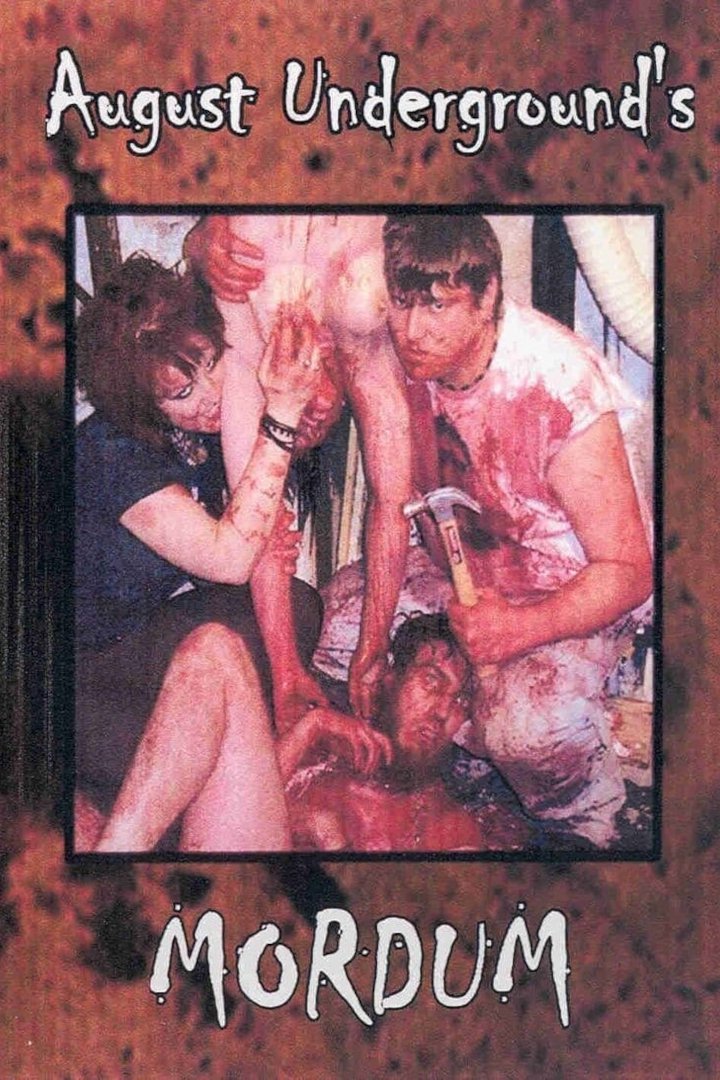
Peter continues to record acts of violence, now in the company of Crusty and her brother Maggot. Their group moves through private homes, social gatherings and increasingly disturbing encounters with victims. The sexual relationship between the siblings and Crusty's involvement with Peter add tension among the perpetrators. As control of the camera passes between them, the recordings capture both their crimes and the instability of their relationships.
Alternative Titles
八月地下坊 (China) — ChineseПодполье 2: Смерть (Russia) — Russian
The contested Toe Tag sequel expands pseudo-snuff found footage through a volatile trio, practical effects and competing edits.
August Underground's Mordum (2003) occupies a difficult place in American independent horror. Made within the Pittsburgh-based circle that developed around Fred Vogel and Toe Tag Pictures, the sequel retains the first film's conceit of videotapes recorded by murderers, but introduces a volatile group whose private conflicts structure the violence. It was conceived for viewers already familiar with the rough audiovisual language of the original August Underground (2001). The home-video appearance is part of its fictional method: images that seem carelessly recorded are organized to make the audience question where a performance ends and an apparent document begins.
The film's reputation is inseparable from its practical makeup effects, its deliberately abrasive treatment of sexual violence, and the circulation of different edits. The production history also illustrates the collaborative and sometimes contested authorship of microbudget horror. Its later Blu-ray edition made interviews, commentary tracks and material from early screenings accessible to a wider audience. Those records allow the film to be discussed as a constructed work of horror without accepting publicity claims about its extremity as evidence of artistic influence or historical notoriety.
Production and the Toe Tag Circle
The first August Underground established a form of serial-killer fiction presented as rough personal recordings. In a 2010 interview with HorrorNews.net, Vogel described his wish to make an unusually difficult horror film and recalled the challenges of distributing an independently produced video. That testimony concerns the original project's ambitions; the sequel developed after a small production circle began working together more formally. The same interview identifies Vogel, Shelby Vogel, Jerami Cruise and Cristie Whiles as central figures in Toe Tag Pictures. Their connections to makeup work and underground horror helped provide an environment in which performers and effects artists could contribute to scenes beyond their formal credits.
The circumstances of Mordum's development were less linear than its position as a sequel suggests. In interviews revisited for the 2023 Blu-ray, Vogel connected the project to work undertaken with Killjoy of the horror-metal band Necrophagia, including a proposed music-video collaboration. The eventual feature expanded that association into a succession of episodes featuring Peter Mountain and two new principal characters. The production credits name five directors: Vogel, Cruise, Whiles, Killjoy and Michael Todd Schneider. Their shared billing is worth retaining, since treating the film as a solo-director project would obscure the unusual division of creative work that later became important to disputes over its editing.
The Three Killers and the Structure of Violence
Vogel again plays Peter Mountain, now accompanied by Crusty, played by Whiles, and Maggot, played by Schneider. Crusty and Maggot's incestuous relationship and Peter's possessive reactions introduce an unstable domestic arrangement into the recorded crimes. The film alternates scenes of intimidation, assault and apparent murder with excursions and casual exchanges among the three. This shifting attention differs from the first installment's narrower arrangement of a killer and the person filming him. Personal jealousy becomes a recurring interruption, and the perpetrators sometimes appear more interested in provoking one another than in maintaining any coherent account of their actions.
Film scholar Steve Jones, writing in Scope in 2011, identifies the changing relationships among the three killers as a source of narrative movement. His reading situates the sequel within the wider problem of representing sexualized violence as entertainment. The distinctions matter: character psychology can be discussed as an organizing device without attributing a clear moral purpose to every scene. The camera's apparent intimacy with the perpetrators makes the victims' vulnerability difficult to separate from the trio's attempts to impress or humiliate each other. The resulting discomfort arises partly from the fictional social setting, which turns acts of cruelty into occasions for argument, performance and rivalry.
Digital Video, Improvisation and False Evidence
Mordum was photographed in the visual idiom of low-resolution consumer video. Its unstable framing, abrupt changes in proximity and poorly controlled lighting resemble footage gathered without concern for polished presentation. The camera often seems to belong to whichever participant is nearest to the action. This perspective limits information about the surrounding space and creates an impression of accidental access. At other points, the recording continues beyond a dramatic incident, giving ordinary movement and awkward silence the same place in the supposed archive as the violence. The appearance of disorder is central to the film's particular version of found footage.
Descriptions of the 2023 supplements attribute substantial improvisation to the production. Vogel recalled that there was no conventional script directing every exchange and later came to value the shaken camera's contribution to the on-screen chaos. These are retrospective explanations rather than production records for individual takes. Jones examines the trilogy as a form of pseudo-snuff, in which the spectator's position resembles that of an illicit viewer of recorded material. The film's illusion depends on the audience recognizing an amateur-video vocabulary while remaining aware that the images were planned and performed. Its method should therefore be distinguished from both an actual crime recording and the more controlled documentary realism of conventional fiction films.
Practical Effects and Production Labor
The effects work supplies much of Mordum's physical credibility. Cruise participated in creating the makeup and fabricated injuries, while Schneider and other collaborators contributed to the production's practical work. Coverage of the 2023 edition describes how the filmmakers discussed the construction and painting of prosthetic material, the use of substitute body parts and the practical difficulties of performing beside them. The film repeatedly places those objects close to actors, making texture and continuity of movement more important than elaborate visual-effects compositing. Its amateur-video presentation also affects how viewers inspect the effects: short glimpses can disguise a substitution, while extended observation places greater demands on the illusion.
The later commentaries further complicate the idea of a spontaneous underground recording. Their accounts describe planning, preparation and agreements among participants who had to perform physically demanding scenes. In the edition's interviews, Cruise spoke about establishing boundaries with performers and relying on trusted collaborators. Such testimony describes working methods within a deliberately transgressive production, not evidence that the fictional violence was real. The film's strongest effects are achieved through ordinary craft disciplines directed toward an unusually confrontational aesthetic. Their credibility comes from the meeting of materials, performers, camerawork and editing, although the available documentation does not support assigning a specific technique to every wound on screen.
Competing Edits, Screenings and Home Video
The history of Mordum involves more than one completed arrangement of its footage. Schneider assembled an alternative version generally known as the Maggot Cut. In interviews discussed by Severed Cinema and Inside Pulse, Vogel described dissatisfaction with an early edit and tensions over the amount of emphasis given to Schneider's character and the sexual material. The filmmakers subsequently reworked the film, and the Toe Tag version became its principal circulating cut. Those statements are especially useful when attributed: they recount a creative disagreement from Vogel's perspective and cannot substitute for a detailed side-by-side documentation of every variation. The existence of the alternate cut nevertheless makes a single, unqualified account of the film's structure incomplete.
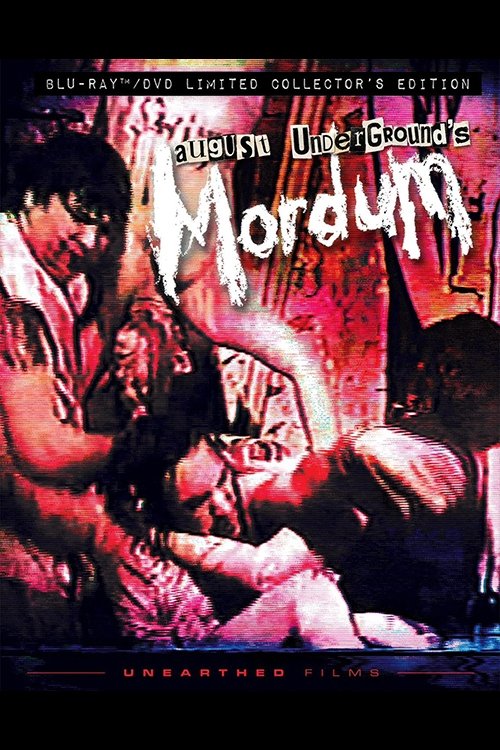
The original production circulated through the extreme-horror home-video community in 2003. Archive material on the 2023 Blu-ray preserves footage identified as the United States premiere, along with a screening at Flashback Weekend in 2004. These records establish that the film was being presented to organized audiences, even though a comprehensive theatrical release history and reliable box-office figures have not been documented. On October 10, 2023, Unearthed Films released a two-disc Blu-ray and DVD edition featuring a new transfer for the Blu-ray, the earlier DVD presentation, multiple interviews, commentaries and behind-the-scenes materials. A transfer of the surviving video source should not be confused with the recovery of originally photographed high-resolution footage.
Critical Debate and Underground Horror
Reception has remained divided even among writers accustomed to extreme cinema. Chris Severed's 2023 review emphasizes the effectiveness of the effects work, the performances and the film's sustained assault on the viewer's comfort. Reviewing the same Blu-ray for Horror Society, Blacktooth likewise praises the practical effects but argues that repetition, exaggerated behavior and limited dramatic development weaken the film. The disagreement is more informative than attempts to measure the movie against an imagined universal threshold of disgust. Both responses recognize the material achievement while reaching sharply different judgments about whether the surrounding structure is compelling.
Jones's academic discussion places the series within arguments about pseudo-snuff, pornography, spectatorship and the rhetoric of supposedly authentic images. That framework helps explain the interest of Mordum for horror scholarship without converting it into a landmark credited with directly inspiring later filmmakers. The film belongs to a period when independent digital-video technology and specialist physical-media distribution allowed unusually confrontational productions to reach audiences outside conventional cinemas. Its home-video circulation and later archival supplements are part of that history. What distinguishes it is the combination of fabricated bodily violence with a social relationship among killers that the camera records as if no outside audience were intended.
Steve Jones's peer-reviewed 2011 study in Scope examines the August Underground trilogy, pseudo-snuff aesthetics, sexualized violence and the spectator's position.
Severed Cinema — Exploring August Underground's Modrum: Review of the Colossal Limited Collector's Edition Blu-ray from Unearthed Films!
Chris Severed's substantial 2023 review includes firsthand discussion of supplementary interviews, production disagreements, practical effects and the film's reception.
Inside Pulse — Blu-ray Review: August Underground's Mordum
Joe Corey's October 2023 review examines the film's aesthetic and reports in detail on the new interviews, 2003 premiere footage, alternate editing and release presentation.
Horror Society — Blu Review - August Underground: Mordum (Unearthed Films)
Blacktooth's original October 2023 review offers a contrasting critical assessment and independently discusses the practical effects and home-video extras.
HorrorNews.net — Interview: Fred Vogel - Director (ToeTag Pictures) (Maskhead, August Underground)
Rob Dimension's 2010 interview with Vogel documents the development of Toe Tag, the first film's release ambitions and the filmmaker's stated attitude toward simulated violence.