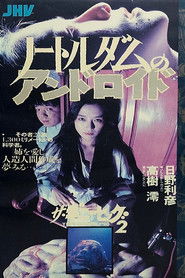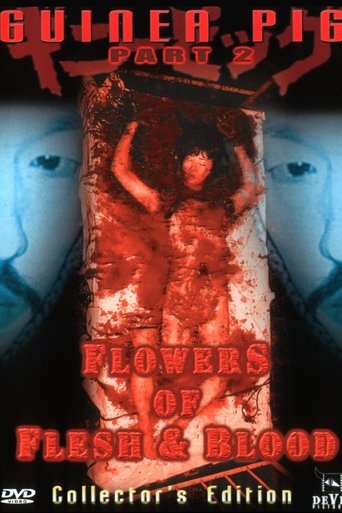
Guinea Pig 2: Flower of Flesh and Blood (1985)

JP
HORROR FILM
SUBGENRES EXTREME SPLATTER
Runtime
42 min
Release
October 7, 1985
Budget
$125,000
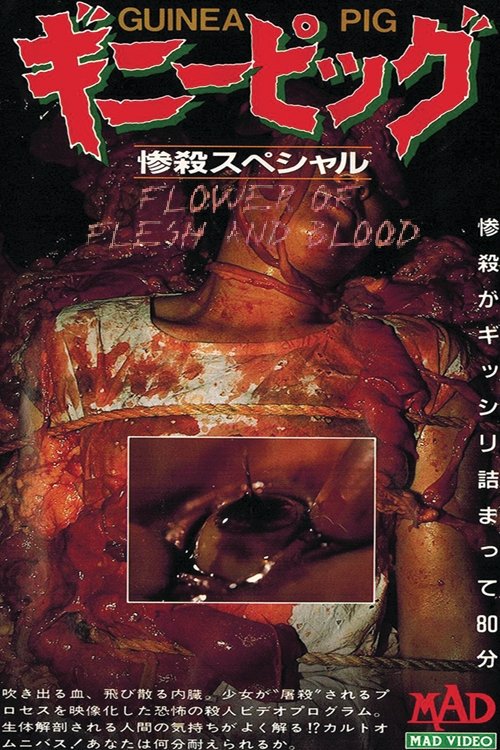
Guinea Pig 2: Flower of Flesh and Blood (1985) poster
Director
Writer
Production Company
Sai Enterprise
Plot

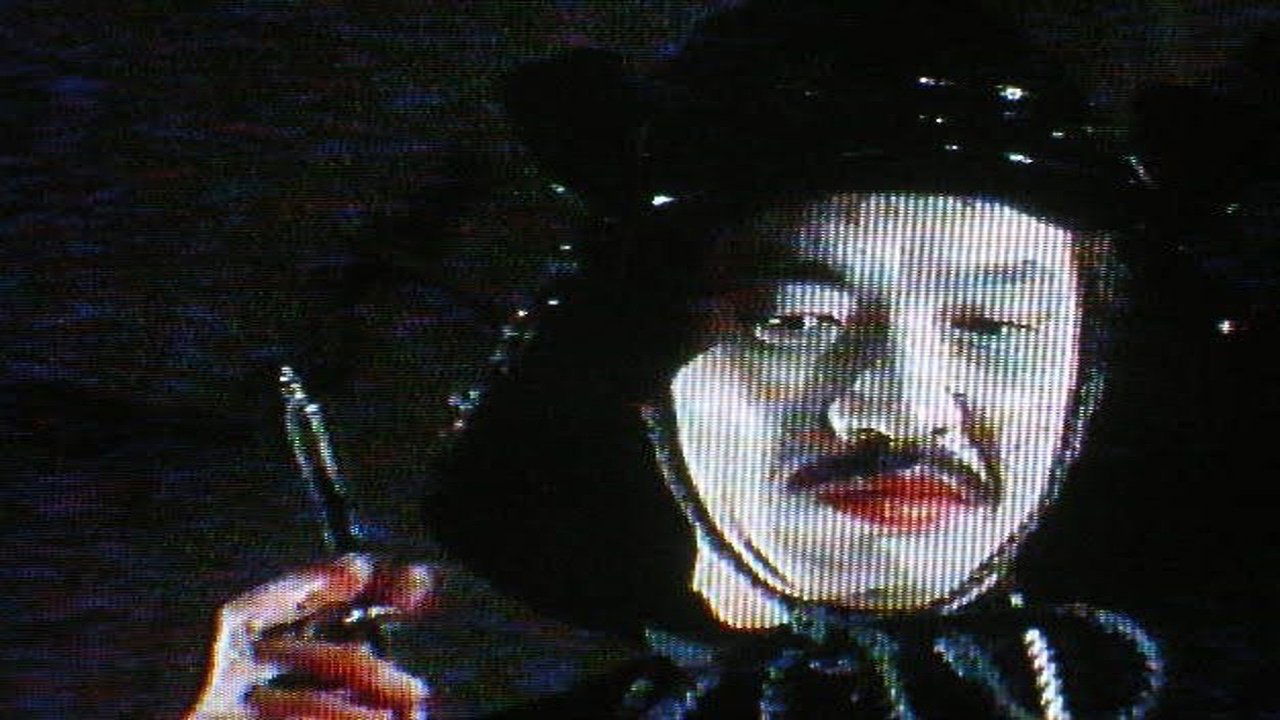
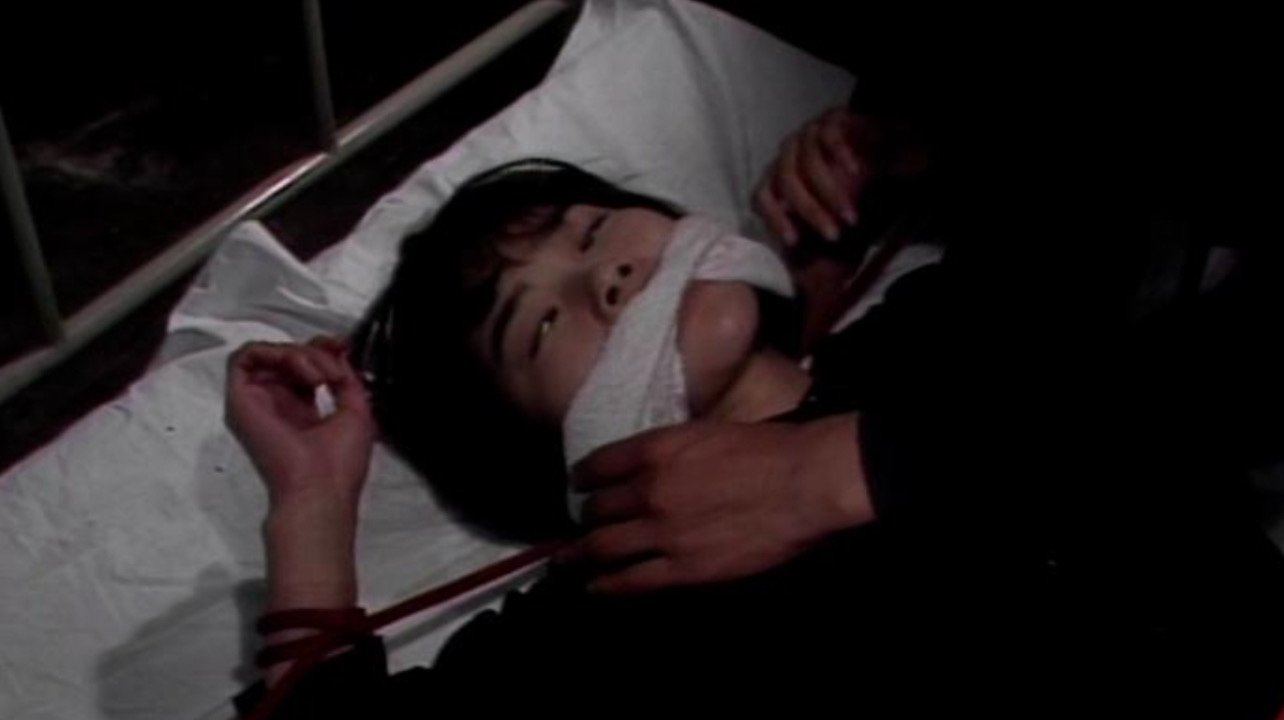
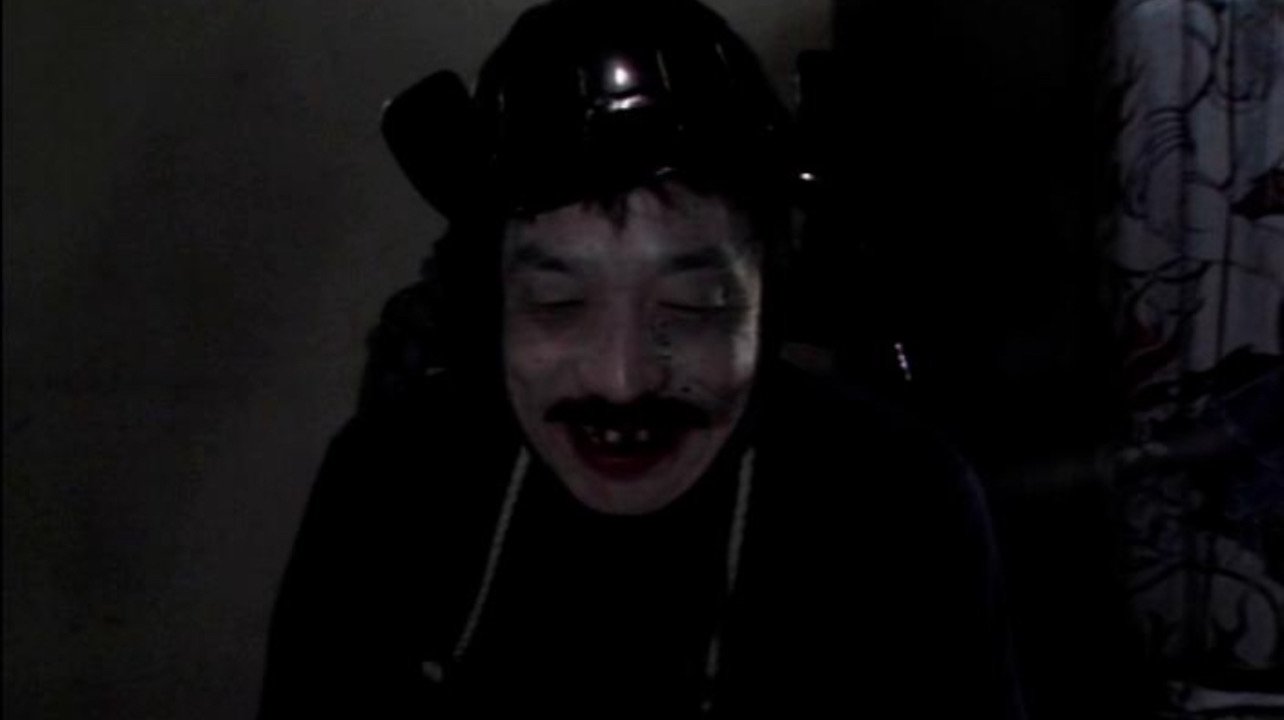
A woman is abducted and wakes in a confined room where a figure wearing a samurai-style helmet begins a ritual of bodily destruction. The assailant treats the captive as material for a macabre artistic arrangement, while the recording remains fixed on the disturbing physical spectacle. A framing premise suggests that the images originated as illicit footage later reconstructed for an audience. Directed by horror manga artist Hideshi Hino, the film uses prolonged prosthetic effects, minimal dialogue and a restricted setting to create the impression of a private recording whose authenticity the viewer is invited to question.

Alternative Titles
豚鼠2:血肉之花 (China) — Chinese Guinea Pig 2: Flowers of flesh and blood (Spain) — Spanish Guinea Pig 2: Flowers of Flesh and Blood (France) — French פרחים של בשר ודם (Israel) — Hebrew Guinea Pig: Flowers of flesh and blood (Italy) — Italian Ginî piggu 2: Chiniku no hana (Japan) — romanization Ginî piggu 2: Ketsuniku no hana (Japan) — Japan (alternative transliteration) 기니어피그 EP2 : 혈육의 꽃 (South Korea) — Korean
Show all 16 alternative titles Guinea Pig 2 Flower of Flesh and Blood (Mexico) — Spanish Ginî piggu 2: Chiniku no hana (Netherlands) — Dutch Królik doświadczalny 2: Kwiat ciała i krwi (Poland) — Polish Cobai Partea 2: Floare din carne și oase (Romania) — Romanian Подопытная свинка 2: Цветок из плоти и крови (Russia) ดอกไม้โลหิต (Thailand) — Thai Guinea Pig Part 2: Flower of Flesh and Blood (United States) — English Slow Death: The Dismemberment (United States) — Bootleg Title

Film Guide & Analysis

Hideshi Hino stages simulated violence as a forbidden recording, a strategy whose practical effects and disputed circulation shaped an enduring pseudo-snuff reputation.

Guinea Pig 2: Flower of Flesh and Blood (1985) occupies an unusually contested position in Japanese video horror. Written and directed by the horror manga artist Hideshi Hino, it transforms a short account of abduction and murder into a carefully staged demonstration of simulated bodily destruction. A perpetrator dressed in samurai-like costume treats a captive woman's dismemberment as the making of an artwork. With character history and external explanation reduced to a minimum, the film places unusual weight on the material credibility of its makeup effects and on the viewer's willingness to accept the recorded image.

Its international reputation developed as much through the movement of videotapes as through the film itself. Rumors that the violence had been photographed during a real killing, Hino's account of a Japanese media controversy, and documented complaints about an American cable broadcast helped turn an underground production into a disputed object of evidence. Those episodes are frequently compressed into one legend. The production history, later recollections and contemporary reporting describe distinct events, each requiring a different degree of certainty.

Production and Hino's Concept

Hino was known for grotesque manga when the producers of the first Guinea Pig video approached him. In an interview published by Vice in 2009, he recalled that his name had arisen during the earlier production's wrap party. The subsequent offer came with strict economic limits: the filmmakers wanted a single setting, extended shots and very little editing. Hino initially regarded those conditions as obstacles to storytelling. They ultimately shaped a work in which the passage of time and the apparent physical integrity of each action matter more than conventional dramatic incident. The restricted space follows a production constraint that changed Hino's original approach to the story.

Hino also described his invention of an elaborate framing story. In this invented premise, a deranged admirer sent him an 8mm reel depicting an actual killing, and the finished video purported to reconstruct that forbidden material. This was the director's fictional device, devised against a background of Japanese rumors about snuff recordings, and should never be treated as evidence that such a reel was received. He explained that he deliberately withheld a moral explanation and the killer's interior life. His account makes the work's absence of conventional justification an intentional choice, even if the surrounding premise encouraged spectators to confuse cinematic simulation with documentary proof.

Staging and Visual Language

The victim's journey from a public street into an isolated room establishes a sharp contraction of space. Once she is restrained, the staging becomes a prolonged encounter between the performer's body, the assailant and the camera. The costumed killer speaks of transforming flesh into flowers; the language makes the mutilation a perverse craft, with the victim reduced to materials in an imagined composition. The visual organization repeatedly draws attention to the arrangement of limbs and anatomical substitutes. Those images connect the film to Hino's wider fascination with bodily decay and grotesque beauty, although a close formal reading remains an interpretation of the finished work rather than a statement about every detail of the shoot.

The impersonation of a private crime recording is also unstable. A staged light source, conspicuous costume and sustained attention to the action make the perpetrator seem like a performer as well as a criminal. The central horror comes from the uneasy overlap between evidence and spectacle: the viewer is asked to examine each cut while also knowing that examination is what the film has been designed to provoke. The sparse dramatic structure leaves few opportunities to escape that task. Hino's contemporary critics objected to the apparent absence of a social or moral lesson; he later rejected the assumption that horror needed to justify itself through an improving message.

Practical Effects and the Illusion of Violence

The film depends upon fabricated anatomy, controlled framing and performance to suggest injuries that were not inflicted on a human being. The images ask the viewer to accept successive substitutions between a living actress and artificial body parts. Their effect rests on relative scale, surface texture, movement and the duration for which an illusion survives inspection. A severed part shown in isolation may appear convincing for different reasons from a procedure staged beside an actor's face. Some individual effects are visibly constructed, while others sustain the intended confusion. A detailed account identifying the materials and mechanisms behind each effect has not been established. Assigning a particular compound or device to an individual wound would therefore exceed the documented production history.

The production's deception was later addressed by behind-the-scenes footage from the Guinea Pig cycle. During a separate American controversy in 1996, a journalist identified that explanatory footage as evidence that the apparent dismemberment had been achieved with special effects. Its existence is historically important because the film's reputation had come to depend upon the possibility that spectators might misidentify an artificial performance as a documented death. A making-of demonstration can establish the fictional construction of the violence without requiring extravagant claims about unprecedented technology. The practical work is inseparable from the limitations of the small production and from the director's decision to hold the spectator's attention on physical actions.

Japanese Video Circulation and Public Response

The film originated in the Japanese home-video environment of the mid-1980s. That context mattered to its meaning: a tape encountered privately could seem disconnected from the reassuring conventions of a theatrical release. Hino told Vice that schools and educational authorities had scrutinized the production and that copies were withdrawn from circulation. Those are the filmmaker's recollections, not independent proof of a uniform nationwide ban or a precisely documented legal order. The interview itself complicates a simple prohibition narrative because the journalist said he had found a rental copy in a Tokyo video shop years later. Claims about the original market, sales and formal censorship therefore need more evidence than the film's notoriety supplies.

Hino recalled a critical dispute on Japanese television in which journalist Taro Kimura questioned the work and critic Haruo Mizuno condemned its lack of moral purpose. This exchange, as retold by Hino, helps place the controversy in a disagreement about what violent entertainment was supposed to offer its audience. For its director, the ability to leave viewers frightened was a legitimate artistic result. For the critic he quoted, the absence of narrative or ethical framing made the spectacle indefensible. Neither position is evidence that viewers actually believed a murder had been committed; the argument concerns the public acceptability of simulated violence and the cultural expectations applied to a direct-to-video work.

The Miyazaki Case and Misattribution

A later Japanese controversy developed around the crimes of serial killer Tsutomu Miyazaki. In his 2009 interview, Hino recounted that police had wanted to discuss the psychology of his film's killer. According to the director, a Guinea Pig tape was then reported among items associated with Miyazaki, but the recording was a different installment, not the film Hino had directed. Hino claimed that police and news reporting had conflated the titles after investigators watched his film. The account explains why reports tying this particular work to the murders require scrutiny. It cannot independently resolve every question about the investigation, but it directly contradicts the frequently repeated assertion that the authorities had found this exact video.

Hino said the resulting publicity damaged planned manga publications and disrupted preparations for an additional theatrical project connected with Mermaid in a Manhole. These consequences remain Hino's retrospective account. The public attention directed toward the videos is well documented, while assertions that this work caused an actual crime have no demonstrated basis. The distinction matters because a lurid association can become part of a film's historical identity even after the original identification is challenged. Later retellings have often preserved the accusation while omitting the director's correction and the difficulty of establishing what police actually possessed.

Overseas Controversy and Later Reputation

The best-known overseas anecdote concerns actor Charlie Sheen, who reportedly saw a copy of the video and believed it depicted an actual killing. Jordi Costa's 2006 profile of Hino in El País records the story and the artist's amused response, while the 2009 Vice interview is more limited: Hino said he had learned about the alleged FBI attention from American journalists and did not possess detailed firsthand knowledge. Accounts differ over the intermediary and timing, and a documented investigative file was not available among the sources consulted. The widely repeated episode has uncertain particulars, especially the extent and course of any federal investigation.

A separate American dispute is firmly documented. On October 14, 1996, the San Francisco Chronicle reported complaints after the Hino video appeared on the public-access program The Pain Factory on October 5. Cable operator TCI sought a copy to assess whether the broadcast violated its obscenity agreement. The show's producer said the supposed killing was simulated. Two days later, the Chronicle reported Rider McDowell's explanation that the filmmakers had issued footage demonstrating the effects. These are contemporary reports of named participants and an identifiable broadcast, quite unlike an anonymous account of a hidden snuff reel. The incident shows how the film's imagery could still be mistaken for documentary violence more than a decade after its Japanese release.

The video's reputation continues to rest on this uneasy combination of physical effects, transnational tape circulation and stories attached to the images. The same compact visual premise that made the film easy to circulate also made it vulnerable to retelling without context. Hino's later discussions of his manga suggest a continuing interest in horror arising from the human body itself. Colette Balmain's 2011 study in Asian Cinema examines the treatment of the female body across the Guinea Pig films and the Western marketing that shaped their reputation as underground Japanese extreme cinema. Her research places the series within critical debates about gendered spectatorship and the promotion of transgressive imagery. Its place in underground horror culture is closely linked to debates over the credibility of manufactured gore and the ethics of spectatorship.

References

  1. Vice Flowers of Flesh and Blood

    Tomo Kosuga's 2009 original interview with Hideshi Hino on the commission, budget restrictions, fictional snuff premise and controversies in Japan and abroad.

  2. El País El nieto dibujante del 'yakuza'

    Jordi Costa's 2006 reporting and direct comments from Hino on the relation between corporeal horror, manga, the Guinea Pig films and the Charlie Sheen story.

  3. San Francisco Chronicle JOHN CARMAN on TELEVISION -- A 'Snuff' Video on S.F. Cable?

    Contemporary October 1996 reporting on the public-access broadcast, named complaints and a cable operator's inquiry into the film's authenticity.

  4. San Francisco Chronicle JOHN CARMAN on TELEVISION -- News Director Stan Hopkins Leaves KRON

    October 1996 follow-up quoting Rider McDowell on fabricated effects and the public-access controversy; independently records the Sheen story as an account then in circulation.

  5. Asian Cinema (Intellect) Flesh and Blood: The Guinea Pig Films

    Colette Balmain's peer-reviewed 2011 study examines gender politics, representations of the female body and Western marketing of the Guinea Pig series as underground extreme cinema.

Connections

Cast

View Full Cast & Crew →

Release & Distribution

Production Companies (1)

  • Sai Enterprise

Release History (2)

Release DateTerritoryRelease TypeFormatDistributorCertificationNotes
1985-10-07 Japan Physical — — —
1985-10-07 Japan Physical VHS — R18+ VHS
I am going to show you the ideal of beauty.