After a series of personal disappointments, an office worker discovers that attempts to kill himself do not have the expected consequences. His apparent inability to die becomes a source of increasingly grotesque experimentation and, eventually, a means of frightening the people around him. Moving away from the pseudo-documentary cruelty of the first two Guinea Pig films, the story uses elaborate bodily illusions as black comedy. Its absurd premise and performers' reactions turn scenes of apparently serious injury into an escalating confrontation between everyday frustration and impossible physical survival.
Alternative Titles
豚鼠3:他不会死 (China) — Chinese豚鼠系列之 3:他不會死 (Hong Kong SAR China) — ChineseGinî piggu 3: Senritsu! Shinanai otoko (Japan) — romanizationギニーピッグ3 戦慄!死なない男 (Japan) — Japanese기니어피그 EP3 : 죽지 않는 남자 (South Korea) — KoreanGuinea Pig 3 He Never Dies (Mexico) — SpanishKrólik doświadczalny 3: On nigdy nie umiera (Poland) — PolishПодопытная свинка 3: Он никогда не умрет! (Russia) — RussianShow all 9 alternative titlesGuinea Pig Part 3: He Never Dies (United States) — English
▤
Film Guide & Analysis
Masayuki Kusumi turns the Guinea Pig series toward grotesque comedy, using practical gore, mock-documentary framing and a portrait of workplace isolation.
Guinea Pig 3: He Never Dies (1986), written and directed by Masayuki Kusumi, occupies a distinct place in Japan's Guinea Pig cycle of short-form extreme horror. Where the first two installments cultivated the appearance of filmed atrocity, this entry organizes its graphic imagery around a recognizably fictional predicament: an exhausted office worker discovers that injuries cannot kill him. The result is a grotesque comedy whose violence becomes progressively more absurd. Its importance to the series lies in that formal change. Bodily destruction remains central, but it now serves an escalating joke and a character's troubled relationship with everyday life.
The film emerged from the Japanese video market that sustained the original Guinea Pig productions during the mid-1980s. In the context of exploitation cinema, these short works could circulate as provocative attractions outside conventional feature-film expectations. He Never Dies shows how flexible their organizing concept had already become. An audience drawn by the franchise's reputation for convincing wounds encountered a story about work, humiliation and extraordinary physical survival. The contrast between domestic routine and gruesome impossibility gives the third installment an identity separate from the simulated-snuff imagery associated with its predecessors.
The Video Series and a New Approach
The Guinea Pig project was associated with Satoru Ogura and Sai Pictures, which handled Japanese distribution under the Orange Video House name. Film scholar Nicolò Gallio describes the company's involvement with the series against a wider home-video economy of shock documentaries and transgressive exploitation. Kusumi's film belongs to that industrial setting, although surviving public documentation provides little reliable detail about its individual financing, shooting schedule or casting process. Its short running time is consistent with the compact format that characterized the cycle. Claims about exact budgets or undocumented production incidents would add apparent precision without establishing how the work was actually made.
A more revealing decision is visible in the narrative itself. Hideshi, an unhappy salaryman, is introduced through social failure and workplace tension before his unusual condition takes command of the story. The character's inability to die turns a private crisis into an increasingly outrageous performance for another person. This structure creates anticipation through situations and reactions, giving the physical effects a dramatic purpose. In Lorenzo Paviano's 2015 assessment of the complete series, the third installment marks the introduction of a more developed plot and an overtly comic tone. That judgment describes a recognizable stylistic departure rather than evidence of a documented change in the producers' intentions.
Performance and Documentary Framing
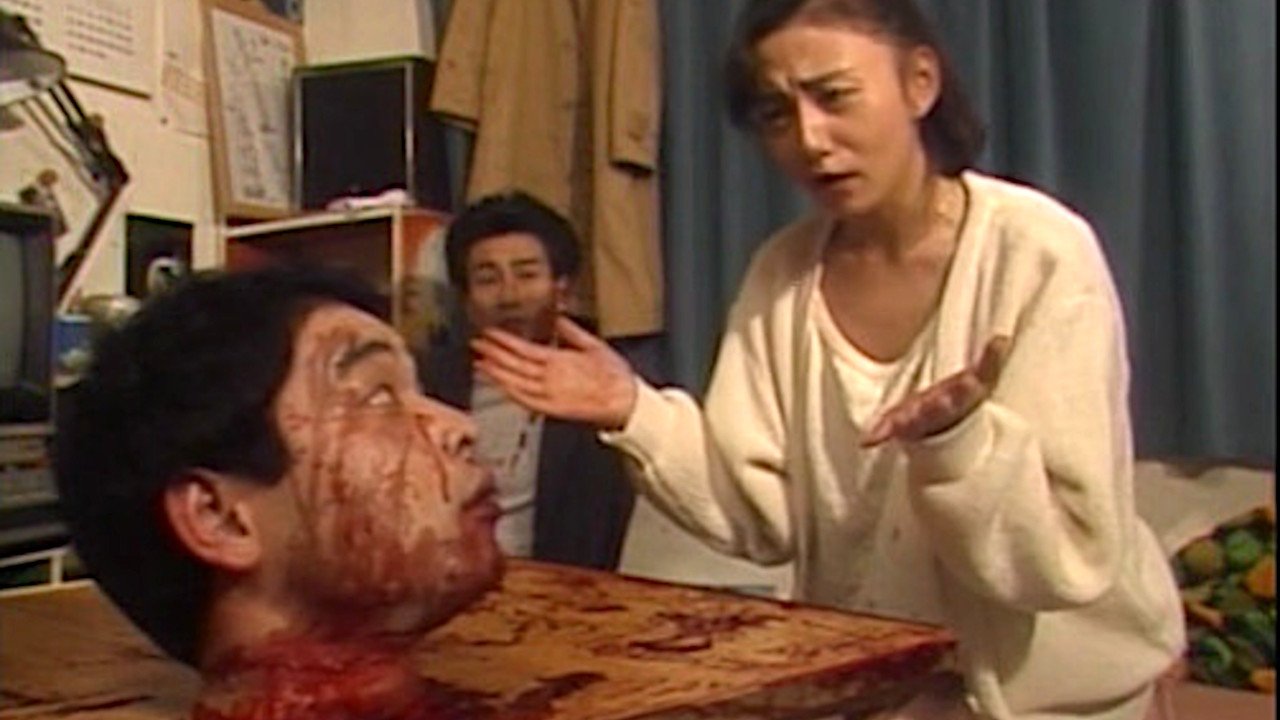
He Never Dies retains traces of the series' fascination with purportedly authentic footage while making its comic construction increasingly visible. A framing introduction presents the material as an unusual recorded case, and passages involving office colleagues resemble interviews. Within the central narrative, however, the camera moves through scenes designed around dramatic timing and the contrast between Hideshi's excitement and other characters' bewilderment. Colette's 2013 review for HorrorNews.net identifies this mobile camera and the shifts between monochrome and color imagery as signs of the film's move toward openly staged fiction. The framing device remains part of its exploitation vocabulary even as the performances undermine any straightforward claim to documentary realism.
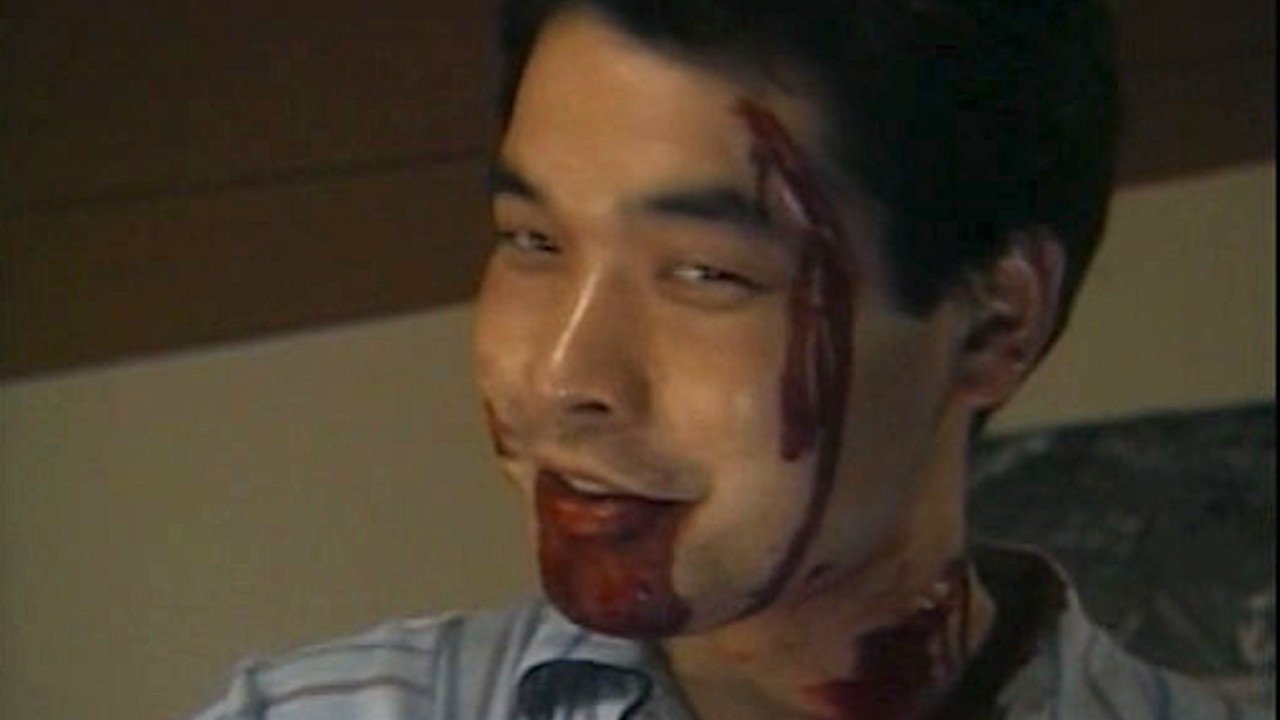
The workplace material provides a recognizably ordinary setting for increasingly impossible events. Masahiro Sato's Hideshi alternates frustration with exuberance once he grasps the implications of his condition; the reactions of Nakamura and Kyoko anchor the resulting chaos in embarrassment and disbelief. Their behavior changes the direction of the horror: what looks like an emergency becomes an awkward social encounter. This contrast supports a reading of the protagonist's invulnerability as a fantasy of escape from humiliation. Colette connects the film's portrait of isolation to anxieties surrounding work and masculinity in modern Japan. That remains a critical interpretation, grounded in the scenes, rather than a confirmed political intention stated by Kusumi.
Prosthetics and Grotesque Comedy
The film's practical gore effects supply the physical foundation for its impossible premise. Wounds and separated body parts must remain legible even when Hideshi continues talking and responding to those around him. The horror therefore depends on the visible contradiction between extreme injury and uninterrupted consciousness. Instead of withholding the consequences of violence, the staging lets the audience observe the incongruity for long enough that revulsion can become laughter. This is a different use of the body's vulnerability from the earlier entries, whose graphic imagery was designed to resemble inflicted harm. He Never Dies finds its central disturbance in the collapse of the expected relationship between injury, pain and death.
The 1986 production documentary Making of Guinea Pig covers the series' early installments, including He Never Dies, and places fabricated injuries within a demonstrably staged filmmaking process. Its existence matters because the franchise's later reputation was entangled with stories that viewers had mistaken special effects for genuine violence. The documentary belongs to that history of revealing the fabrication behind the images; it does not, by itself, establish the materials or exact construction method for every individual gag. He Never Dies also places prosthetic spectacle within a comic rhythm. The reactions surrounding the apparent mutilations are as important to the sequence's effect as the physical illusion displayed on screen.
Circulation, Criticism and Position in the Series
The film's release history is best understood through the original Japanese video cycle and later specialist editions. Gallio documents the use of different distributors for international territories and the subsequent circulation of multiple Guinea Pig titles on European and American home video. He also discusses collectors' attention to packaging, compilations and differing editions. Accounts of particular cuts, however, cannot simply be transferred from one entry to another: an altered version of a film paired with He Never Dies does not demonstrate that Kusumi's work was itself recut. The film's documented identity rests on its place within the series and the circulation of the series as a whole.
Critical discussion has often emphasized the third installment's distance from its predecessors. Paviano regards the greater emphasis on comedy as a potentially divisive departure, while Colette reads the depiction of an isolated office worker as an unexpectedly sympathetic element amid the grotesque action. Both interpretations help explain why responses to the film may differ depending on expectations formed by the first two entries. The recurring Guinea Pig title promised graphic extremity, yet the subjects and storytelling methods changed across the cycle. He Never Dies makes that adaptability unusually apparent by allowing a living character to remain the comic center of scenes built around effects that would ordinarily signal his death.