A disputed independent production transforms immortality research into refrigerated zombie horror and later enters the British video-nasty controversy.
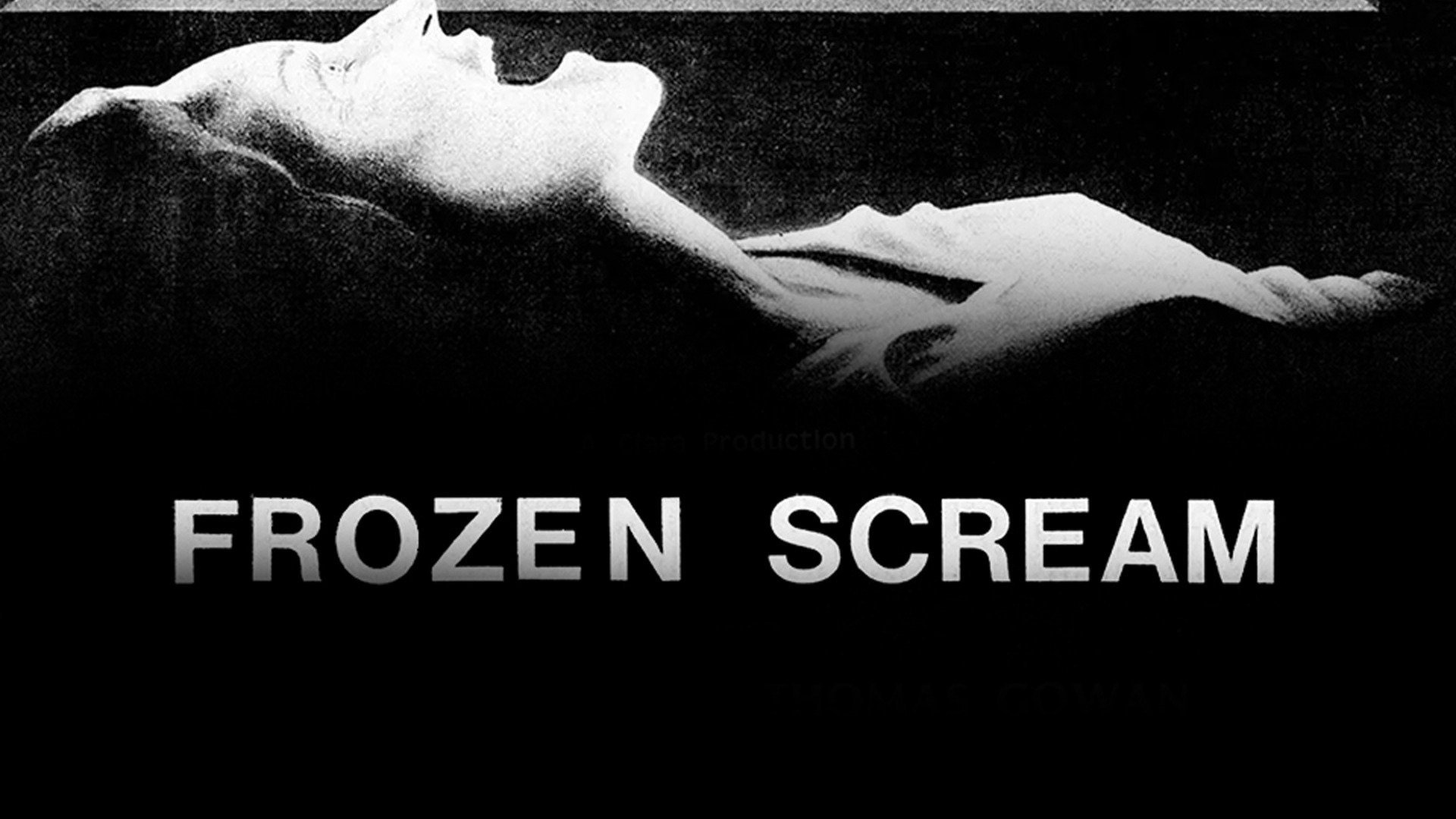
Frozen Scream (1975) is a small American zombie-horror production in which experiments intended to prolong human life create obedient bodies that survive only under refrigerated conditions. A university doctor, Lil Stanhope, and her collaborator Sven Johnsson conceal their work behind apparently legitimate academic activity. Their subjects return as killers controlled through implanted devices, and the disappearance of researcher Tom Girard draws his wife into the laboratory's secret. The film combines mad-scientist horror with a mystery involving robed attackers and the manipulation of living people through medical technology.
The familiar premise is presented through unusually fragmented editing, recorded narration and scenes that drift between scientific conspiracy and quasi-religious ritual. Producer and performer Renee Harmon later disputed the official direction credit given to Frank Roach, while recollections of the production disagree about when the film was actually completed. Its first documented British VHS circulation brought it into the video-nasty controversy. These circumstances give an otherwise obscure independent picture a revealing history of contested authorship, delayed distribution and home-video notoriety.
Production, Authorship & Conflicting Dates
The film is credited to Frank Roach as director, with a screenplay attributed to Doug Ferrin, Celeste Hammond and Michael Sonye and a story involving Renee Harmon. Harmon also produced the picture and plays Lil Stanhope, its principal antagonist. In an interview conducted by Stephen Thrower for Nightmare USA, she claimed that she had actually directed the production and assigned the formal credit to Roach for business reasons. Her statement is valuable testimony about the creative arrangement, but it does not erase the official credit or independently establish who directed each scene.
The date is similarly unsettled. Accounts place initial photography in Los Angeles in 1975, and some describe later shooting or post-production work around 1980 or 1981. Art director and actor Art Piatt, also interviewed by Thrower, recalled a production date closer to 1980 or 1981. These are retrospective memories that conflict with the commonly assigned 1975 year. Neither the date used in filmographies nor the later video publication should be presented as proof of a precisely documented theatrical premiere. The staggered history is part of the film's identity as an independent production seeking distribution.
Refrigerated Zombies & Medical Control
The scientists' ambition is to interrupt the body's ordinary decline. Their treatment leaves subjects capable of movement but dependent on low temperatures, turning a freezer into both a storage chamber and a source of continued existence. Implants allow the experimenters to direct those subjects as servants and attackers. The arrangement differs from the contagious dead of many zombie films: the menace is engineered by identifiable people and sustained through equipment. The scientists exploit access to students and medical facilities, converting spaces associated with research and care into places where individuals lose control of their own bodies.
Tom Girard's refusal to remain involved exposes that hidden purpose. Hooded figures invade his home, and his wife Ann subsequently struggles to establish what happened to him. Lil attempts to discredit Ann's account while police detective Kevin McGuire investigates linked disappearances. The plot repeatedly makes Ann dependent on people who may already be compromised by the experiments. In the later stages, refrigerated subjects and medical injections become immediate threats, culminating in a bleak proposal of permanent togetherness through artificial undeath. Love and immortality are phrases used by the conspirators to disguise coercion.
Ritual Imagery, Editing & Sound
The medical scheme coexists with black-robed participants, beachside ceremonies and communal declarations of devotion. This imagery suggests the culture of unconventional group therapy and spiritual movements around the period in which the project was conceived, although the film does not document any real organization. Robes and gatherings give the experimenters an atmosphere of secret affiliation outside their professional identities. The film rarely clarifies how that ritual behavior relates to the scientific mechanism. Its uncertainty sometimes generates unease, leaving the viewer unsure whether a scene concerns occult belief, a laboratory plan or a performance intended to control recruits.
The assembly adds a second layer of disorientation. Detective McGuire's commentary at times overlaps dialogue spoken by characters already visible, and passages of apparent memory or dream interrupt the investigation. Retrospective critics have noted conspicuous dubbing and irregular transitions. No production testimony establishes that the fragmented continuity was deliberately planned. A Halloween gathering with conspicuously energetic dancing interrupts the murders, while brief gore effects and injections carry much of the physical shock. The film's low-budget construction is especially evident when spoken explanation attempts to bridge images whose dramatic relationships remain uncertain.
Video-Nasty History & Preservation
Evidence for a regular American theatrical opening is uncertain. Retrospective research identifies a British VHS issued by Home Video Productions in 1983 and a later American cassette pairing the film with The Executioner Part II. Those releases should not be conflated with the year commonly assigned to production. British censorship histories place Frozen Scream on the Director of Public Prosecutions' changing video-nasty list in August 1984 and record its removal by October of the same year. The brief listing does not demonstrate a successful obscenity prosecution or an official BBFC rejection of a submitted version.
The controversy gave an obscure film a degree of recognition that its original distribution had not achieved. The scenes most often mentioned in accounts of its notoriety involve hypodermic violence, including an injection directed at an eye, yet the film spends substantial time on investigation, medical deception and dialogue. Its appearance beside far more graphic titles illustrates the unstable criteria of the early VHS campaign. A title's presence on the DPP list is a historical fact about enforcement decisions, not a reliable measurement of its violence or cinematic importance.
Later editions made the feature accessible in better condition. Vinegar Syndrome issued the two films together and advertised a restoration based on surviving film negatives; its documentation gives an approximately eighty-minute running time and lists the production as 1980. Mondo Digital identifies the Frozen Scream source element as 16mm and describes the clearer image compared with older tapes. These records provide evidence for preservation and presentation, but their different production years and running times cannot establish a single definitive date or all differences among releases.
References
Daily Grindhouse — My Exploitation Education: Frozen Scream (1975/1983/1985)
Film-specific historical and critical examination of the narrative, disrupted editing and delayed British and American video circulation.