Deep Red (1975)

IT
UK censorship history Section 3 · Supplementary list
6.2/10 6 votes
Runtime
127 min
Release
March 7, 1975
Revenue
$2,864,091
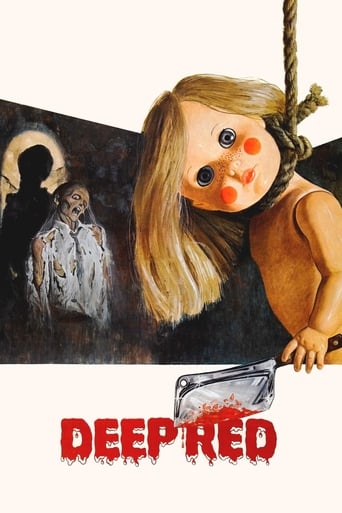
Deep Red (1975) poster
Director
Plot

A musician witnesses the murder of a famous psychic, and then teams up with a fiesty reporter to find the killer while evading attempts on their lives by the unseen killer bent on keeping a dark secret buried.

Alternative Titles
Qan Qırmızı (Azerbaijan) Кървавочервено (Bulgaria) — Bulgarian Prelúdio Para Matar (Brazil) Prelúdio para Matar [1975] (Brazil) — Prelúdio para Matar [1975] 夜深血红 (China) — Chinese 深夜止步 (China) 深红 (China) Tmavě červená (Czechia) — Czech
Show all 33 alternative titles Rosso - Die Farbe des Todes (Germany) — German Mordets melodi (Denmark) — Danish Roig fosc (Spain) — Catalan Rojo oscuro (Spain) — Spanish Verenpunainen kauhu (Finland) — Finnish Les Frissons De L'Angoisse (France) 深夜止步 (Hong Kong SAR China) — Chinese Mélyvörös (Hungary) — Hungarian עמוק בדם (Israel) — Hebrew Suspiria part 2 (Japan) サスペリアPART2 (Japan) — Japanese サスペリアPART2 赤い深淵 (Japan) — DVD title 딥 레드 (South Korea) — Korean 써스페리아 2 (South Korea) Sodriai raudona (Lithuania) — Lithuanian Tumši sarkans (Latvia) — Latvian Głęboka czerwień (Poland) — Polish O Mistério da Casa Assombrada (Portugal) — Portuguese Кроваво-красное (Russia) — Russian Skrivnost zapuščene hiše (Slovenia) — Slovenian Derin Kırmızı (Türkiye) — Turkish 深夜止步 (Taiwan) — Chinese Криваво-червоний (Ukraine) — Ukrainian Dario Argento's Deep Red (United States) — home video title The Hatchet Murders (United States) — alternative title

Trailers & Videos

3 videos

Film Guide

Dario Argento transforms the giallo into an elaborate nightmare of unreliable perception, childhood trauma, brutal murder and architecture that seems to conceal memories of its own.

Profondo Rosso (Deep Red, 1975) stands at a crucial point in Dario Argento's development and occupies a central position in the history of Italian giallo cinema. Returning to the investigative structure of his earlier thrillers, Argento introduces a more disturbing and irrational dimension through childhood trauma, psychic perception and unusually elaborate scenes of physical violence. The story follows Marcus Daly, a British jazz pianist living in Italy, whose attempt to investigate a murder depends upon recognizing the significance of something he has already seen but failed to understand. The mystery develops around the limitations of perception, the persistence of traumatic memories and the dangerous possibility that crucial evidence may remain visible without being recognized.

That problem of perception shapes the entire film. Paintings, reflections, architectural details, children's drawings and apparently insignificant objects contain information before either Marcus or the spectator understands its significance. Around this mystery, Argento constructs a world in which Rome and Turin merge into an unstable fictional geography, familiar interiors become threatening and murder is staged with a degree of visual and musical intensity that pushes the giallo toward outright horror. The practical effects associated with Carlo Rambaldi and Germano Natali, combined with the groundbreaking collaboration between Giorgio Gaslini and Goblin, establish an unusually close relationship between physical violence, photographic composition and sound.

Production & Development

Profondo Rosso marked Argento's return to the murder mystery after Le cinque giornate (1973), his historical drama about the Five Days of Milan. Working with screenwriter Bernardino Zapponi, Argento developed a narrative that placed greater emphasis on childhood memories, parapsychology and the instability of visual evidence than his earlier thrillers. The investigation follows recognizable conventions of detective fiction, yet its most important revelations emerge from images that have been misunderstood or partially concealed. Rather than progressing entirely through testimony and conventional clues, Marcus must repeatedly reconsider spaces, objects and experiences that initially appeared insignificant. The resulting structure connects the discovery of the murderer with the recovery of a violent event buried in the past.

The casting of David Hemmings gives this approach an additional cinematic resonance. In Michelangelo Antonioni's Blow-Up (1966), Hemmings had portrayed a photographer whose apparent discovery of a crime depended upon enlarging and interpreting images. Treccani identifies Antonioni's film as a significant reference point for Profondo Rosso, where Hemmings again plays a man who has seen something without understanding its implications. Argento transforms that uncertainty into a murder mystery in which the missing information is directly connected with a concealed history of violence. The relationship between the two films is particularly significant because their protagonists encounter the limits of visual knowledge through different means: photographic investigation in Blow-Up and the reconstruction of remembered images in Profondo Rosso.

Argento later described the development of the screenplay as a process involving extensive discussion with Zapponi, followed by the elaboration of specific visual arrangements. His recollections indicate that certain images were already central to his conception of the film before the practical organization of shooting. The director's interest in painting, architecture and deliberately artificial spaces consequently formed part of the narrative's development. The screenplay also incorporates contrasting approaches to investigation. Marcus relies upon memory and observation, while journalist Gianna Brezzi uses questioning, research and professional persistence. Their exchanges introduce humor and romantic tension into a story increasingly dominated by violence. The psychic demonstration involving Helga Ulmann establishes another form of perception, one that the film's rational investigators cannot initially accommodate.

Filming & Visual Design

Profondo Rosso combines locations in Rome and Turin into a geography that cannot be identified as one continuous real city. The recognizable architecture of Turin appears alongside Roman settings and interiors whose arrangement creates the impression of an unfamiliar urban environment. Treccani describes the film's world as a spectral Rome transformed by elements of Turin, historical villas and pictorial references. This geographical instability contributes to the narrative's treatment of perception. Marcus moves through recognizable streets and buildings, yet their spatial relationships often appear uncertain. The city becomes an extension of the mystery, with its architecture concealing evidence and directing attention toward details whose importance emerges only after repeated examination.

The square where Marcus meets Carlo provides a particularly revealing example of Argento's visual approach. The director has identified Edward Hopper's Nighthawks as an inspiration for the composition, especially the illuminated bar and the arrangement of figures within a carefully controlled urban space. The reference connects the scene with the loneliness, geometric organization and apparent stillness associated with Hopper's painting. Elsewhere, Treccani identifies affinities with Edvard Munch and contemporary forms of pictorial expression. These artistic references contribute to an environment in which realistic architectural details coexist with compositions that appear deliberately theatrical. The visual design creates unease before the violence begins, allowing empty spaces, illuminated windows and unusual perspectives to acquire threatening significance.

Architecture repeatedly becomes evidence. The Villa of the Screaming Child preserves traces of a crime through its hidden drawing, altered rooms and concealed architectural features. Marcus discovers that the building's surfaces contain information that has survived attempts to erase the past. Walls, corridors and abandoned interiors therefore perform a narrative function extending beyond atmosphere. Their physical arrangement becomes essential to understanding the murders. The same principle governs the film's treatment of reflections and decorative objects: a detail may occupy the frame without being recognized as evidence. Argento uses this relationship between visibility and interpretation to make spectators reconsider images they believed they had already understood. The film's photographic compositions turn the act of looking into an unreliable and potentially dangerous activity.

Carlo Rambaldi, Practical Effects & the Murder Set Pieces

The murders in Profondo Rosso depend upon the close integration of camera placement, editing, performance and physical effects designed specifically for individual sequences. Carlo Rambaldi, already an established Italian effects designer before his later international career, contributed the mechanical doll that suddenly enters Professor Giordani's apartment. Argento subsequently recalled that members of the production considered the figure absurd, but its disturbing artificiality was precisely what he wanted. The doll appears before the attack, abruptly interrupting the scene with an object whose exaggerated expression and unexpected movement seem detached from the surrounding reality. Its introduction produces a moment of uncertainty before the violence begins, demonstrating how an apparently childish object can become frightening through timing and presentation.

Other practical mechanisms were developed by effects technician Germano Natali, whose work contributed to some of the film's most memorable scenes of violence. The Museo Nazionale del Cinema preserves production material associated with Profondo Rosso, including the axe connected with Clara Calamai's character and the specially constructed table used during Giordani's murder. These objects were exhibited during the film's fortieth-anniversary celebrations in Turin. Their survival provides material evidence of the technical preparation underlying sequences that may appear spontaneous on screen. The violent encounters depended upon specially constructed props and carefully coordinated physical actions, with the camera transforming practical engineering into images of bodily injury.

Argento intensified the physical character of the murders through extreme photographic detail. He has described using specialized macro photography for inserts involving objects, toys and the killer's black-gloved hands, which he frequently performed himself. These images isolate individual elements from their surroundings, giving ordinary objects an exaggerated visual presence. The approach also changes the spectator's relationship with the killer, whose identity remains concealed while particular bodily details become intensely familiar. Combined with abrupt movements and carefully arranged practical effects, the enlarged imagery makes the murder sequences operate as elaborate visual constructions. Their emphasis upon bodily suffering and material violence anticipates the more openly horrific territory Argento would explore in Suspiria (1977), while remaining connected with the investigative traditions of the giallo.

Music & Sound

The soundtrack combines compositions by Giorgio Gaslini with music created by Goblin, establishing one of the most recognizable musical identities in Italian horror cinema. Gaslini had already developed material for the production when Argento began seeking a more forceful contemporary sound. Claudio Simonetti later recalled that the musicians, then associated with the name Oliver, were introduced through record producer Carlo Bixio. Their initial involvement concerned the performance and arrangement of existing music, but the collaboration expanded when Argento commissioned additional themes. The resulting soundtrack preserves the contributions of both Gaslini and Goblin, whose separate authorship is documented in the Cinevox catalogue. This production history is important because the finished film is sometimes discussed as though its entire score originated with the band.

The musical contrast is fundamental to the film's atmosphere. Childlike melodies associated with buried memory and approaching danger coexist with progressive-rock passages driven by keyboards, electric bass, guitar and percussion. Rather than functioning exclusively as discreet accompaniment, the music frequently assumes control of a sequence, establishing a rhythm that intensifies the anticipation of violence. The recurring musical themes also connect individual murders with the concealed childhood event at the center of the mystery. An archival Rai television appearance from November 1975 provides further evidence concerning the musicians' equipment and working methods, including their discussion of organ sounds and the processing of electric bass through a Leslie speaker. Such testimony offers a documented basis for understanding the soundtrack's distinctive combination of amplified rock instrumentation and electronic timbres.

Profondo Rosso became Goblin's breakthrough in film music and established the association with Argento that would continue through later productions. Treccani records that the soundtrack album became Italy's best-selling 33 rpm record during 1975, an exceptional commercial achievement for music composed for a horror thriller. Its success demonstrated that the score had developed an identity independent of the images it accompanied. The film also established a recognizable relationship between progressive rock and Italian horror, subsequently explored through additional collaborations involving Argento and the group. Within Profondo Rosso, the music remains inseparable from the treatment of suspense, physical violence and childhood trauma, contributing to a sensory experience whose intensity exceeds the requirements of conventional mystery storytelling.

Release & Restoration

Profondo Rosso entered Italian theatrical distribution in March 1975. The Museo Nazionale del Cinema identifies 7 March as the anniversary of its original release, a date commemorated through a major retrospective event in Turin in 2015. The film's original presentation ran approximately 126 minutes, allowing substantial space for the relationship between Marcus and Gianna, the gradual investigation of the murders and the exploration of locations associated with the concealed childhood crime. Its length contributes to a narrative rhythm in which extended passages of observation and investigation alternate with episodes of extreme violence. These quieter scenes are essential to the progressive reconstruction of the mystery, giving the film a structure different from versions subsequently shortened for international markets.

The preservation of the complete film became an important concern as different editions circulated internationally. In 2014, the Centro Sperimentale di Cinematografia – Cineteca Nazionale, working in collaboration with RTI, presented a digital restoration at the Torino Film Festival. The work was undertaken at L'Immagine Ritrovata in Bologna with the collaboration of cinematographer Luciano Tovoli. The project contributed to the recovery of the film's photographic identity and made the complete version available for renewed theatrical presentation. The preservation of its widescreen compositions was particularly important because the positioning of objects and architectural details frequently contributes directly to the mystery.

The following year's fortieth-anniversary celebrations demonstrated the significance that Profondo Rosso had acquired within Turin's cinematic heritage. The Museo Nazionale del Cinema organized Profondo Rosso Day, presented the restored film at Cinema Massimo and exhibited original and reconstructed objects connected with the production. The programme included surviving practical-effects material associated with several murder sequences, linking archival preservation with the technical history of Italian horror. These events provided a public opportunity to examine the film's original visual construction and its surviving production artifacts. The institutional attention also confirmed the importance of distinguishing the restored long version from the altered editions through which many international audiences had previously encountered the film.

Alternate Versions

The international distribution history of Profondo Rosso is complicated by the circulation of shortened editions. Sight and Sound identifies the integral Italian version at approximately 126 minutes and reports that the original American theatrical release removed around twenty-two minutes. The alterations affected much more than the level of graphic violence. Material involving Marcus and Gianna's developing relationship was reduced, together with significant passages connected to the House of the Screaming Child. These changes compressed the investigative structure and removed portions of the emotional and historical background surrounding the murders. The resulting edition preserved the central mystery but altered the balance between character development, atmosphere and violent spectacle.

The film underwent additional changes during television and early home-video circulation. Pan-and-scan transfers cropped its original widescreen compositions, sometimes excluding visual information positioned near the edges of the frame. Such modifications were particularly damaging to a work whose narrative repeatedly depends upon details concealed within carefully organized images. One American incarnation was also marketed under the title The Hatchet Murders, adding another commercial identity to its international history. That title does not independently identify a single definitive edit, since language, running time and image presentation must be considered when comparing surviving editions. Modern restorations have made the longer Italian version more widely available, restoring the relationship between its investigative passages, architectural imagery and murder sequences.

Reception & Legacy

Profondo Rosso has become one of the central reference points for the history of the Italian giallo. Treccani emphasizes its baroque visual construction, its combination of grand-guignol violence with directorial virtuosity and its movement toward the more openly horrific territory that would characterize Argento's subsequent work. The British Film Institute has likewise identified Deep Red as a defining example of the form. Its importance rests partly upon the transformation of established giallo mechanisms. The mystery still involves witnesses, an unidentified killer and clues whose meaning must be discovered, but these elements coexist with psychic disturbance, childhood trauma, elaborate bodily violence and locations that preserve traces of concealed events. The resulting structure establishes a relationship between criminal investigation and supernatural unease without abandoning the rational explanation ultimately required by the murder mystery.

The film also occupies a distinctive position within Argento's artistic development. Its emphasis upon the instability of perception extends concerns already explored in his earlier thrillers, while the elaborate practical effects, expressive music and increasingly irrational visual environments anticipate Suspiria. The relationship with Antonioni's Blow-Up provides another important historical perspective, particularly through the casting of David Hemmings and the shared concern with visual information that has been seen but not properly interpreted. Argento's use of pictorial references and constructed urban environments gives that problem a specifically horrific dimension. Familiar architecture can become threatening because its surfaces contain evidence, while apparently ordinary objects may acquire disturbing significance through photography, music and repeated observation.

The film's musical legacy remains particularly substantial. The success of Goblin's soundtrack established a commercially significant relationship between progressive rock and Italian horror, while its themes continued to circulate independently through recordings and performances. The preservation of practical-effects props and the restoration of the complete film have provided additional material for understanding its technical construction. Profondo Rosso remains a major work of Italian genre cinema because its different creative elements operate together: the mystery requires close attention to images, the violence transforms ordinary objects into instruments of terror, and the soundtrack intensifies experiences of fear and uncertainty. Its lasting historical importance is supported by these identifiable achievements and by its central position in the development of the giallo.

References

  1. TreccaniProfondo rosso, by Giacomo Manzoli

    Encyclopedic analysis of Argento's narrative structure, pictorial references, cinematography, childhood trauma and the film's relationship with Italian giallo and supernatural horror.

  2. Rai TecheI Goblin e le colonne sonore dei film di Dario Argento

    Archival television interviews and performances documenting Goblin's early soundtrack work, instruments and musical techniques.

  3. Museo Nazionale del Cinema#ProfondoRossoDay

    Institutional documentation of surviving practical-effects props, Germano Natali's constructions and the fortieth-anniversary screening of the restored 126-minute film.

  4. Centro Sperimentale di CinematografiaProfondo rosso nella versione restaurata dalla Cineteca Nazionale

    Primary documentation of the digital restoration undertaken at L'Immagine Ritrovata with the collaboration of cinematographer Luciano Tovoli.

  5. BFI / Sight and SoundRemake/Remodel: 45 Alternative Film Cuts

    Historical comparison of the complete Italian version, the shortened American theatrical release, removed narrative sequences and altered home-video presentations.

Cast

View Full Cast & Crew →

Release & Distribution

Distributors (1)

  • Cineriz IT

Release History (12)

Release DateTerritoryRelease TypeFormatDistributorCertificationNotes
1975-03-07 Italy Theatrical — — —
1975-10-31 Spain Theatrical — — —
1976-04-01 Netherlands Theatrical — — —
1976-06-09 United States Limited Theatrical — — R
1976-06-11 United States Theatrical — — R
1977-08-17 France Theatrical — — 12 Visa CNC 47354
1978-09-23 Japan Theatrical — — R18+
1978-12-24 South Korea Theatrical — — 18
1991-04-24 Germany Physical — — — Video Premiere
1993-02-25 United Kingdom Physical — — 18
2008-11-05 Sweden Physical DVD — 15 DVD Premiere
2018-02-12 Sweden Theatrical — — 15 Restored Version
When the Screaming starts and the Blood begins to flow... Pinch yourself and keep repeating I'M AT THE MOVIES! I'M AT THE MOVIES! I'M AT THE MOVIES! I'M AT THE MOVIES!