

Origins and Independent Production
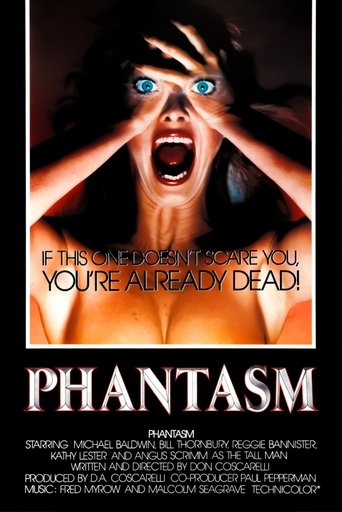
Phantasm was Coscarelli’s third feature, following Jim the World’s Greatest and Kenny & Co. Both earlier productions had involved performers who would subsequently become central to the new film. Coscarelli developed the project after observing the effectiveness of frightening moments in Kenny & Co., although his interest in horror and fantasy predated his filmmaking career. In an interview with DVD Talk, he explained that the American funeral industry provided an important source of inspiration. The transformation of a dead body into a prepared object, carried through concealed rooms by formally dressed attendants, suggested a world of unfamiliar procedures that could be developed into supernatural horror.
Coscarelli’s father, investment consultant D. A. Coscarelli, helped raise the financing and received the producer credit. Paul Pepperman also worked closely with the director throughout production. The estimated budget was approximately $300,000, assembled from private investors and family assistance. In a 2016 interview with Filmmaker Magazine, Coscarelli recalled that equipment rental, film stock, laboratory processing and special effects absorbed much of the available money. Many crew members worked with deferred payment arrangements, while the production attempted to provide reliable meals and maintain access to professional equipment. Following the film’s commercial success, the collaborators whose compensation had been postponed were paid.
The production developed during 1977 and continued through an unusually extended shooting period. Rather than operating according to a continuous major-studio schedule, the filmmakers repeatedly assembled performers and equipment around available locations and resources. This approach helped Coscarelli maintain control over the screenplay, photography and editing. He used a Panaflex camera package obtained through a favourable arrangement with Panavision, recording images on 35 mm film despite the severe financial limitations. The director’s control of several technical departments allowed decisions to be revised as scenes were assembled. It also contributed to the film’s unusual structure, in which individual supernatural encounters sometimes take precedence over conventional narrative explanation.