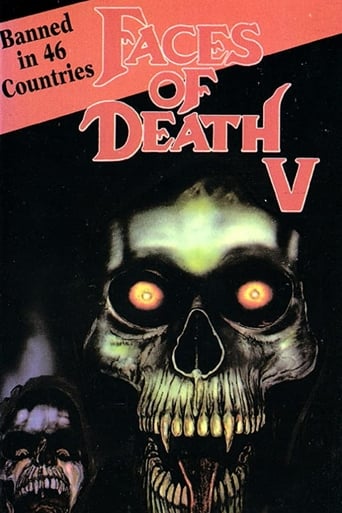
A later video compilation assembles sequences already seen in earlier Faces of Death installments. The release revisits the series' familiar combination of documentary images and performed incidents without presenting a comparably extensive new production. Reused extracts appear under another numbered title, and their earlier introductions and contexts are not always preserved. The result reflects the franchise's shift from creating new collections toward rearranging its existing library of disturbing footage.
Alternative Titles
Faces da Morte 5 (Brazil) — PortugueseFaces da Morte V (Brazil) 死亡真面目5 (China) — ChineseGesichter des Todes - Teil 5 (Germany) Gesichter des Todes 5 (Germany) Gesichter des Todes V (Germany) — GermanFace à la mort V (France) — FrenchA halál 1000 arca 5. (Hungary) — HungarianShow all 9 alternative titlesЛики смерти 5 (Russia) — Russian
▤
Film Guide & Analysis
A 1995 direct-to-video compilation that reuses earlier shockumentary footage and the franchise's unresolved claims of authenticity.
Faces of Death V (1995) belongs to the later, compilation-driven phase of the American shockumentary series that began in 1978. Instead of developing a new documentary investigation or staging another sustained collection of incidents, this video release draws upon material circulated in earlier installments. Its place in horror history therefore depends on the reuse of footage and the continuing market for images advertised as encounters with actual death. The fifth title carried a recognizable identity into the home-video era even as the series had exhausted much of its original format.
The distinction between a new film and a recut collection matters especially in this franchise. The earlier productions mixed authentic archival recordings with scenes manufactured using actors and practical effects, often without identifying the difference within their narration. This later volume inherits that uncertainty whenever it presents established material to another audience. Surviving sources describe the release as a roughly ninety-minute compilation, but provide little independent documentation about the editing process, the precise origin of every extract or a newly organized production crew.
A Compilation in the Series
The original Faces of Death established a recognizable presentation: an ostensibly authoritative guide to mortality assembled from unrelated visual records and reconstructed incidents. The host, Dr. Francis B. Gross, was played by Michael Carr, whose appearances in later releases maintained the suggestion of an ongoing documentary enterprise. Carr is associated with the fifth entry through archival footage. That credit should not be read as evidence of a newly filmed performance for this edition. The most securely documented production history still belongs to the earlier works whose images furnished the compilation.
Film scholar Giuseppe Previtali includes the fifth entry in his historical account of the series and situates shockumentaries within a wider culture of watching death on screen. That connection explains the commercial logic of another numbered volume, even without a substantially new body of material. The title promises continuity to viewers familiar with earlier tapes. What the release actually offers is another arrangement of images whose notoriety was already established. No reliable production record located for this installment establishes a distinct original shoot, extensive new special effects or an independently documented theatrical release.
The Problem of Authenticity
Recycled sequences carry the ambiguities of their first presentation. In a 2012 interview with WNYC's On the Media, creator John Alan Schwartz confirmed that the original film's notorious monkey-brain meal and electric-chair execution had been staged. He explained the use of a trained animal, a manufactured head and other simple effects to make the banquet appear genuine. His recollections concern the 1978 production. They provide evidence about how the series constructed its documentary illusion, without identifying every segment reused in the fifth video or proving the authenticity of any other image.
The contrast between an actual record and a performed death is central to the horror effect. A genuine image may preserve traces of a specific accident or historical event, while a fabricated incident can be photographed to resemble news footage. Once placed together in a compilation, those different origins become harder to recognize. Previtali's research on filmed death treats shockumentaries as an extension of mondo cinema's unstable relationship with documentary truth. For this installment, that framework is more useful than repeating unsourced claims that the assembled footage is uniformly real or uniformly simulated.
Home Video, Numbering and Historical Limits
The fifth release is generally dated to 1995 and identified with the direct-to-video market. Its circulation followed a period in which the franchise had become notorious through video rentals, word of mouth and disputed accounts of what viewers were seeing. Reporting by The Independent, drawing on interviews with film scholar Mark Goodall and documentary producer Michael Felsher, documents the importance of that domestic viewing culture to the reputation of the original. The later compilation relied on the same established interest in forbidden-looking material, although those interviews do not supply a release history for this specific volume.
Different editions bearing similar German and English titles have also complicated attempts to reconstruct the series from catalogue entries alone. An alternate-language title does not by itself establish that two videocassettes contain identical edits. The accessible documentation is insufficient to specify every territory, certify an exact sequence list or transfer censorship decisions from one edition to another. The release documents the continued packaging of previously circulated shock footage under an established horror label. Its detailed editing history remains unresolved in the available evidence.
Giuseppe Previtali's doctoral research places the numbered Faces of Death series, including its 1995 fifth entry, within the history of shockumentaries and the representation of recorded death.
Original 2012 interview with John Alan Schwartz explaining the staged sequences and the tension between documentary claims and fabricated material in the original film.
The Independent — Faces of Death: How the gore porn sensation became the original viral video and gripped the world
Chris Stokel-Walker's 2018 historical report draws on interviews with Mark Goodall and Michael Felsher about video distribution and the franchise's reputation; it supplies series context rather than a production dossier for the fifth entry.