From an Anthology Story to a Feature Film
Lamberto Bava has traced the project to a short story conceived by Dardano Sacchetti for an unrealized three-part horror anthology. In a 2021 interview with MadMass, he recalled that Argento approached him with an offer to produce a feature and asked whether he had a suitable idea. Bava presented the anthology material, and Argento favored the central episode about an audience threatened during a film screening. The idea was expanded into a feature screenplay credited to Bava, Argento, Sacchetti and Franco Ferrini. This account establishes the basic progression of the project without reducing its development to a single author’s contribution.
The partnership developed from Bava’s earlier work alongside Argento. Bava recalled meeting him through Daria Nicolodi and subsequently serving as assistant director on Inferno and Tenebrae. Their arrangement on Dèmoni placed Argento in the producer’s role while Bava directed. The film was designed around a succession of effects-driven incidents, with the screenplay organizing different groups of spectators inside the same threatened building. The premise offered a practical advantage: once the audience had entered the cinema, additional characters and dangers could be introduced without requiring a new location for every sequence.
The casting brought together young performers with recognizable Italian horror associations. Natasha Hovey plays Cheryl, one of the women who accepts an invitation to the screening; Urbano Barberini portrays George, who becomes central to the escape attempts. Michele Soavi, Bava’s assistant director, appears both as the masked figure distributing tickets and as a character in the film shown on screen. Those double appearances add to the uncertainty surrounding the cinema’s purpose. The production’s central decision, however, remained the use of a public entertainment space as the place where an anonymous, contagious threat would become impossible to ignore.
The Metropol and the Horror Film Within the Film
The Metropol is introduced as an unusually mysterious cinema. A masked man offers free tickets without explaining the screening, and the building’s audience assembles from people with little in common. Inside the auditorium, the projected film follows young people exploring a crypt and finding a sinister mask. Its imagery appears to have escaped into the theatre lobby, where a replica is exhibited as a promotional object. When Rosemary tries the mask on, it cuts her skin. The apparently minor injury becomes the first material connection between the images on the screen and the spectators watching them.
The film’s most unsettling idea emerges from this duplication. What initially seems to be a harmless prop has the power attributed to its fictional counterpart, so the ordinary difference between a represented monster and a physical object no longer holds. Bava develops that situation through the audience’s changing reactions. The first disturbances might still be mistaken for part of the attraction, but the rapidly worsening injuries force people to recognize that the violence is occurring around them. The projection continues while the building’s exits become inaccessible. The spectators can no longer leave the story they paid, or were invited, to witness.
The premise encourages a reading of Dèmoni as horror about cinema itself, but the film does not remain confined to an intellectual puzzle. Once the first transformations occur, survival and the movement of infected bodies take priority. The fiction within the fiction establishes a means of introducing the curse, then yields to the physical consequences in the auditorium. In this respect, the Metropol is more than an eccentric backdrop. Its rows of seats, projection booth, aisles and sealed doors determine which people can move, hide or cooperate as the audience loses control of the space.
West Berlin, the Metropol Building and Visual Design
The exterior setting was photographed in West Berlin, giving the film an urban identity distinct from the rural and historical landscapes associated with earlier Italian supernatural cinema. The film-location archive Shot in Berlin identifies the Metropol building, the Heidelberger Platz and Wittenbergplatz underground stations, and several streets around the Kurfürstendamm among the locations used. These records substantiate the real Berlin geography without implying that every interior was filmed inside the historic theatre. The cinema’s fictional function depends on its imposing public entrance and on the almost complete separation of its interior from the outside world.
Cinematographer Gianlorenzo Battaglia uses the auditorium’s large dark spaces and illuminated passages to make the figures difficult to locate once panic spreads. The film begins in a recognizable city of trains, traffic and shops, then moves into a highly controlled environment in which doors no longer perform their normal function. The audience members can see the entrances and stairways that ought to lead to safety, yet those familiar routes become useless. As the creatures multiply, the arrangement of seats becomes an obstacle course rather than a place from which people observe the action.
The visual contrasts are conspicuous. Bright blue and red light, smoke and blood effects give the transformed bodies an appearance that changes from shot to shot as they move between the lobby, screen and auditorium. The montage also alternates the sealed cinema with a group of young people driving through the city, establishing a danger that is not confined to the people who accepted tickets. Their arrival breaks the apparent completeness of the theatre trap while increasing its chaos. The final movement beyond the building then widens the scale of the supernatural disaster beyond its original enclosed setting.
Contagion, Demonic Possession and Physical Violence
Dèmoni uses the multiplication of infected bodies as its main narrative engine. Rosemary’s transformation begins after the mask scratches her, and the illness spreads through attacks that leave other characters similarly afflicted. The symptoms are violent and unmistakably physical: skin changes, teeth deform, nails lengthen and the body produces an unnaturally colored fluid. The process moves much faster than the gradual decline associated with many traditional possession narratives. Each new demon creates immediate danger, so the survivors’ numerical disadvantage becomes worse whenever they fail to escape an encounter.
Bava has emphasized that the filmmakers wanted the monsters to differ from the shambling undead familiar from George A. Romero’s Dawn of the Dead, which Argento had helped produce. He described the demons as fast, powerful and vicious. That distinction is evident in their attacks and in the way the performers move through the cinema. Although the spread of their condition resembles an infection, the initiating object and the film within the film place it in a supernatural framework. There is no documented medical explanation that would turn the creatures into realistic victims of a disease.
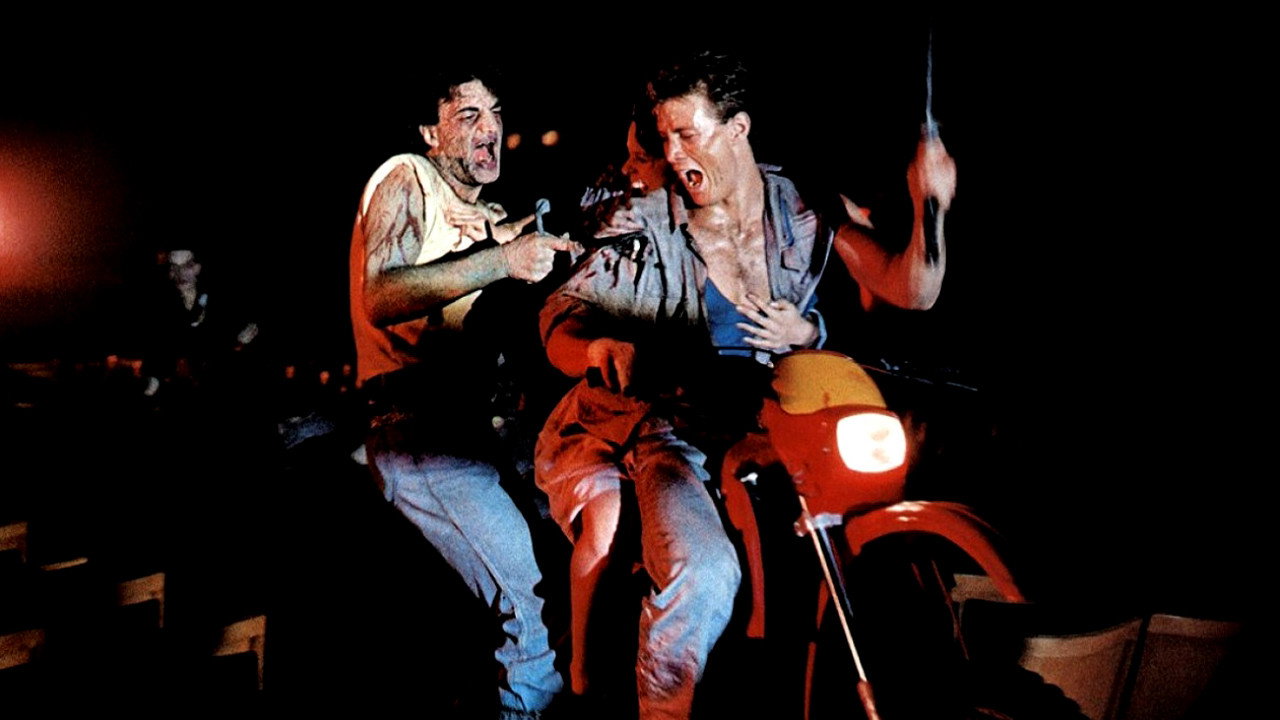
The action increasingly favors improvisation under pressure. Audience members attempt to barricade themselves, fight attackers or exploit whatever equipment remains accessible. The film’s most conspicuous reversal comes when George rides a motorcycle through the auditorium and wields a sword against the demons. Its excess suits a story in which the orderly behavior expected inside a cinema has entirely collapsed. The sequence gives the survivors a temporary means of resistance, but the broader disaster remains uncontrolled. The horror’s rhythm comes from repeated transformations and desperate physical action rather than a detective’s gradual recovery of hidden information.
Sergio Stivaletti and the Transformation Effects
Sergio Stivaletti’s contribution was an important stage in the development of his effects work. In a 2015 interview with Cinefilos, he recalled Dèmoni as his first substantial official film assignment after earlier work connected with Argento’s Phenomena. He described the challenge as creating transformations through a combination of makeup, sculpture, prosthetics and mechanical effects. Bava and Argento, he said, hoped to attempt the kind of step-by-step bodily metamorphosis made prominent by John Landis’s An American Werewolf in London. This is Stivaletti’s recollection of the team’s objective, rather than a claim that they invented those techniques.
The effects give the supernatural threat a series of visible stages. A human face can begin to change before a character is fully recognizable as a creature, allowing other spectators to witness the transformation rather than merely encounter its result. Teeth, claws and distorted facial surfaces carry much of the impact at close range. The film also includes more elaborate bodily ruptures, including the emergence of a demon from a victim’s back. Different kinds of physical illusion were therefore needed: detailed makeup for a performer who still had to move and larger constructions for incidents in which a body is violently reshaped.
The grotesque green fluid associated with the demons becomes an identifying visual element alongside their illuminated eyes and aggressive movement. These effects function as evidence for characters within the story, making denial increasingly difficult once a transformation is witnessed. Bava later explained that he entrusted Stivaletti with part of the effects work because of the young artist’s previous experimentations, and that the collaborators discussed how the monsters should look and behave. The resulting sequences depend on visible practical surfaces and performer interaction. Their exaggerated texture places the film within the Italian splatter tradition while giving the transformations a distinct mechanical emphasis.
Claudio Simonetti, Synthesizers and the Rock Soundtrack
Claudio Simonetti composed the original score after being approached through Argento. Speaking to la Repubblica in 2025, he recalled working with electronic instruments drawn from his contemporary dance-music practice. He described two complementary scoring methods: composing while watching filmed scenes, and supplying music that the director and editor could later fit to the images. Synchronization relied on techniques such as a metronome rather than the digital tools available in later production. These recollections explain the score’s deliberately electronic character without requiring undocumented claims about particular synthesizer models or recording sessions.
The score’s driving pulses and abrupt accents accompany a soundtrack built partly from licensed rock recordings. Bava recalled discussions with RCA that made contemporary tracks available at prices the production considered manageable. The credited song selections include performers associated with hard rock and heavy metal, contributing to the film’s deliberately modern sonic identity. Their placement during action gives the violent scenes a momentum different from suspense built almost entirely around silence. Simonetti’s own composition remains separate from those previously released songs: the two forms of music perform related but different functions throughout the film.
Bava has also described the original sound presentation as an important technical ambition, claiming in an interview that the film was an Italian pioneer of Dolby Stereo. That statement is best identified as his recollection rather than repeated as a verified national first. The music’s continuing life is easier to document. Simonetti has performed material from Dèmoni in concert and discussed later soundtrack editions and reworkings. Such performances help explain why the score remains closely associated with the film decades after release, while the use of rock songs situates the original soundtrack unmistakably in the mid-1980s.
Release, Versions and British Classification
Dèmoni was released in Italy on October 4, 1985, and reached other territories during the following year. The film later circulated under the English title Demons, with release materials varying by market and by exhibition format. Its official theatrical and home-video records require particular care because a different running time is not automatically evidence of censorship. Film and video playback speeds can differ, and particular editions may also have been prepared for distinct distributors. An assessment of cuts therefore needs a record tied to a specific submitted version rather than a comparison of printed durations alone.
The British Board of Film Classification provides such evidence. Its database records cuts to an 86-minute cinema submission examined in January 1987 and to a home-video submission examined in December 1986. It also lists a later 2000 video version requiring the removal of an image involving a razor blade on a woman’s breast. By contrast, the BBFC’s 2021 cinema classification records an 88-minute version submitted by Arrow Film Distributors without a cuts notation. Those records establish differences in British certification history, while leaving open the question of precisely which visual changes account for every second of duration variation.
The classification descriptions emphasize extensive bodily violence, demonic attacks and drug use. They help distinguish the film’s original content from alterations made during distribution, particularly because the razor-blade scene was identified as a classification issue rather than an accidental omission. Subsequent reissues have also presented the film in restored formats. The value of such documentation is chronological: the 1980s British cuts, the specific 2000 video alteration and the later theatrical classification belong to different decisions and should not be collapsed into a single international version history.
Reception, the Sequel and Its Place in Italian Horror
The film’s contemporary critical response was not uniformly favorable. Reviewing Dèmoni for the Monthly Film Bulletin in April 1987, Kim Newman objected to what he considered an uncertain tone and an excess of heavy-metal music, although he acknowledged its memorable violent transformations and the potential of its central setting. This judgment differs from later retrospective interest in the film’s ferocious practical effects and its self-referential premise. The contrast is important: a film’s present reputation as a cult favorite does not mean that all contemporary critics approved of its approach or regarded its narrative construction as accomplished.
The premise proved commercially and creatively durable enough to support a direct sequel. Dèmoni 2 (1986), again directed by Bava and produced by Argento, moves the outbreak into a residential tower and develops the screen-related motif through a television broadcast. The second film preserves the principle of sudden supernatural contagion while using an apartment complex instead of a cinema as its enclosure. Subsequent productions have sometimes been marketed with Demons-related titles without belonging to the same direct narrative continuity. For historical clarity, the Bava-Argento films of 1985 and 1986 form the central pair.
Dèmoni occupies a particular position in the evolution of Italian horror during the 1980s. Its debt to infection cinema and the contemporary popularity of elaborate makeup effects is visible, but the film’s defining premise turns an audience into participants in the images they were supposed to watch safely. The practical effects, aggressively physical monsters and musical energy mark a departure from the more restrained mystery structures Bava had previously explored. Retrospective screenings, restored editions and performances of Simonetti’s music document its continued circulation. Those developments support its cult status without requiring an exaggerated claim that it single-handedly transformed the genre.