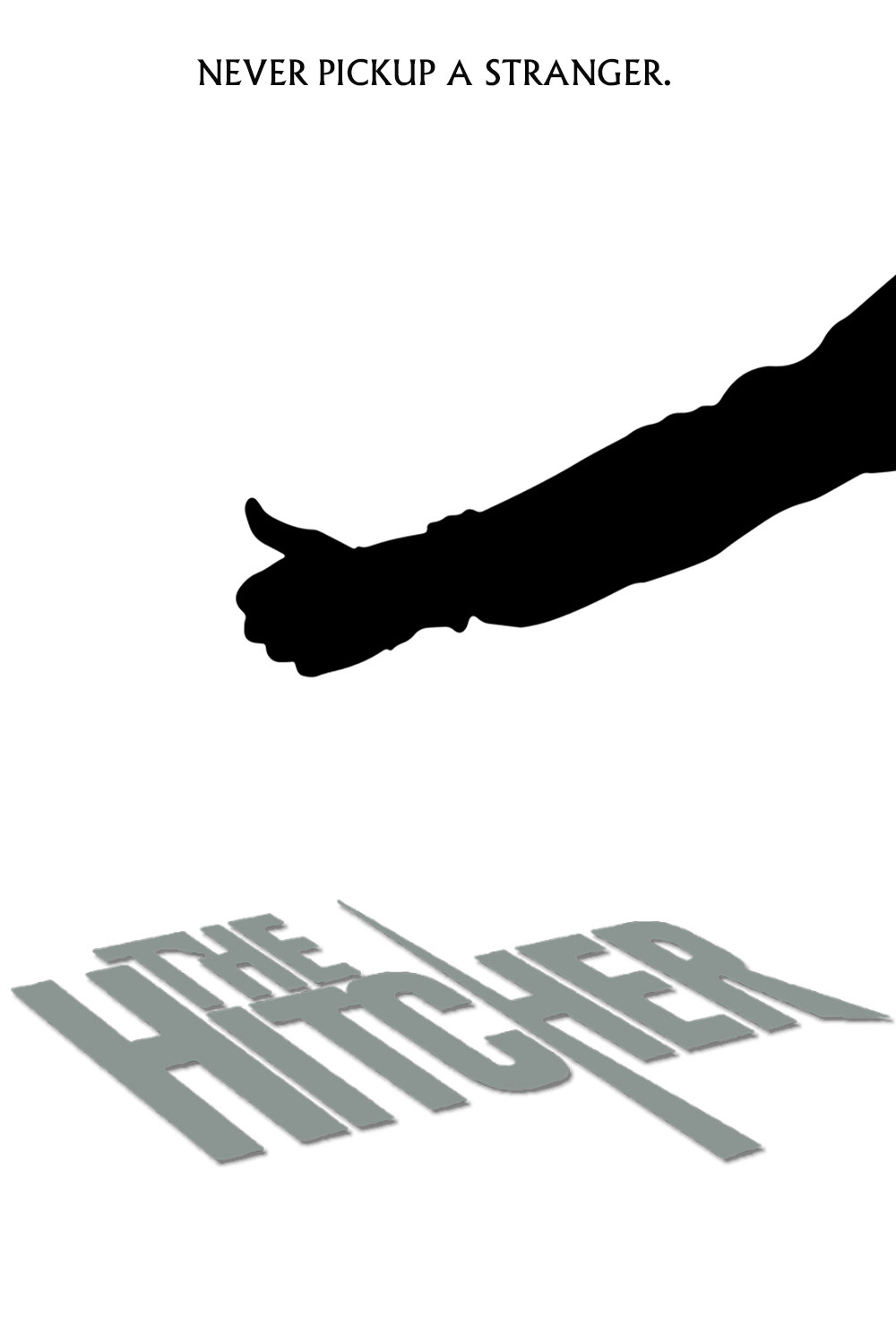
The Hitcher (1986)

US
HORROR FILM Thriller Action
7.0/10 1 votes
Runtime
98 min
Release
January 17, 1986
Budget
$6,000,000
Revenue
$5,844,868
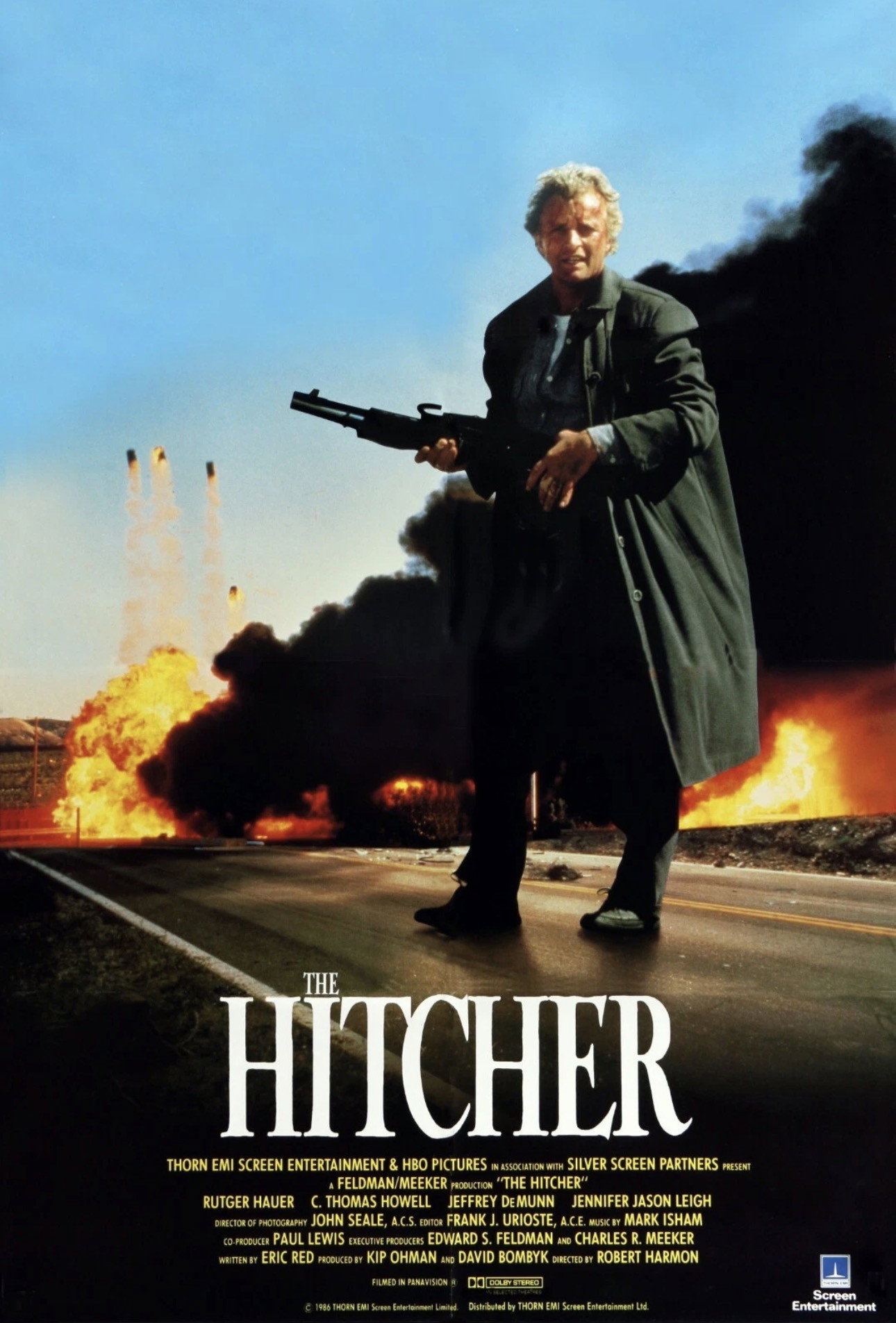
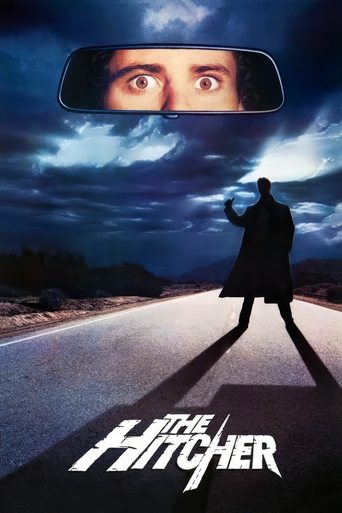
The Hitcher (1986) poster
Director
Writer
Production Company
Feldman/Meeker Productions
Plot

On a stormy night, young Jim, who transports a luxury car from Chicago to California to deliver it to its owner, feeling tired and sleepy, picks up a mysterious hitchhiker, who has appeared out of nowhere, thinking that a good conversation will help him not to fall asleep. He will have enough time to deeply regret such an unmeditated decision.

Alternative Titles
Yol Yoldaşı (Azerbaijan) Стопаджията (Bulgaria) — Bulgarian A Morte Pede Carona (Brazil) L'auto-stoppeur (Canada) — French title 搭车人 (China) — Chinese Stopař (Czechia) — Czech Hitcher, der Highway Killer (Germany) — German På stop med en dræber (Denmark) — Danish
Show all 39 alternative titles Carretera a l’infern (Spain) — Catalan Carretera al Infierno (Spain) — Spanish Liftari (Finland) — Finnish Hitcher (France) — French Το ωτοστόπ του τρόμου (Greece) 魔鬼司令 (Hong Kong SAR China) — Chinese Autostoper (Croatia) — Croatian Az országút fantomja (Hungary) — Hungarian הטרמפיסט (Israel) — Hebrew The Hitcher - La lunga strada della paura (Italy) — Italian ヒッチャー (Japan) — Japanese ヒッチャー:1986 (Japan) 힛쳐 (South Korea) — Korean Pakeleivis (Lithuania) — Lithuanian El asesino de la carretera (Mexico) El caminante (Mexico) — Home Video Title The Hitcher: Asesino de la Carretera (Mexico) — Spanish Haikeren (Norway) El pasajero de la muerte (Peru) Autostopowicz (Poland) — Polish Terror na Auto-Estrada (Portugal) — Portuguese Stoper (Serbia) Ауто-стопер (Serbia) — Serbian Попутчик (Russia) — Russian الراكب الغريب (Saudi Arabia) — Arabic Liftaren (Sweden) — Swedish Stopár (Slovakia) — Slovak ไม่ต้องฆ่าก็บ้าแล้ว (Thailand) — Thai Otostopçu (Türkiye) — Turkish Попутник (Ukraine) — Ukrainian Kẻ Đón Đường (Vietnam) — Vietnamese

Trailers & Videos

10 videos

Film Guide & Analysis

Robert Harmon and Eric Red’s highway horror: development, Rutger Hauer’s John Ryder, John Seale’s desert cinematography, the two-truck sequence, Mark Isham, reception and restoration.

Robert Harmon's The Hitcher (1986) transforms an encounter on a deserted highway into a sustained ordeal of pursuit, mistaken identity and apparently motiveless violence. Jim Halsey, a young driver transporting a car across the American Southwest, picks up a stranger during a rainstorm and discovers that the passenger, John Ryder, is a killer. Escaping the vehicle does not end the encounter. Ryder repeatedly reappears, murders people along Jim's route and arranges circumstances that turn the surviving driver into the police's principal suspect. The threat depends on an ordinary social exchange becoming impossible to undo, with the open road offering little protection from a man who appears wherever Jim attempts to flee.

Written by Eric Red and directed by Harmon in his feature debut, the film combines the highway thriller with the relentless pursuit associated with modern horror. Rutger Hauer's performance gives Ryder an unsettling mixture of physical presence, restraint and apparent sympathy; C. Thomas Howell's Jim is forced toward a violent confrontation he never sought. John Seale's desert photography, Mark Isham's score and the decision to leave the most notorious killing largely unseen make the violence felt beyond what the camera shows. The film attracted strongly divided contemporary criticism and later developed a substantial cult following, while its 2024 restoration renewed attention to the visual design of the original release.

Eric Red and the Development of the Screenplay

Eric Red developed the story while attempting to establish himself as a screenwriter in the early 1980s. According to production records assembled by the American Film Institute, he had been travelling from New York toward Los Angeles when he stopped in Austin, Texas, and briefly accepted a hitchhiker before deciding to put the stranger out of his car. Financial difficulties prolonged his stay, during which he wrote the screenplay over several months. Harmon later recalled that Red also connected the premise with the threatening traveller in the Doors song Riders on the Storm. The road encounter and musical recollection are complementary accounts of the project's development rather than proof of a single moment of inspiration.

Red approached producers by correspondence, sending proposals to hundreds of contacts drawn from an industry directory. His letter reached development executive David Bombyk, who requested the script and recognized the possibilities of its extreme central premise. The early draft ran approximately 190 pages and contained more graphic violence than the finished picture. Bombyk and producer Kip Ohman worked with Red on revisions, while Edward S. Feldman and Charles R. Meeker supported the project. Red retained sole on-screen writing credit. Contemporary reporting shows that the material encountered repeated resistance from studios concerned about its brutality and its uncertain commercial classification.

Robert Harmon entered the project after making the short film China Lake, which demonstrated his ability to build suspense around a dangerous man and an isolated landscape. He considered Red's script striking but wanted to reduce its dependence on explicit gore, placing more emphasis on the psychological contest between Jim and Ryder. Several prospective financiers hesitated, and the project eventually obtained backing through HBO Pictures and Silver Screen Partners. The final film emerged from a compromise in which its most troubling narrative events remained, but the staging of many of them depended on anticipation and aftermath rather than prolonged images of bodily destruction.
Rutger Hauer and the Enigma of John Ryder

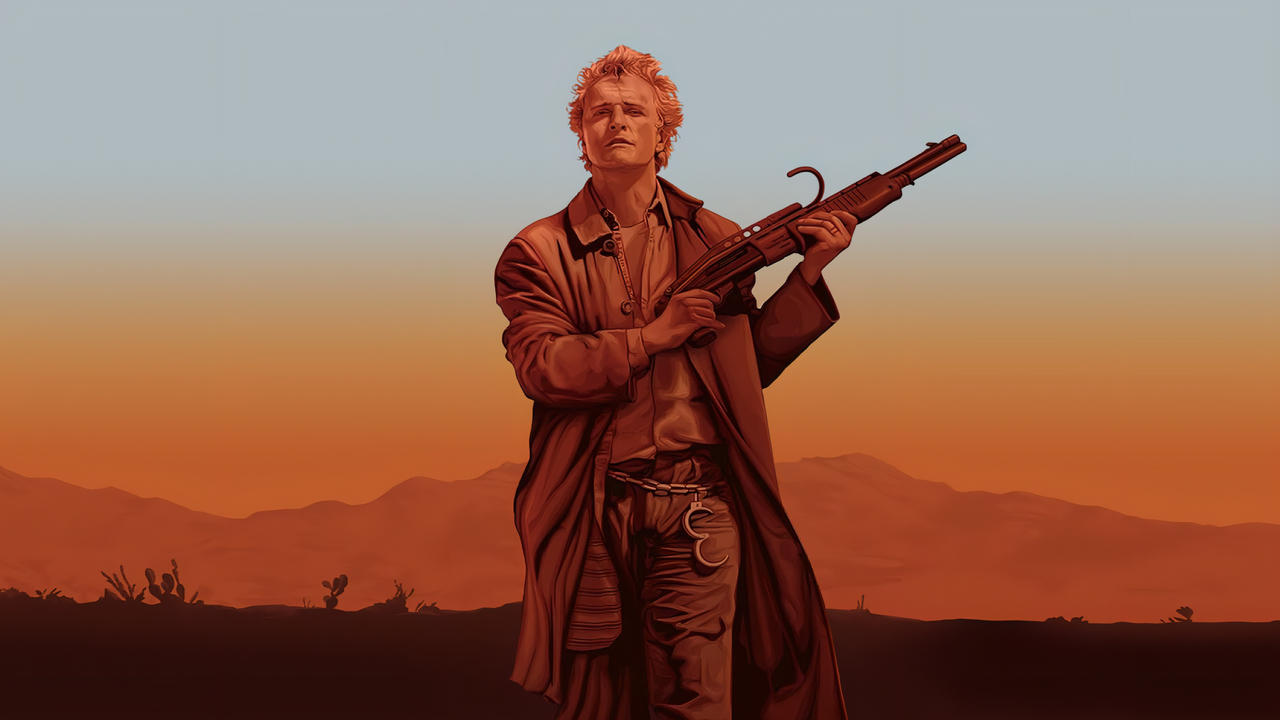
The casting of Ryder was important because the film offers almost no reliable account of his origins or objectives. The AFI records that several actors were discussed for the part, including Terence Stamp, while Harmon later identified Stamp as an early preference. Rutger Hauer had become internationally familiar through roles including Blade Runner, but was reluctant to be defined exclusively by villains. He nevertheless accepted Ryder, whose calm behaviour could turn an ordinary conversation into an immediate threat. His face and voice allow the character to appear approachable for a few seconds before the danger reasserts itself.

Harmon deliberately altered the conception of the killer from the screenplay's more overtly monstrous figure. He recalled that an early version gave Ryder a damaged larynx and an electronic voice device; the finished film instead relies on Hauer's natural speech and controlled physical presence. The director intended an ambiguity that could accommodate a mythic interpretation without declaring Ryder a supernatural being. The killer travels through recognizable roads, motels and police stations, yet his uncanny timing and apparent invulnerability disturb their realistic logic. Presenting him literally as a demon would overstate what the film establishes.

Hauer contributed details to the performance through rehearsal and improvisation. In a 2024 interview, Howell remembered his co-star introducing small gestures involving a knife, a handkerchief and coins placed over Jim's eyes. Such additions give the relationship moments of intimacy that make the violence harder to categorize. Ryder sometimes appears to recognize fear or suffering in the younger man while continuing to endanger him. That contradiction encourages readings of their encounter as a ritual of domination, although Harmon was careful not to settle the character's psychology into a single explanation. The absence of a backstory remains an intentional part of Ryder's effect.

Jim Halsey, Nash and the Destruction of Safety

C. Thomas Howell plays Jim as a young man whose lack of preparation is immediately apparent. He accepts Ryder in part to remain awake during a long night of driving and reacts with disbelief when his passenger reveals a murderous purpose. His escape initially suggests that quick thinking can restore safety, but every subsequent stop destroys that expectation. Jim encounters murdered travellers, finds himself implicated by circumstantial evidence and discovers that appeals to the authorities can expose more people to danger. Police officers interpret his account through the ordinary assumptions of a criminal investigation, while Ryder engineers events that make those assumptions increasingly plausible.

Jennifer Jason Leigh's Nash provides the clearest human interruption to the pursuit. Working at a roadside establishment, she responds to Jim as a frightened person rather than accepting the case constructed against him. Her decision to help creates a brief partnership based on trust and shared vulnerability. Howell later emphasized that the relationship was not developed as a conventional romance, a choice that preserves the urgency of their situation. Nash occupies a different position from the police and the killer: she has little institutional power, but she can still choose to believe someone whose apparent guilt has become overwhelming.

The film's movement through diners, service stops and police vehicles gradually removes places where Jim might expect ordinary assistance. Ryder's apparent ability to anticipate him produces a sustained feeling of entrapment despite the vast landscape. By the final confrontation Jim has acquired knowledge of the killer's methods but has also been driven toward the use of lethal force. His transformation is the narrative's most disturbing development. The young traveller who initially wants only to survive must confront a man who seems to have arranged the ordeal so that Jim will eventually act on his own terms.

Desert Locations, Cinematography and Editing

Principal photography began in February 1985. AFI documents a nine-week period across Southern California desert locations including Barstow, Brawley, Death Valley, Twenty Nine Palms and the Chocolate Mountains, with additional work near Las Vegas. These environments are essential to the film's sense of exposure. The long roads allow vehicles to be seen approaching from a great distance but give travellers few places to hide once danger arrives. Rural buildings and scattered service stations become temporary shelters rather than secure destinations. The setting draws on American road-film imagery while converting the freedom of movement normally associated with the highway into a condition of vulnerability.

Cinematographer John Seale builds tension from the scale difference between fragile human figures and the vehicles that surround them. A car crossing an immense landscape can seem isolated even before Ryder appears, while a truck bearing down on another vehicle creates an immediate physical threat. Harmon had worked in still photography and valued precise visual composition; Seale brought considerable feature-film experience to the debut director's production. Their collaboration maintains spatial clarity during chases and collisions, making it possible to understand danger without reducing every action sequence to rapid, disorienting fragments.

The editing by Frank J. Urioste alternates movement with abrupt interruption. Jim can be driving across an apparently empty road when another vehicle, police encounter or sign of Ryder's activity changes the stakes. The film also places significant weight on transitions from daylight to darkness, and from the openness of the highway to constrained interiors. Howell recalled a scene after a police attack in which a break in the clouds illuminated Jim as he rose from the ground; Seale filmed a separate view of the emerging sun to complete the sequence. That documented production choice illustrates how photography and editing could turn an unplanned change in light into a moment of apparent transformation.

Violence, Withholding and the Two-Truck Sequence

The Hitcher's reputation for brutality depends partly on events that viewers are made to imagine. The film does show bloody aftermaths, shootings and physical attacks, but the most notorious scene avoids displaying the fatal damage itself. Ryder captures Nash and restrains her between two large trucks, forcing Jim to confront the consequences of resistance while threatening to drive the vehicles apart. The cutting emphasizes faces, mechanical movement and Jim's helplessness. As Harmon and Howell later confirmed, the actual dismemberment is not photographed for the audience. The scene's remembered explicitness is therefore greater than the images directly shown.

This sequence was disputed during development because producers and financiers feared that the material would overwhelm the picture. Harmon reduced the early screenplay's more graphic descriptions, yet insisted on retaining Nash's death as a decisive point in Jim's ordeal. He also changed a grotesque detail in a diner scene: the finished discovery of a severed finger replaced an earlier proposal involving an eyeball and a written message. These decisions should not be described as evidence that the violence was incidental. They demonstrate an effort to control its presentation while preserving the cruelty that drives the plot.

The two-truck scene also became a focal point of critical objections to the film. Roger Ebert, writing at the time of release, condemned the treatment of Nash and the absence of any moral or psychological explanation for Ryder's actions. The judgment differs from later accounts that praise the sequence's power of suggestion. Both perspectives address the same formal choice: restricting the visible injury does not necessarily diminish the significance of the act being represented. In the wider film, violence removes potential helpers one after another, isolating Jim and making the killer's control appear nearly total.

Mark Isham, Road Noise and the Sound of Pursuit

Mark Isham composed the original music, which supports the film's uneasy movement between psychological threat and physical action. Rather than supplying a continuous layer of emphatic horror music, the score leaves space for the surrounding environment to be heard. Vehicle engines, the impact of collisions, rain and sudden gunfire can dominate a scene, establishing the road as a source of immediate danger. The music becomes particularly effective when a passage of relative quiet is followed by a violent interruption. Its restrained presence allows the performances and shifting visual conditions to determine much of the tension.

The sound world also links apparently separate encounters through recurring sensations. Jim first meets Ryder during a rainstorm, when the enclosure of the car makes the stranger's words especially difficult to escape. Later, the noise of heavy vehicles and police activity expands the conflict across the landscape. A match being struck frames the story at its beginning and conclusion, an acoustic repetition noted in contemporary criticism. The motif associates the two men without requiring the film to explain their relationship through dialogue. Specific claims about instruments, studio sessions or electronic equipment used for Isham's score would require production evidence beyond the general composition credit.

The production's renewed home-video life has also made the soundtrack's historical forms relevant. The director-approved 2024 restoration made the original stereo presentation available alongside a newer Dolby Atmos mix. Those are distinct audio options for the same film, and the later mix should not be described as the soundtrack heard at its original theatrical release. The preservation of a period mix is important for assessing the original relationships among music, dialogue and vehicle effects, particularly in a work where auditory pressure repeatedly precedes visible danger.

Release, Contemporary Reception and Restoration

AFI records the main American theatrical release on 21 February 1986 through Tri-Star Pictures, after a planned March date was brought forward. A limited Texas engagement is separately listed in release records and should not be confused with the national opening. The film was classified R in the United States. AFI reports approximately four million dollars in domestic receipts during the first seventeen days, a dated partial figure rather than a confirmed worldwide gross. The British Board of Film Classification separately records a cinema examination on 27 February 1986. Its entries document different running times for theatrical and home-video submissions, which cannot on their own be treated as proof of specific censored scenes.

Initial critical response was divided and frequently hostile to the degree of violence. In February 1986 Roger Ebert objected particularly to Nash's fate and to the unclear motivation of the central relationship. The Los Angeles Times also published a sharply critical assessment while acknowledging elements of Harmon's staging. Such responses establish substantial reservations among contemporary reviewers rather than a uniform rejection by audiences. Subsequent writing has reconsidered the film's withholding of information, Hauer's performance and the way the desert setting magnifies vulnerability. Harmon himself has attributed part of its enduring interest to the absence of the explanatory backstory usually supplied for a screen killer.

The film's continued circulation led to a 2003 direct-to-video sequel, The Hitcher II: I've Been Waiting, and a separate 2007 remake; neither is an alternative version of the 1986 production. Preservation took a more significant turn when Second Sight prepared a 4K restoration from the original camera negative, supervised and approved by Harmon and released in 2024. The director described the restoration process and his participation in colour timing, contrasting the resulting images with earlier transfers he considered inadequate. This work restored greater visibility to Seale's photography and the careful relationship between daylight, empty landscape and nocturnal threat that defines the original film.

References

  1. American Film Institute AFI Catalog — The Hitcher (1986)

    Institutional history drawn from AMPAS production records and contemporary trade reporting, documenting screenplay development, casting, financing, shooting locations, release dates and distribution.

  2. Los Angeles Times The Hitcher Gets a Ride to Hollywood — Deborah Caulfield

    Contemporary February 1986 production report with interviews concerning Eric Red’s screenplay, David Bombyk’s involvement, studio resistance and Harmon’s suspense-oriented revisions.

  3. The Guardian Rutger Hauer Said He Didn’t Play Bad Guys: How We Made The Hitcher — Chris Broughton

    Original interviews with director Robert Harmon and actor C. Thomas Howell concerning Ryder’s characterization, on-set improvisation, Nash’s offscreen death and cinematographic decisions.

  4. Primary British classification record identifying the 1986 theatrical examination and subsequent home-video submissions, durations, violence descriptions and the 2024 restored edition.

  5. The Hollywood News Robert Harmon Reflects on The Hitcher — Kat Hughes

    September 2024 filmmaker interview documenting Harmon's involvement in the original-negative 4K restoration, colour timing and his retrospective assessment of earlier video presentations.

Connections

Cast

View Full Cast & Crew →

Release & Distribution

Production Companies (1)

  • Feldman/Meeker Productions

Distributors (1)

  • TriStar Pictures US

Release History (28)

Release DateTerritoryRelease TypeFormatDistributorCertificationNotes
1986-01-17 United States Limited Theatrical — — R Victoria, Texas
1986-02-21 Canada Theatrical — — —
1986-02-21 United States Theatrical — — R
1986-05-03 Japan Theatrical — — G
1986-05-16 United Kingdom Theatrical — — 18
1986-06-04 Hong Kong SAR China Theatrical — — —
1986-06-13 Ireland Theatrical — — 18
1986-06-25 France Theatrical — — 12
1986-06-26 Netherlands Theatrical — — 16
1986-06-27 Sweden Theatrical — — 15
1986-07-03 Portugal Theatrical — — M/18
1986-07-10 Australia Theatrical — — R 18+
1986-09-12 Denmark Theatrical — — 15
1986-10-02 Spain Theatrical — — 18
1986-10-31 Finland Theatrical — — K-18
1986-11-27 Brazil Theatrical — — 16
1986-11-27 Germany Theatrical — — 18 West Germany
1986-12-18 Italy Theatrical — — VM14
1987-01-07 Colombia Theatrical — — —
1987-05-29 Norway Theatrical — — 18
1987-10-08 Mexico Theatrical — — B-15
1988-05-19 Peru Theatrical — — —
1990-04-26 Hungary Theatrical — — 18
2000-04-25 Iceland Physical — — — (video premiere)
2002-09-03 Greece Physical DVD — — DVD
2003-11-28 Netherlands TV — — 16
2007-07-19 Netherlands Physical — — 16
2024-09-30 United Kingdom Physical 4K UHD — 15 Added 4K UHD release date
The terror starts the moment he stops.