From The Forbidden to an American Ghost Story
Rose encountered Barker’s The Forbidden in the fifth Books of Blood volume and became interested in its account of an educated outsider studying a frightening story associated with public housing. In a retrospective interview, he recalled that Barker gave him an option on the material without demanding an expensive initial agreement. Rose wanted to make a film about folklore and class division, but feared that an American production might erase the specificity of the British setting through dubbing or other changes. He therefore decided to relocate the story before production. The fictional estate in Liverpool became Chicago’s Cabrini-Green, a place whose social divisions would shape a substantially different supernatural history.
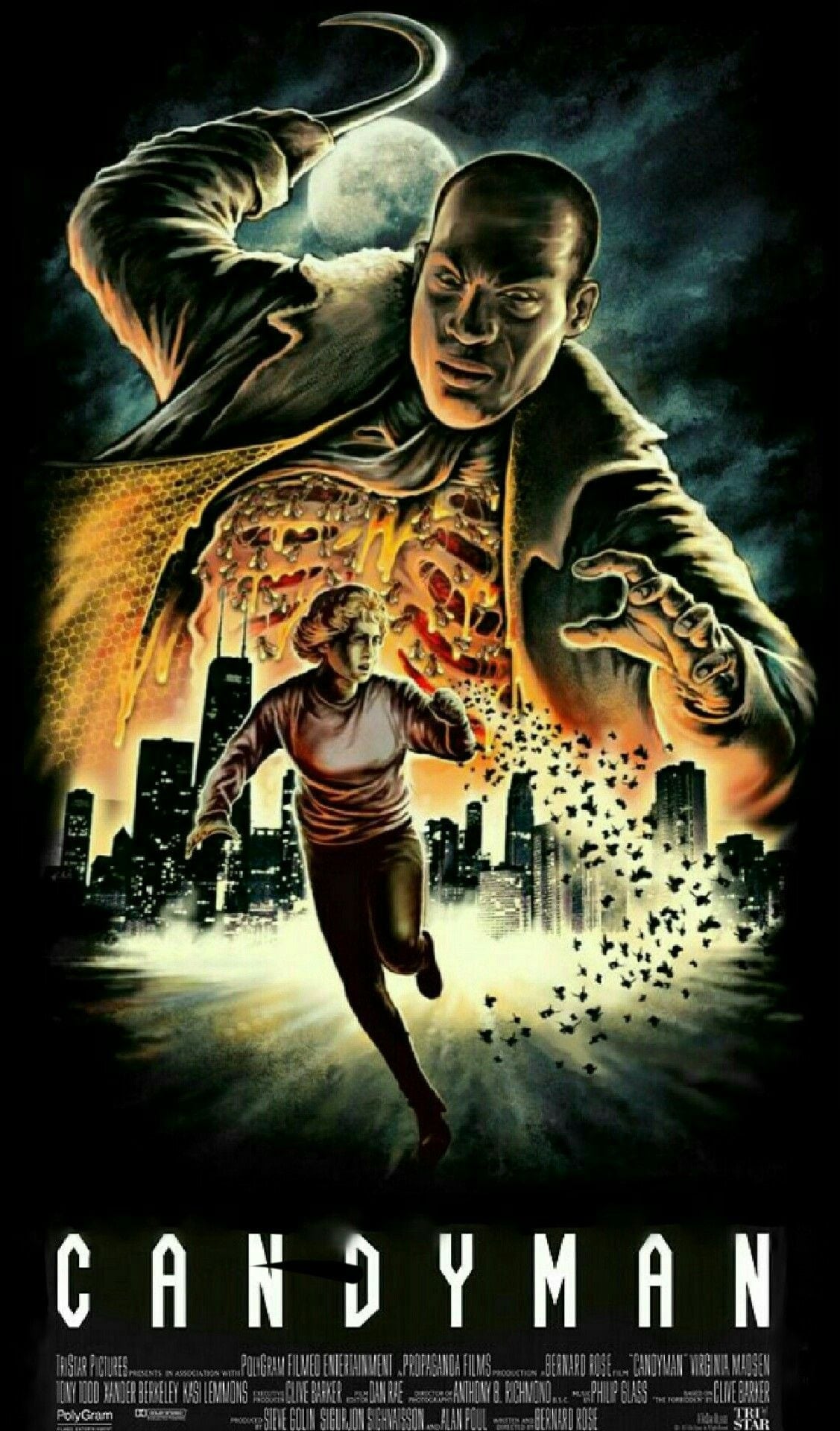
The adaptation made Candyman a Black artist whose father had been enslaved. In the film’s narrated backstory, he is mutilated and murdered by a racist mob after a relationship with a white woman; the hook and the bees become attributes of the returning spirit. This history was created for Rose’s American film rather than inherited unchanged from Barker’s tale. Rose told The Guardian that he insisted the screen figure be African American, while Todd described drawing on the history of slavery and the expressive pain of blues music. Their remarks establish different but connected creative intentions: the director was interested in belief and the social fear of outsiders, while the actor sought a tragic historical identity for the monster.
Propaganda Films acquired the project, with Clive Barker serving as executive producer. The production later involved PolyGram Filmed Entertainment and received a TriStar theatrical release. Rose’s earlier Paperhouse (1988) had already joined psychologically unstable experience to images of threatening domestic space. Candyman expanded that interest into a story about an entire neighborhood and the way its reputation circulates beyond its residents. Its fictional mythology follows a clear rule of transmission: a story becomes dangerous through repetition, and an investigator who tries to disprove it risks supplying the next chapter.
Cabrini-Green, Segregation and the Outsider’s View
Rose said that he chose Chicago before he had a detailed knowledge of its public housing. After contacting the Illinois Film Commission, he was directed toward Cabrini-Green, where the production initially encountered restrictions requiring police escorts. He subsequently recalled how stark the separation between prosperous districts and the estate appeared, while emphasizing that most residents were occupied with ordinary daily life. Production records held by the American Film Institute confirm that exterior and aerial photography began in Chicago in November 1991. Rose estimated that the crew worked in Cabrini-Green for about one week before completing much of the interior material on Los Angeles sets.
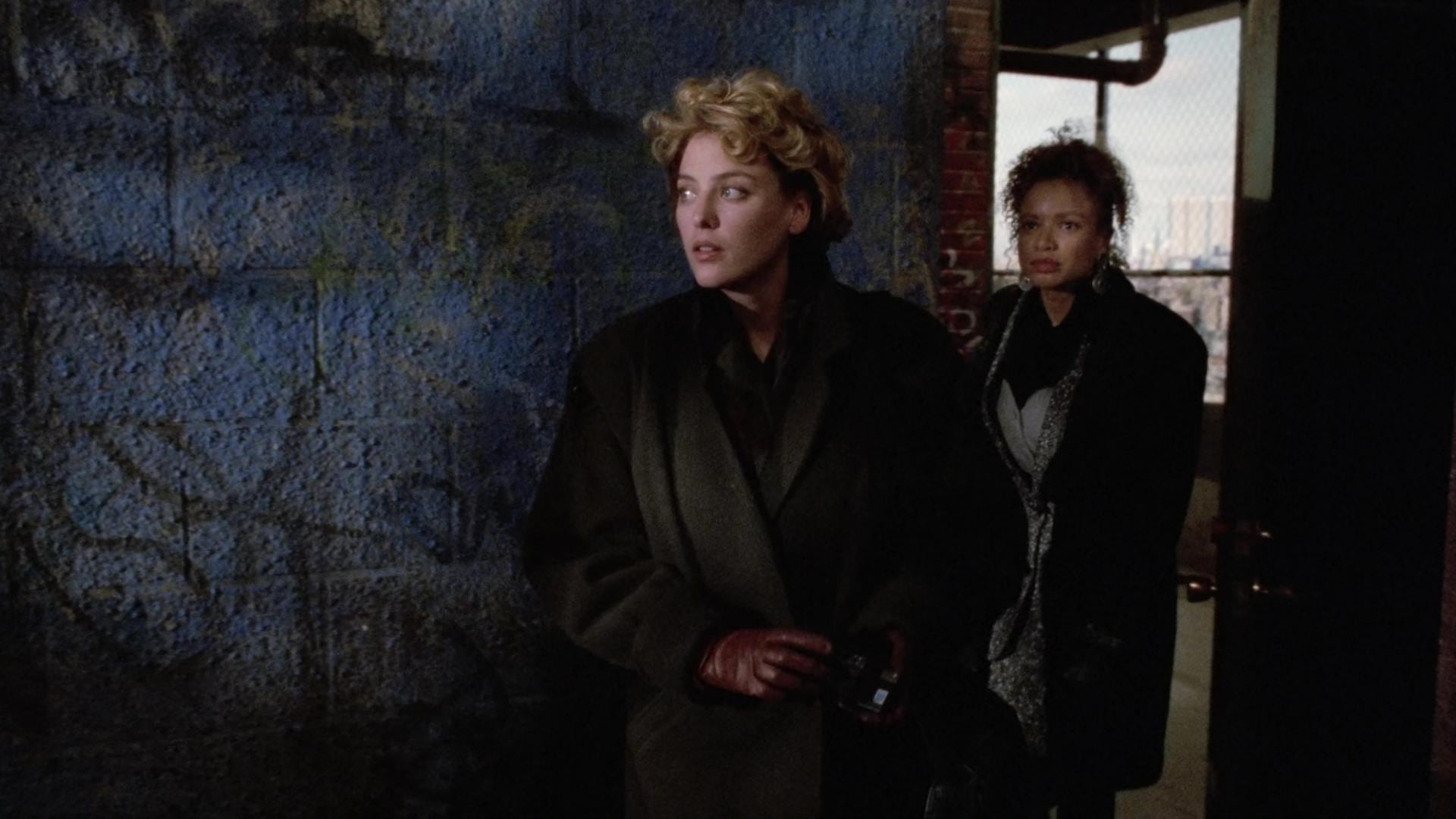
Helen’s research makes those divisions visible through the contrast between her secure apartment and the estate she enters with her fellow student Bernadette Walsh. The two buildings are described as sharing a basic design, even though one has been adapted for affluent occupants and the other is marked by neglect. Passageways concealed behind bathroom mirrors reveal how easily one private dwelling can be entered from another. This is a narrative image of social separation built into residential space, rather than a neutral background for attacks. Helen moves through Cabrini-Green with the confidence of someone who expects observation to produce knowledge; the residents have to live with the consequences of the building’s actual insecurity.
The film’s treatment of race also has limitations. Its central point of view belongs to a white researcher, while Black characters such as Bernadette and Anne-Marie McCoy often bear the immediate danger associated with Helen’s inquiry. Rose recalled that the NAACP raised concerns about presenting a Black man as a figure of terror when the script was reviewed. He defended Candyman as a tragic monster with whom horror audiences might identify and said he listened to the Black performers, especially Kasi Lemmons. Those intentions are documented, but they do not settle the question of representation: the film’s concern with racism coexists with a narrative in which the predominantly Black community is often seen through the outsider’s fear and curiosity.
Urban Legend, Belief and Helen’s Disintegration
The summoning ritual gives the legend an action anyone can repeat. Five repetitions before a mirror seem to transform hearsay into a testable proposition, and Helen initially approaches the stories with the skepticism expected of an academic researcher. She records accounts, studies reports of violence and considers how details change as a rumor passes from person to person. The appearance of a local criminal who adopts Candyman’s identity complicates the distinction between supernatural belief and real intimidation. People can use the legend to frighten one another whether or not a ghost exists, so the social effect of the story precedes any verified supernatural event.
Candyman’s eventual appearance changes the inquiry’s terms. His threat is linked to Helen’s attempts to expose him as an invention, because disbelief would deprive the legend of its authority. The murders surrounding her then strip away the institutions on which she relies: academic status, marriage, police testimony and medical judgment. Even when she can describe what she believes she has witnessed, the evidence seems to place her at the center of the crimes. This reversal makes the spectator share her uncertainty about the relation between perception and explanation. The film’s later transformation of Helen into another figure of urban legend completes the process: the researcher becomes a story that others repeat, with her own life reduced to the terms of a frightening tale.
Architecture, Aerial Photography and the Opening Titles
The opening aerial views give Chicago an impersonal scale before the film introduces Helen’s investigation. Rose explained in an extended interview with Art of the Title that he had been influenced by Saul Bass’s credits for North by Northwest and wanted a moving view directly above traffic. Helicopter pilot Bobby Zajonc captured the shot with the aircraft angled steeply because its camera mount could not point straight down. Rose recalled severe cold during the November filming, including film breaking during some attempts. These are specific technical circumstances behind an image that presents roads and moving cars as patterns, reducing individual lives to almost invisible elements of the urban grid.
The credits were added through optical processes rather than the digital compositing familiar today. Rose said that an early plan to keep the lettering continually moving proved difficult to read because of strobing; the final titles enter, pause and depart. Their deliberate motion corresponds to the camera’s passage over the city, while the subsequent superimposition of bees and Helen’s face joins the metropolitan setting to the supernatural danger. Anthony B. Richmond’s photography then shifts from the distant city to narrow corridors, residential rooms and enclosed passages. The effect is a spatial argument: an apparently legible city contains barriers and concealed routes that an outsider does not immediately understand.
Live Bees, Prosthetics and Bodily Horror
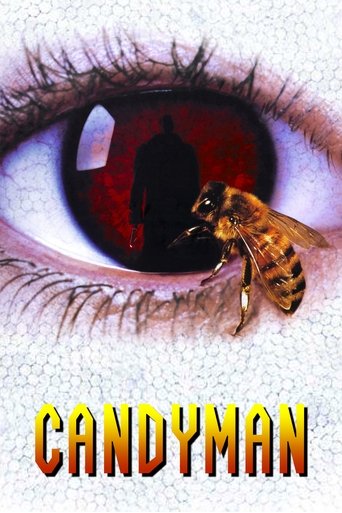
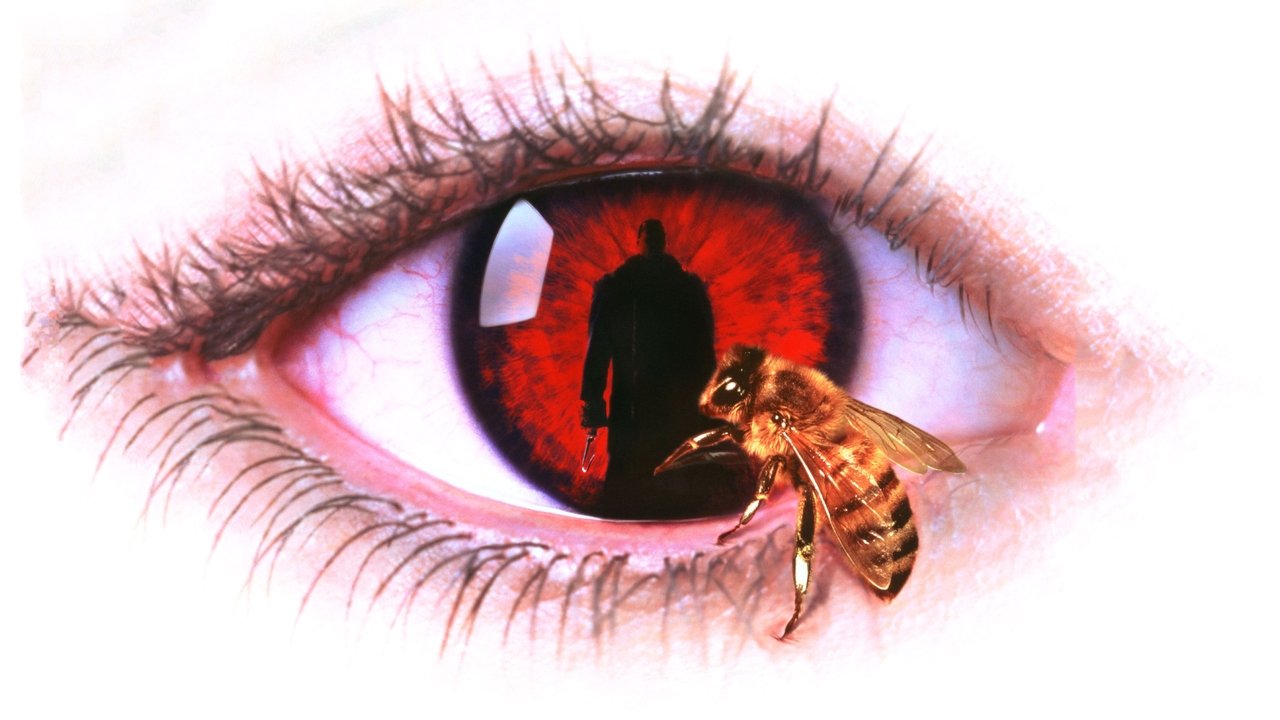
The bee imagery was achieved substantially with live insects. The American Film Institute’s production history reports that nearly 200,000 bees were used across principal photography, with entomologist Norman Gary supervising their handling. For scenes in which bees covered the actors, Gary bred young insects that had not yet developed the same stinging capacity as mature bees. A specialized low-suction device collected the insects between takes, while a protective mouth apparatus was developed for Todd’s shot with bees emerging from Candyman’s mouth. These details distinguish the effect from a simple optical overlay and help explain the unusually tangible movement of the swarm.
Rose said he first saw Gary demonstrating his work with bees on television and contacted him because the technique offered a way to realize the imagery physically. He recalled the resulting scenes as demanding and stressful. Todd separately remembered negotiating an additional payment for each sting he suffered and said he was stung twenty-three times. The numbers come from a participant’s recollection, while the scale of the insect work is also recorded in contemporary production documentation. The bees connect the monster’s bodily corruption to his fictional death and threaten to invade Helen’s own body. Their unsettling impact depends on the visibly shared space of performer and insects, reinforced by makeup and special effects credited to Bob Keen and Image Animation.
Philip Glass’s Score and the Film’s Sacred Sound
Rose approached Philip Glass partly because he admired the composer’s work on Koyaanisqatsi, particularly its association with aerial urban imagery. Glass was asked to provide a musical language capable of accompanying an atmosphere of contemporary myth rather than merely punctuating violent attacks. Documentation published on the composer’s official site describes a score for piano, pipe organ and chorus. The familiar repeated patterns and the resonance of voices give the urban legend an almost liturgical character. Those sounds can suggest mourning and solemnity even where the images describe poverty, abandoned rooms or the approach of a killer.
In his Art of the Title interview, Rose explained that Glass viewed an early edit and sent him a suite of music. The director then cut scenes to that material, after which the cues were rearranged to fit the finished film. The account makes the score an active part of the editing process, rather than a final layer added to already locked images. Organ and choral textures contribute to the ambiguity of Candyman’s presence: the music can lend grandeur to a murderer whose power derives from accumulated suffering and repeated stories. The score’s association with the aerial opening is especially important, joining an apparently ordinary city to a threatening history before the plot has introduced the figure responsible for the curse.
Theatrical Release, Critical Response and Afterlife
TriStar opened Candyman in the United States on October 16, 1992. The American Film Institute records an initial engagement on 1,251 screens and a first-weekend gross of approximately $5.4 million, followed by expansion into additional markets. Contemporary trade reports cited in the AFI history offered differing budget estimates, so an exact production cost cannot responsibly be reduced to one uncontested figure. The film’s release brought an unusually elaborate urban-legend horror story into a commercial landscape where supernatural antagonists were already established box-office attractions. Its reliance on psychological uncertainty and social geography nonetheless gave it a distinctive identity.
Critical judgment was not confined to its shocks. In a review published in Sight and Sound in March 1993, Kim Newman praised the film’s use of Barker’s premise, the aerial imagery and the shifting pattern of apparently familiar slasher situations. He also found the final bonfire less natural after the story’s relocation from a British context associated with Guy Fawkes celebrations. His response is valuable because it documents how the film’s Gothic atmosphere and adapted social setting were evaluated close to its original release. Later discussions have increasingly examined the contradiction between Candyman’s history as a victim of racist violence and his attacks upon a Black community, alongside the film’s dependence on Helen as the audience’s guide.
Todd returned as Candyman in Candyman: Farewell to the Flesh (1995), and the mythology eventually acquired further cinematic continuations, including Nia DaCosta’s Candyman (2021). These later productions demonstrate the persistence of the character, but they are separate works with their own creative and political emphases. Rose’s film remains identifiable through its particular convergence of Cabrini-Green, the mirror ritual, Todd’s performance, the bees and Glass’s music. Its most durable narrative idea is that an urban legend can shape behavior before anyone proves it true, and that every new retelling may change who is remembered as a victim or monster.