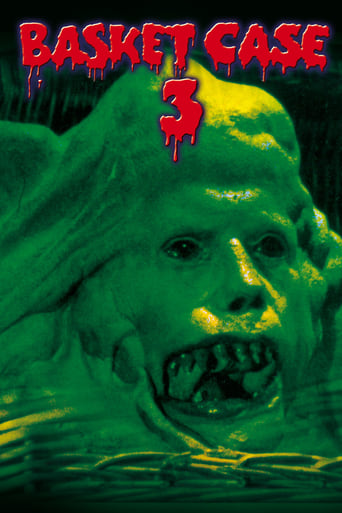
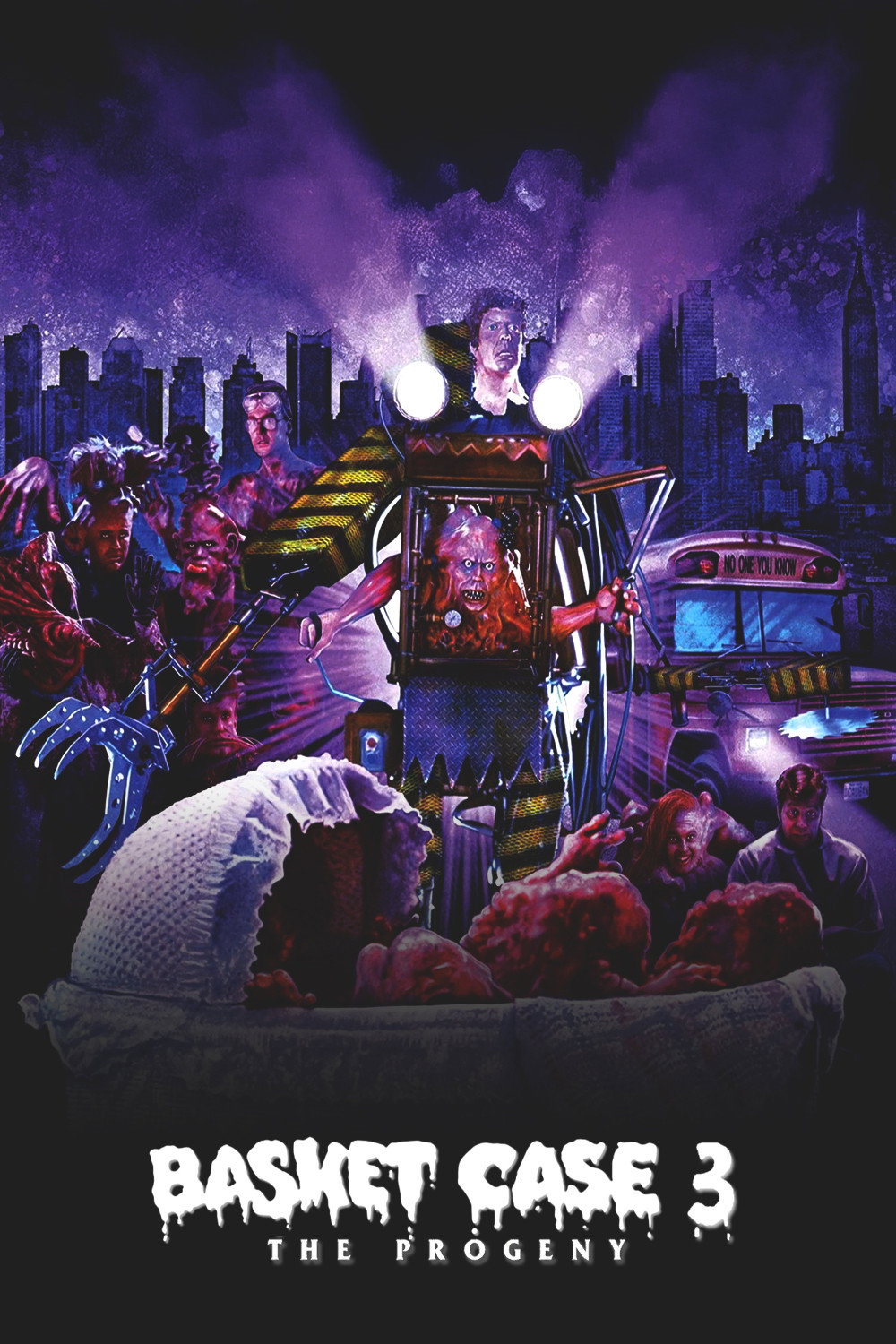
Following the events at Granny Ruth's sanctuary, Belial is expecting offspring with Eve, and the household travels to obtain medical help for the birth. Duane remains emotionally unstable and estranged from his brother. As the group crosses unfamiliar territory, encounters with local authorities endanger the residents and the new family they are trying to protect.
Alternative Titles
Кошницата 3 (Bulgaria) — BulgarianO Mistério do Cesto 3 (Brazil) — Portuguese篮子里的恶魔3 (China) — ChineseBasket Case 3 - Die Brut (Germany) ¿Dónde te escondes, hermano? 3 (Spain) Basket Case 3: La prole (Spain) — alternative titleFrère de sang 3 (France) Frère de sang 3 : La Progéniture (France) — FrenchShow all 20 alternative titlesFrères de sang 3 : La Progéniture (France) 籃子裏的惡魔 3 (Hong Kong SAR China) — Chineseバスケットケース 3 (Japan) — Japaneseバスケットケース3 (Japan) 바스켓 케이스 3 (South Korea) — KoreanBasket Case 3: La Prole (Mexico) — SpanishLa canasta del horror 3 (Mexico) Wiklinowy koszyk 3 (Poland) O Segredo do Cesto 3: A Prole (Portugal) Существо в корзине 3: Потомство (Russia) อะไรอยู่ในตะกร้า 3 (Thailand) — ThaiBasket Case 3: The Progeny (United States) — publicity title
▤
Film Guide & Analysis
Frank Henenlotter’s final Basket Case installment develops Belial’s impending fatherhood through grotesque comedy, practical creature effects and a troubled production shaped by major screenplay cuts.
Basket Case 3: The Progeny (1992) concludes Frank Henenlotter’s original horror trilogy by following Duane Bradley, his surgically separated twin Belial and the community of physically unusual people sheltered by Granny Ruth. Continuing directly from Basket Case 2 (1990), the story concerns Belial’s impending fatherhood and the violent consequences of an encounter with hostile authorities in rural Georgia. The third installment moves further toward grotesque comedy, expanding the ensemble of creatures and making reproduction central to its body-horror imagery.
The production was marked by disagreements over the screenplay and the amount of graphic material permitted. Henenlotter later identified the film as a particularly unhappy experience, explaining that extensive reductions to the planned birth sequence undermined his original conception. Its creature effects, supervised by Gabe Bartalos and David Kindlon, nevertheless continued the practical makeup tradition established in the previous installment. The film received a limited American theatrical release on 21 February 1992 and became the director’s final feature before a prolonged absence from narrative filmmaking.
Development & Production Conflicts
The project followed the production of Basket Case 2 and Frankenhooker (1990), both made through Henenlotter’s relationship with Shapiro-Glickenhaus Entertainment. The commercial success of the original Basket Case had created an established property that distributors were interested in extending. Henenlotter later explained that he preferred the second film because it developed a community of unusual characters rather than repeating the original’s New York revenge story. His decision to make another sequel came during a period when independent exploitation producers were facing increasing commercial difficulties. The director subsequently described accepting the assignment without sufficient enthusiasm for the material.
The American Film Institute records that a March 1990 trade announcement projected a $2 million budget and a July production start in New York City. Filming eventually took place in Georgia, although the precise dates remain undocumented in that record. The screenplay was credited to Henenlotter and Robert Martin. During production, the producers demanded reductions to the graphic material. In a later interview with Denver Westword, Henenlotter recalled losing eleven pages devoted to Eve’s prolonged childbirth. He had intended reproductive horror to dominate the film, and regarded the removal of that material as a fundamental change to its dramatic purpose.
Family, Outsiders & Narrative
The story resumes after Duane’s unsuccessful attempt to reunite physically with Belial at the conclusion of Basket Case 2. Separated again, Duane remains under the supervision of Granny Ruth, while his brother refuses to communicate with him. Belial’s relationship with Eve introduces a new family connection that Duane cannot control. When Eve becomes pregnant, Granny Ruth organizes a journey south to visit Uncle Hal, a doctor she trusts to oversee the delivery. The road trip carries the sheltered community into an environment where its members attract dangerous attention from ordinary society.
The birth of Belial’s offspring gives the film its central conflict. Local authorities interfere with the unusual family, and the abduction of the newborn creatures provokes a violent response. The narrative continues the previous sequel’s interest in people whose physical differences make them vulnerable to exploitation and persecution. Duane, despite his conventional appearance, becomes increasingly unstable, while Belial displays recognizable parental concern. The reversal is emphasized through Granny Ruth’s determination to protect her companions. Anton Bitel’s retrospective review identified this unstable relationship between family loyalty, outsider identity and apparent normality as a recurring source of the film’s grotesque humor.
Practical Makeup & Creature Effects
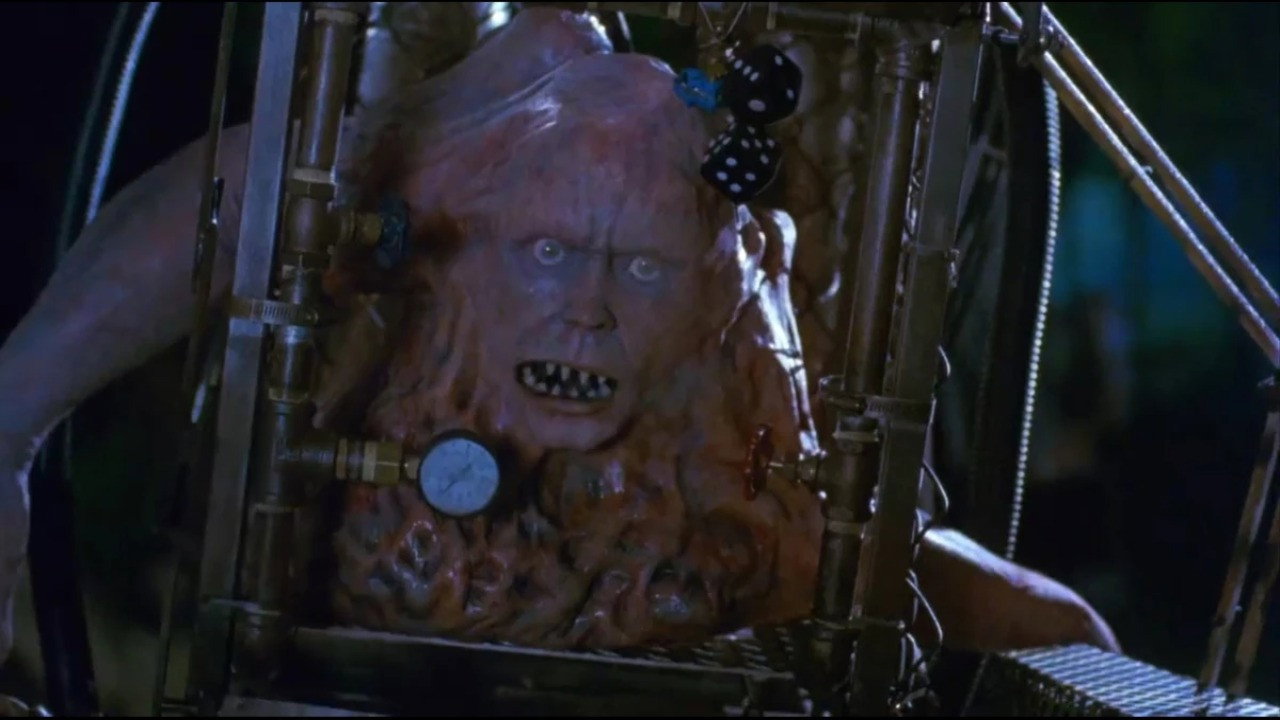
Gabe Bartalos and David Kindlon received principal creature and makeup-effects credits, with additional work undertaken through Atlantic West Effects. The production employed specialist makeup artists and animatronics technicians to realize its unusually large collection of characters. Several creatures had already appeared in Basket Case 2, while the new film required further designs associated with Eve’s pregnancy and the expansion of Granny Ruth’s community. The offspring, mechanical creatures and exaggerated bodily transformations continued the series’ reliance on tangible constructed effects. The climactic appearance of Belial within a mechanical apparatus provided another elaborate extension of the character’s physical capabilities.
Henenlotter described his collaboration with Bartalos as a process in which the director supplied an initial concept and the effects artist developed its physical form. In a 2010 interview, he specifically recalled his surprise at seeing Twister, one of the creatures designed for the third installment. He encouraged Bartalos to develop unexpected ideas rather than restricting him to predetermined designs. The effects operation involved prosthetic fabrication and mechanical performance, with the credited animatronics personnel responsible for technical aspects of the constructed creatures. Henenlotter’s later statements about the deleted childbirth material also establish that the effects visible in the finished film represent a reduced version of his intended reproductive horror.
Performances, Music & Grotesque Comedy
The film’s comic approach becomes especially apparent during the journey to Georgia. Granny Ruth, played by Annie Ross, organizes her companions with a mixture of maternal authority and theatrical enthusiasm. A musical performance of Personality, written by Lloyd Price and Harold Logan, features Ross and the Renzettes. The scene uses the collective presence of the unusual characters as entertainment before their arrival in a less welcoming community. Joe Renzetti received the music credit. These musical and performance elements distinguish the third installment from the grimy urban atmosphere that had defined the original Basket Case.
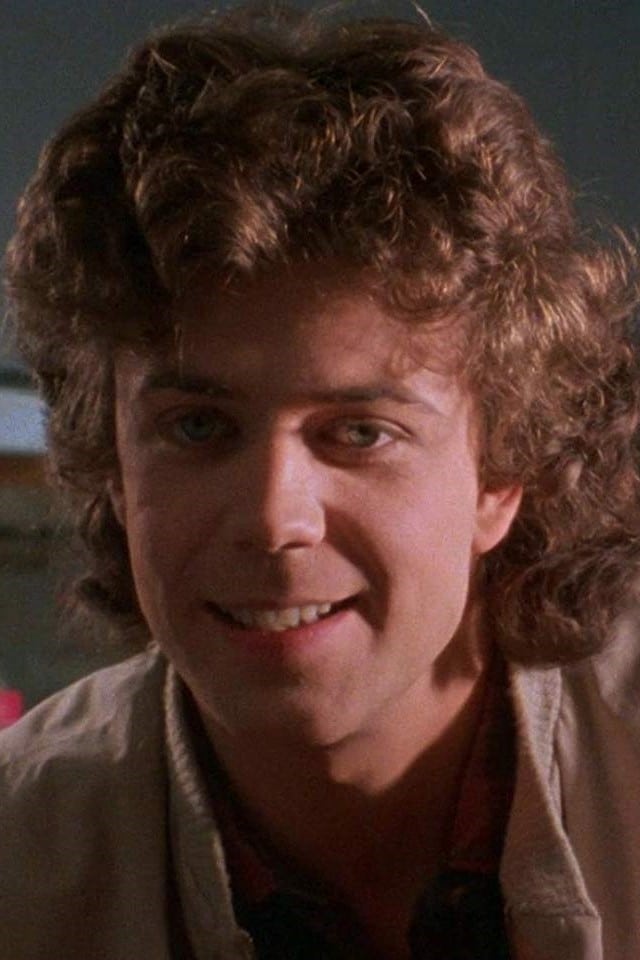
The performances frequently emphasize exaggerated behavior. Kevin Van Hentenryck portrays Duane as increasingly detached from ordinary judgment, while Ross presents Granny Ruth as a protective figure whose determination grows more militant. The local authorities become targets of the film’s physical comedy as well as its violence. Henenlotter’s interest in grotesque spectacle allows the creatures to participate in scenes that resemble slapstick confrontations. This emphasis changes the balance between horror and comedy established in the earlier films, placing the assembled community and its collective actions at the center of the narrative.
Release, Reception & Historical Position
The film’s title and distribution history underwent several changes. Variety listed the project as Basket Case 3: The New Generation in October 1991, while Daily Variety used Basket Case 3: The Progeny in February 1992. The American Film Institute documents a Los Angeles opening on 21 February 1992, with an R rating and a running time of approximately ninety minutes. Contemporary trade reviews described a restricted theatrical engagement involving midnight screenings. The documentary evidence does not establish a reliable total theatrical gross, and the proposed production budget reported in 1990 should not be treated as a verified final expenditure.
Henenlotter’s retrospective assessment has been unusually negative. In interviews published by ComingSoon and MovieMaker, he expressed regret about making the third film and associated the experience with declining creative freedom and financial pressures on independent exploitation cinema. He remained more satisfied with Basket Case 2, whose expansion of the original premise he considered worthwhile. Basket Case 3 subsequently occupied a divisive position within the trilogy. Retrospective critics such as Anton Bitel have recognized its extravagant comic imagination while acknowledging the director’s dissatisfaction. The film remains historically relevant as the concluding chapter of Belial and Duane’s original screen story and as an example of the practical creature work developed through Henenlotter’s collaboration with Bartalos.
Archival production and distribution history documenting the planned budget, Georgia filming, alternate titles, theatrical opening, original credits and effects personnel.
Denver Westword — Basket Case Director Frank Henenlotter on the Film’s History and Impact
Direct interview in which Henenlotter discusses his dissatisfaction with the third film, the abandoned childbirth material and the removal of eleven screenplay pages.
ComingSoon — Exclusive Interview: Frank Henenlotter!
Original interview describing the director’s working relationship with Gabe Bartalos, creature design methods, the Twister character and his assessment of the third installment.
Extended career interview examining the commercial conditions surrounding Basket Case 3, production disagreements and Henenlotter’s subsequent withdrawal from feature directing.
Eye for Film — Basket Case 3: The Progeny — Review by Anton Bitel
Substantial retrospective analysis of the film’s grotesque humor, family relationships, outsider community and position within the Basket Case trilogy.