Full Moon and the Move to Digital HD
Dangerous Worry Dolls became a transitional production for Charles Band because it helped change his attitude toward digital acquisition. Band had spent most of his career working with film and remained skeptical that inexpensive digital cameras could produce images he considered sufficiently cinematic. For this production he used a Sony HD camera after studying tests and concluded that the results finally remained convincing once the finished movie reached the DVD and television environments in which most Full Moon customers were actually seeing his work.
The attractions of digital production extended beyond reduced stock and laboratory costs. Band emphasized the reduction in physical production weight. Smaller digital equipment could be moved and reset faster than the larger film packages with which he had previously worked, allowing a small production to obtain more setups during a restricted schedule. For a company whose model depended on making genre films quickly and economically, that improvement affected the camera department and the entire rhythm of the set.
Band nevertheless rejected the idea that digital equipment automatically made filmmaking easier. He argued that lighting, framing and professional production discipline remained essential and that audiences could recognize when a cheaply acquired image had also been cheaply conceived. Dangerous Worry Dolls mattered to him because he believed its cinematography demonstrated that a small HD production could still look deliberately constructed. He subsequently described the film as one of the projects that convinced him to move Full Moon increasingly toward digital HD production.
Women-in-Prison Meets Possession Horror
Domonic Muir's screenplay, credited under the name August White, uses a structure associated more strongly with women-in-prison exploitation than with Band's established puppet films. Eva enters an institution controlled through intimidation, sexual abuse and inmate hierarchy. Killa Kim and her group pressure her inside the population, while authority offers little protection. The first portion of the film therefore establishes an environment in which violence is already institutional and human before anything supernatural occurs.
The worry dolls introduce a supernatural mechanism into the established prison setting. Their traditional purpose is inverted: they answer Eva's wishes through supernatural intervention, reversing their symbolic function of absorbing anxiety. The important visual decision is that the principal doll enters her ear and remains associated with her body. Eva becomes stronger, more aggressive and increasingly capable of retaliating against the people abusing her. Possession converts a relatively powerless prisoner into the vehicle through which the film delivers revenge.
That concept also prevents the miniature creature from needing the extensive independent animation required by something such as Puppet Master. The film can use the doll selectively and place most of the supernatural action onto Jessica Morris's performance and makeup transformation. It is an economical narrative design particularly suited to Full Moon production: the marketable monster remains present, but the feature does not require dozens of complicated puppet shots to sustain its running time.
Digital Cinematography and Small-Crew Workflow
Thomas L. Callaway and Terrance Ryker are credited with cinematography, with Ryker specifically identified as director of photography. Their work had to solve a recurring problem for inexpensive digital horror of the period: institutional interiors can become visually flat extremely quickly when photographed without careful control of contrast and practical light. Band's comments about the project make clear that he regarded lighting as the element separating a professional digital feature from footage that merely happened to be captured with a digital camera.
The prison environment is consequently organized around restricted corridors, cells and service rooms. This keeps production requirements manageable while allowing lighting changes and camera position to differentiate spaces. Digital acquisition also made it easier to reposition the camera rapidly within those confined environments. Band valued precisely that mobility, arguing that a lightweight camera package allowed his crew to move through setups faster without abandoning conventional principles of shot design.
The workflow was particularly logical for the film's intended exhibition life. Dangerous Worry Dolls was produced for the home-video and electronic market, with no major theatrical rollout. Band reasoned that spending additional money to originate a movie on film, process the negative and then transfer it into the digital domain made decreasing sense when viewers would ultimately encounter the production on DVD, download, pay-per-view or a television display. The movie therefore captures a moment when Full Moon's distribution model and its production technology finally began converging.
Creature Makeup and the Body as an Effect
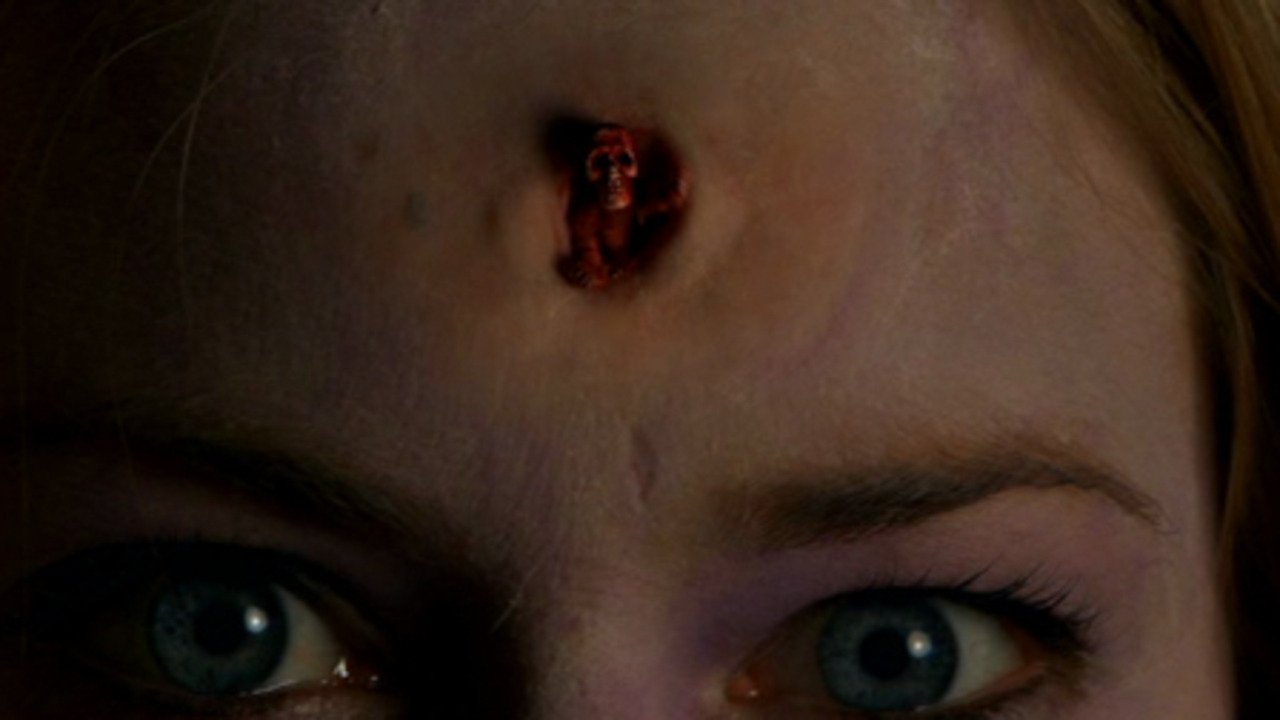
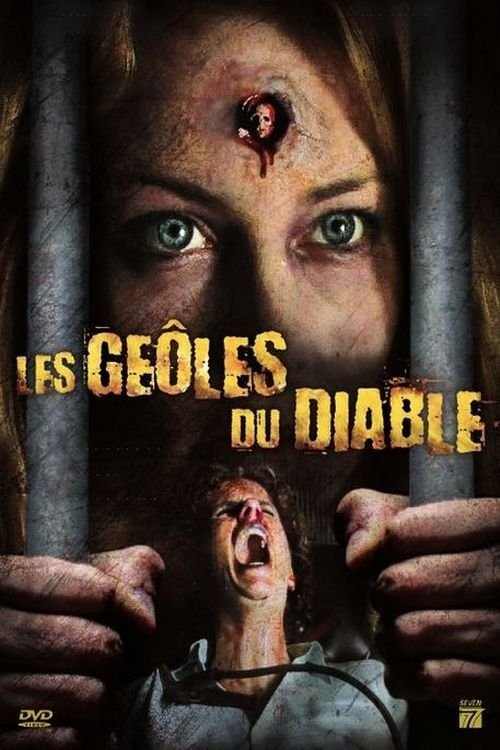
Christopher Bergschneider handled both special makeup and creature-effects work, placing the supernatural component largely inside one practical-effects pipeline. The central visual progression occurs on Eva herself. After the creature enters her ear, a blemish forms on her forehead and develops into an increasingly grotesque opening through which the tiny skull-like figure can eventually emerge. The effect integrates the performer's body into the creature mechanism within individual shots.
This provides an efficient low-budget alternative to constant autonomous puppet animation. A small creature can be fabricated for close interaction, while prosthetic stages applied to Morris establish that something is physically developing beneath her skin. Lighting and editing then control how much of the mechanism must actually be exposed. The production can create a memorable transformation image from a comparatively limited number of creature setups because the audience understands the continuing possession even while the doll itself is not visible.
John Lechago and Juan Patricio are credited with visual-effects work, indicating a hybrid production approach combining practical and visual effects. Digital effects could support titles, cleanup and elements difficult to accomplish physically at the film's scale, while Bergschneider's tangible makeup remained the visual foundation of the possession. That balance is consistent with Band's broader philosophy during the transition to digital production: new technology was useful where it increased speed or solved limitations, but it did not eliminate the practical materials that gave Full Moon horror its physical identity.
Editing, Music and Afterlife
Danny Draven edited the film, another example of the compact network of filmmakers repeatedly working within Full Moon productions. The approximately seventy-five-minute running time reflects the company's preference for direct, commercially manageable genre features with short running times. Editing therefore has to establish Eva's institutional situation rapidly, delay the supernatural element long enough for her grievances to become understandable and then accelerate once the possession begins changing the balance of power.
Richard Band provided the principal music, with Robert Douglas credited for additional composition. The score places the film within a long family relationship between Charles Band's productions and Richard Band's genre music even though the production technology around it was changing considerably. Sound and music also help enlarge environments that remain physically restricted by budget, allowing off-screen institutional activity and supernatural tension to extend beyond the comparatively small number of visible locations.
Dangerous Worry Dolls was released directly to the home-video market in 2008 and remained an obscure entry even by Full Moon standards. Charles Band himself acknowledged that comparatively little promotion meant many viewers missed it, while still describing it as a small film of which he was particularly proud because the technical ingredients had come together successfully. Full Moon later retained the title in its streaming catalogue and in 2025 presented a newly prepared black-and-white Dangerous Worry Dolls Noir version. That later reworking does not transform the film into a major cult landmark, but it reinforces its most defensible historical interest: a minor horror production that captures Full Moon precisely at the moment Charles Band accepted digital HD as the practical future of his low-budget filmmaking model.