Production & Development
Maciste first appeared in Giovanni Pastrone’s Cabiria (1914), where Bartolomeo Pagano portrayed a physically formidable servant whose strength repeatedly saved the endangered heroine. The character became sufficiently popular to sustain an independent series of adventures, with Pagano carrying his recognizable screen identity across different historical periods and settings. By the mid-1920s, however, the extraordinary international prominence that Italian cinema had enjoyed before the First World War had diminished. The production of Maciste all’inferno occurred against this industrial background, when established stars and familiar characters remained valuable assets for companies attempting to attract audiences.
Fert-Pittaluga developed the project as another adventure for Maciste, but Riccardo Artuffo, credited under the pseudonym Fantasio, supplied a premise that differed substantially from the ordinary physical challenges of the series. Instead of confronting human criminals or political adversaries, the hero would encounter supernatural forces within a fantastic representation of Hell. The concept allowed the filmmakers to exploit Pagano’s established association with physical power while surrounding him with enemies whose abilities exceeded ordinary human limitations. Director Guido Brignone consequently had an opportunity to work with a visual environment far removed from the comparatively realistic settings of many earlier Maciste productions.
Principal photography took place during the spring of 1925 at the Fert studios in Turin, with exterior scenes filmed in the Stura valley. The production involved elaborate scenic constructions designed by Giulio Lombardozzi and photographic work credited to Massimo Terzano and Ubaldo Arata. Segundo de Chomón contributed the special effects, bringing experience in cinematic illusion to a project that required convincing representations of the impossible. The collaboration helped establish a distinctive visual identity in which constructed environments and photographic transformations operated together. Rather than presenting Hell through a succession of isolated tricks, the filmmakers attempted to sustain an entire imaginary world across an extended narrative.
Maciste, Morality & the Supernatural
The narrative begins with an infernal conspiracy directed against Maciste. Pluto, ruler of the underworld, sends Barbariccia to Earth under the identity of Doctor Nox, intending to secure souls and bring the powerful hero into the kingdom of Hell. Maciste initially responds to the intruders with the direct physical resistance that had characterized his earlier adventures. Barbariccia subsequently attempts to corrupt Graziella, a young woman living near Maciste, by arranging her relationship with the wealthy Giorgio. When the relationship leaves her vulnerable, Maciste intervenes as protector of the woman and her child. The struggle eventually leads to his capture and descent into the infernal kingdom.
The change of setting alters the conditions under which the hero operates. Maciste remains physically formidable, but the underworld contains threats that cannot always be defeated through strength. He becomes the object of competing desires involving Proserpina, Pluto’s wife, and Luciferina, her stepdaughter. His encounter with Proserpina results in a demonic transformation, while Barbariccia’s jealousy leads to a rebellion against the infernal ruler. The hero’s actions become entangled in supernatural politics, making his physical achievements part of a larger contest between earthly morality and the unstable order of Hell.
The final movement draws upon Christian ideas of innocence, redemption and prayer. After helping Pluto defeat the rebellion, Maciste receives permission to return to Earth, but Proserpina prevents his departure by chaining him to a rock. His eventual liberation comes through the prayer of Graziella’s child on Christmas night. This resolution gives the fantastic adventure a religious dimension, placing spiritual intervention beyond the reach of both human strength and infernal power. The film thus incorporates conventional moral reassurance into a narrative that has spent much of its running time inviting the audience to enjoy the extravagant behavior of its demons.
Visual Design & Infernal Imagery
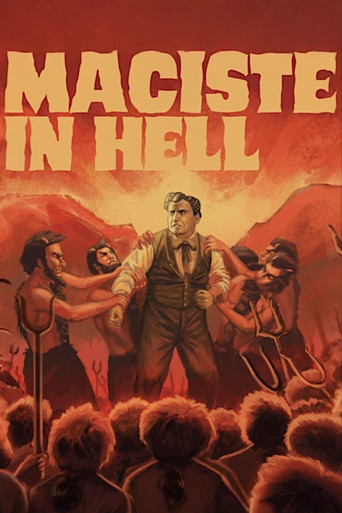
The underworld of Maciste all’inferno combines elements of Dantean illustration, Gothic fantasy and the theatrical traditions of popular spectacle. The monumental scenic work attributed to Giulio Lombardozzi includes cavernous interiors, threatening rocky landscapes and spaces filled with demonic figures. These environments provide a visual contrast to the recognizable countryside of the earthly scenes. The passage between the two worlds becomes one of the production’s principal organizing devices, with ordinary physical space giving way to settings constructed around unnatural forms, fantastic architecture and threatening visual transformations.
The imagery recalls the nineteenth-century engravings of Gustave Doré, although the film treats these artistic precedents with greater comic freedom than a strictly reverential adaptation would permit. Its inhabitants frequently appear as grotesque caricatures, and the solemnity associated with literary representations of damnation is complicated by exaggerated performance and erotic display. The resulting compositions connect established traditions of illustrating Hell with the expressive possibilities of moving images. Demons gather in groups, cavernous spaces become sites of spectacle, and the human figure repeatedly appears vulnerable within surroundings that seem governed by unfamiliar physical laws.
Color also belongs to the film’s historical visual identity. Surviving prints and restoration work demonstrate the importance of tinting and toning in representing its fantastic environments. The fiery imagery and contrasts between illuminated figures and dark spaces contribute to the atmosphere of the infernal sequences. These visual qualities are particularly important because incomplete or altered reproductions may obscure the original presentation. The film’s identity therefore depends on the relationship between scenic construction, photographic effects, coloring and performance, all of which contribute to its particular vision of supernatural disorder.
Special Effects, Demons & Early Horror
Segundo de Chomón’s contribution to Maciste all’inferno forms an important part of its historical reputation. A major figure in the development of cinematic trick photography, Chomón possessed experience in creating effects that transformed ordinary images into fantastic spectacles. Brignone’s production required illusions suitable for an environment where demons could assume new forms, supernatural forces could alter the human body and physical space could behave according to impossible rules. The effects were integrated with Lombardozzi’s elaborate sets and the performances of actors portraying the inhabitants of Hell.
The film’s horror imagery is particularly notable for its concentration of monstrous and threatening figures. Horned demons populate the infernal landscapes, while supernatural transformations and fantastic creatures disturb the familiar relationship between bodies and their surroundings. The demonic rulers combine intimidating appearances with exaggerated behavior, giving the film a visual character that alternates between menace and grotesque comedy. Such imagery belongs to the history of cinematic horror even though the production predates the consolidation of horror as a stable commercial genre. Its relationship with early trick cinema remains especially evident in the pleasure derived from witnessing impossible events.
The surviving visual material also includes erotic elements that proved controversial during the original release process. Proserpina and Luciferina introduce a form of supernatural seduction that threatens Maciste’s moral certainty, while the representation of female bodies distinguishes the film from more restrained religious illustrations of the underworld. The combination of demonic spectacle and sensuality contributes to the film’s distinctive atmosphere. It also explains why the recovery of previously missing sequences became so important to subsequent restorations: the removed material affected the representation of Hell and the balance between temptation, comedy and supernatural danger.
Censorship, Release & Contemporary Reception
Maciste all’inferno was completed in 1925, but its commercial distribution in Italy was delayed by censorship. Historical accounts record public screenings during the Milan Fair that year, before the film received ordinary authorization for release. The censorship commission objected to scenes regarded as excessively licentious, and the original version was initially rejected in October 1925. Authorization was eventually granted in March 1926 after cuts reduced the recorded length from 2,502 to 2,475 metres. These measurements document a specific intervention in the original release material and should be distinguished from the running times of later surviving or restored versions.
The complicated release history also extended beyond Italy. Archival accounts indicate that the Swedish premiere preceded the authorized Italian release, illustrating how national censorship requirements could produce different distribution chronologies for the same production. The film’s identification with both 1925 and 1926 in historical catalogues reflects these circumstances: the earlier year corresponds to production and initial exhibition, while the later year marks its authorized Italian commercial release. A single unqualified release date cannot adequately describe the distinction between completion, preview screenings, foreign distribution and domestic certification.
Contemporary public response was favorable according to the historical account published by Vittorio Martinelli in Treccani’s Enciclopedia del Cinema. The film attracted attention for its unusual combination of fantastic spectacle, humor and popular entertainment. Its commercial reception occurred at a time when the Italian silent film industry was experiencing serious difficulties, making the achievement particularly significant within the contemporary production environment. Subsequent historical appreciation has emphasized both the visual inventiveness of the film and the manner in which it extended the possibilities of the established Maciste character.
Surviving Versions & Restoration
The survival of Maciste all’inferno has been complicated by substantial alterations to its circulating prints. A version with synchronized music and sound effects was exhibited in New York in 1931, while further post-synchronized distribution during the early 1940s introduced the film to new audiences. Some later copies were extensively shortened, changing the balance of the original work and concealing important portions of its visual spectacle. For a considerable period, the film’s reputation depended partly upon incomplete materials that could only suggest the scope of the 1920s production.
The Cineteca di Bologna undertook an extensive reconstruction using surviving film elements from several archives. Two particularly important nitrate prints were preserved by the Danske Filmmuseum and the Cinemateca Brasileira. Although both derived from the same negative, they contained markedly different material. The longer Danish print retained comparatively good photographic quality but lacked important special effects, erotic sequences and elements of the original intertitles. The Brazilian print was substantially incomplete and in poorer physical condition, yet preserved material absent from its Danish counterpart. Additional safety prints supplied further evidence for reconstructing the film.
The restoration presented in 1992 recovered much of the original imagery and intertitle material, demonstrating the importance of comparing multiple surviving witnesses rather than treating one print as definitive. A subsequent restoration in 2009, undertaken by the Cineteca di Bologna and the Museo Nazionale del Cinema in Turin at L’Immagine Ritrovata, reinstated original intertitles describing the infernal world through verses inspired by Dante. The restored circulation of the film has also involved different musical accompaniments. A notable example is the score conceived by Teho Teardo with Zerorchestra for a 2021 presentation, combining electronic sounds with acoustic instrumentation. Such accompaniments belong to the film’s modern exhibition history and should not be mistaken for an original surviving score.
Federico Fellini, Cultural Legacy & Horror History
The most extensively documented individual testimony concerning the lasting impact of Maciste all’inferno comes from Federico Fellini. The director repeatedly recalled the film as the first cinematic experience he remembered, describing a childhood screening attended with his father. His recollection concentrated on striking visual details: a powerful half-naked figure, a formidable woman with heavily made-up eyes and supernatural flames surrounding Maciste. These images remained important within Fellini’s retrospective account of his relationship with cinema. His statements provide direct evidence of the film’s influence upon his personal imagination, although they should be understood as memories recorded many years after the original experience.
Film historians have also located Brignone’s production within broader traditions of fantastic cinema. Vittorio Martinelli’s analysis emphasizes its mixture of Gothic imagery, popular comedy, melodrama and supernatural spectacle. The film’s visual references include Dante and Doré, while its trick effects connect it with the earlier achievements of Georges Méliès and the development of cinematic illusion. Its demonic environments also offer a point of comparison with the fantastic imagery emerging in German cinema during the same period. These affinities illuminate the film’s historical position without requiring unsupported claims that it directly influenced every later example of supernatural horror.
The distinctive value of Maciste all’inferno lies in the way it transforms a familiar popular hero through an encounter with a fully imagined supernatural environment. Its monsters, transformations, infernal landscapes and eroticized demonic figures provide substantial material for the study of pre-sound horror imagery. The film also documents the technical ambition of Italian production during a period of industrial decline. Thanks to the archival reconstruction of its surviving versions, its importance can now be assessed through a much fuller body of visual evidence than was available during decades of truncated circulation.